



How to Prepare for IBPS PO, IBPS Clerk, SBI PO, SBI Clerk and RBI Grade B: A Complete Preparation Guide
Your Complete Roadmap to Crack IBPS PO, IBPS Clerk, SBI PO, SBI Clerk and RBI Grade B Exams
Every year, lakhs of graduates across India compete for a limited number of seats in public sector banks and the Reserve Bank of India. IBPS PO, IBPS Clerk, SBI PO, SBI Clerk and RBI Grade B remain the five most sought after banking examinations in the country, and for good reason. They offer job security, respectable pay scales, career growth and a working environment that continues to attract fresh graduates year after year, even as private sector job markets fluctuate.
But preparing for these exams the right way is not simple. Each exam has its own pattern, its own difficulty level and its own competitive intensity. Many aspirants either spread themselves too thin across every exam or focus so narrowly on one that they miss other genuine opportunities that come up in the same preparation cycle. This guide is meant to fix that. It walks you through what each exam actually demands, how to build a subject-wise preparation plan that works across all of them, and how to sequence your effort so that one solid year of preparation gives you a real shot at multiple selections rather than a single uncertain outcome.
At Sreedhar's CCE, we have trained banking aspirants since 1995, and this guide reflects patterns we have observed across thousands of successful and unsuccessful attempts. If you are serious about a banking career, read this carefully before you start your preparation.
Why These Five Exams Together
IBPS PO, IBPS Clerk, SBI PO, SBI Clerk and RBI Grade B are grouped together in this guide for a simple reason: their core syllabus overlaps heavily. Reasoning, Quantitative Aptitude and English Language form the backbone of the objective sections in all five exams, with variations only in the depth, difficulty and additional subjects layered on top. A candidate who builds a strong foundation in these three areas is effectively preparing for all five exams at once, with targeted extra effort required only for exam-specific components like Banking Awareness, Computer Aptitude, Economic and Social Issues, or Finance and Management.
This overlap is why smart aspirants do not pick just one exam and ignore the rest. Instead, they build a common foundation first, then layer exam-specific preparation on top as each notification approaches. You can explore our dedicated banking coaching batches for a structured programme built around exactly this overlapping syllabus approach.
Understanding Each Exam: A Quick Comparison
Before building your preparation strategy, it helps to understand what distinguishes each of these five exams from the others.
| Exam | Conducting Body | Post | Stages | Eligibility |
|---|---|---|---|---|
| IBPS PO | Institute of Banking Personnel Selection | Probationary Officer | Prelims, Mains, Interview | Graduate, generally 20 to 30 years |
| IBPS Clerk | Institute of Banking Personnel Selection | Customer Service Associate | Prelims, Mains, Local Language Test | Graduate, generally 20 to 28 years |
| SBI PO | State Bank of India | Probationary Officer | Prelims, Mains, Psychometric Test, Group Exercise and Interview | Graduate, generally 21 to 30 years |
| SBI Clerk | State Bank of India | Junior Associate (Customer Support and Sales) | Prelims, Mains, Local Language Test | Graduate, generally 20 to 28 years |
| RBI Grade B | Reserve Bank of India | Officer in Grade B (General, DEPR, DSIM) | Phase I, Phase II, Interview | Graduate with specified minimum marks, generally 21 to 30 years |
IBPS PO and SBI PO are officer level entries with a common core exam pattern but distinct difficulty curves, SBI PO being widely regarded as the more competitive of the two due to the brand value of India's largest public sector bank. IBPS Clerk and SBI Clerk are clerical cadre entries with a comparatively lighter syllabus, making them a good starting point for freshers building exam temperament. RBI Grade B stands apart as a central bank officer role with a distinctly harder syllabus, especially in its General Awareness, Economic and Social Issues, and Finance and Management papers, and it typically has far fewer vacancies than the IBPS and SBI exams, which raises the competition intensity considerably.
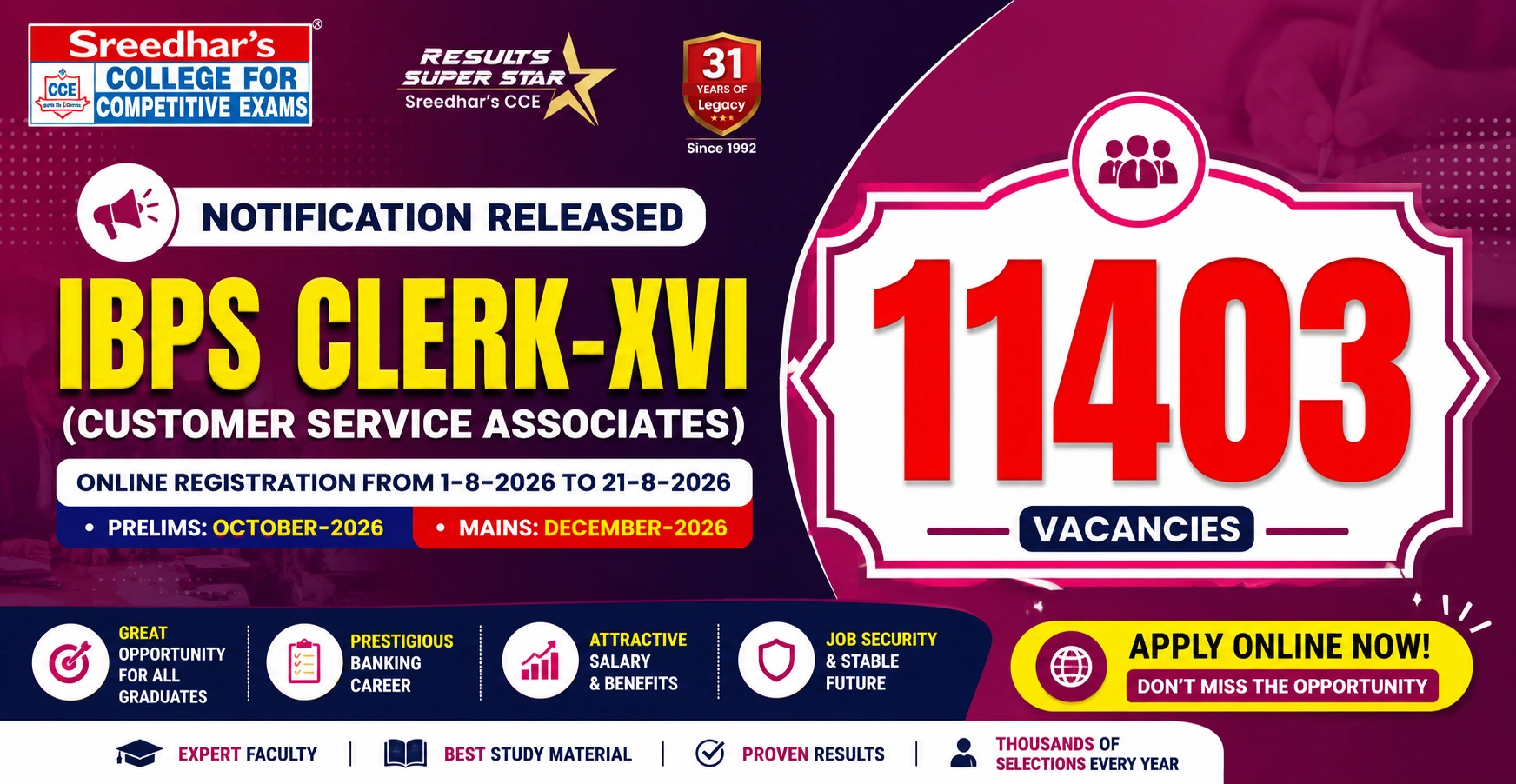
Recent recruitment cycles illustrate this vacancy gap clearly. IBPS Clerk 2026 alone announced over 11,000 vacancies, SBI Clerk 2026 announced close to 9,800 vacancies including backlog posts, and SBI PO 2026 announced 1,500 vacancies, while RBI Grade B 2026 announced only around 60 vacancies across its General, DEPR and DSIM streams combined. This difference matters enormously for how you allocate your preparation time and how realistic your target should be for each exam in a given year.
If you want to explore the complete landscape of banking recruitment in India before deciding where to focus, our detailed banking exams guide breaks down every major exam, including NABARD, SIDBI and IBPS RRB, alongside the five covered here.
IBPS PO: Exam Pattern and Preparation Approach
IBPS PO recruits Probationary Officers for eleven participating public sector banks through a common recruitment process. The exam follows three stages: Preliminary Examination, Main Examination and Interview.
The Preliminary Examination consists of 100 questions for 100 marks across English Language, Quantitative Aptitude and Reasoning Ability, to be completed within 60 minutes with individual sectional timing. This stage is purely qualifying, and candidates need to clear the sectional and overall cutoffs to proceed further.
The Main Examination has been revised in recent cycles to include 170 objective questions worth 200 marks, covering Reasoning and Computer Aptitude, Data Analysis and Interpretation, General, Economy, Banking and Financial Awareness including RBI circulars, and English Language, followed by a Descriptive Test of Essay and Comprehension worth 25 marks. The Mains is where your actual score for merit ranking is built, so treat it as the real exam and the Prelims as the entry gate.
For IBPS PO preparation, focus on building calculation speed in Quantitative Aptitude early, since Data Analysis and Interpretation in the Mains demands heavy numerical processing under time pressure. Reasoning preparation should move beyond basic puzzle solving into complex seating arrangements, tabulation and input-output formats that dominate the Mains level questions. Banking Awareness, particularly recent RBI circulars and monetary policy updates, deserves a dedicated daily reading habit rather than last minute cramming, since this section has become increasingly current and specific in recent cycles. For a full breakdown of the revised syllabus and section-wise weightage, our detailed IBPS PO syllabus and exam pattern guide is a useful reference, and our 90-day IBPS PO study plan lays out a week by week roadmap if your preparation window is limited.
IBPS Clerk: Exam Pattern and Preparation Approach
IBPS Clerk recruits Customer Service Associates through the same participating banks under a separate recruitment process. Its syllabus is lighter than IBPS PO but the competition volume is significantly higher given the larger vacancy count and the wider pool of eligible graduates who apply.
The Preliminary Examination mirrors the IBPS PO Prelims structure in subject composition, testing English Language, Quantitative Aptitude and Reasoning Ability. The Main Examination expands into General, Financial Awareness, General English, Reasoning Ability and Computer Aptitude, and Quantitative Aptitude, without a separate descriptive paper. There is no interview stage for IBPS Clerk, which means your Mains score alone determines your final merit, making Mains preparation even more decisive than it is for the officer level exams.
Because IBPS Clerk draws applicants ranging from first time job seekers to candidates who have already attempted officer level exams and are using Clerk as a parallel option, cutoffs tend to be sharp and unforgiving in the top scoring bands. Prioritise speed and accuracy over depth here. Since the syllabus for General Awareness and Computer Aptitude is comparatively lighter than IBPS PO, candidates who dedicate consistent daily time to current affairs and basic computer fundamentals often gain a noticeable edge over those who neglect these shorter, high-return sections. You can check the latest notification details and important dates in our IBPS Clerk notification guide.
SBI PO: Exam Pattern and Preparation Approach
SBI PO is widely regarded as the most prestigious entry level banking exam in India, given SBI's scale, brand recognition and long term career growth prospects. The selection process runs across four stages: Preliminary Examination, Main Examination, Psychometric Test, and Group Exercise plus Interview.
The Prelims follows a familiar 100-mark, three-section format across English, Quantitative Aptitude and Reasoning. The Mains is considerably more demanding, combining Reasoning and Computer Aptitude, Data Analysis and Interpretation, General, Economy and Banking Awareness, and English Language in an objective format, followed by a Descriptive Test involving Letter Writing and Essay. The Group Exercise and Interview round, unique among these five exams alongside RBI Grade B, tests communication skills, current affairs awareness and the ability to think on your feet in a group setting.
SBI PO preparation demands a slightly different mindset compared to IBPS PO, since the competition is typically sharper due to SBI's reputation and the comparatively lower number of vacancies relative to the applicant pool. Candidates should pay close attention to Data Analysis and Interpretation, which tends to carry more application-based and caselet style questions in SBI PO Mains compared to IBPS PO. General and Banking Awareness should be prepared with an SBI-specific lens, including recent SBI policies, RBI monetary decisions and major banking sector news, since interview panels often probe candidates on exactly these topics. If you want a side by side understanding of how SBI PO compares with IBPS PO in terms of pay, career growth and selection difficulty, our SBI PO vs IBPS PO comparison is a useful read before you decide how to split your preparation time. For the interview stage specifically, our SBI PO interview preparation guide covers commonly asked questions and Group Exercise strategy in detail.
SBI Clerk: Exam Pattern and Preparation Approach
SBI Clerk, officially the Junior Associate (Customer Support and Sales) post, is a two-stage selection process consisting of Preliminary Examination and Main Examination, followed by a Local Language Proficiency Test for candidates who do not already hold a certificate proving proficiency in the local language of their allotted state.
The Prelims consists of 100 questions for 100 marks across English Language, Quantitative Aptitude and Reasoning Ability, to be completed in one hour. The Mains is more elaborate, generally comprising around 190 questions for 200 marks across General and Financial Awareness, General English, Quantitative Aptitude, and Reasoning Ability with computer awareness aspects, completed in roughly two hours and forty minutes.
SBI Clerk attracts an enormous applicant pool each year, often exceeding ten lakh applications, since it is one of the most accessible entry points into public sector banking for freshers. This means that consistency across all sections matters more than excelling in just one or two. A candidate who scores moderately well across all four sections generally outperforms one who is excellent in Reasoning but weak in Quantitative Aptitude or General Awareness. Given the scale of competition, mock test practice under realistic timed conditions becomes especially important for SBI Clerk aspirants, since even a small improvement in accuracy across sections can shift your rank meaningfully. Our detailed SBI Clerk notification guide covers the latest vacancy breakup and exam schedule, while our note on the parallel SBI Junior Associate backlog recruitment is worth checking if you belong to a reserved category, since SBI periodically opens backlog vacancy drives in addition to the regular cycle.
RBI Grade B: Exam Pattern and Preparation Approach
RBI Grade B is in a different league altogether. It recruits officers directly into the Reserve Bank of India across General, DEPR (Department of Economic and Policy Research) and DSIM (Department of Statistics and Information Management) streams, and it is considered one of the most intellectually demanding entry level government exams in the country, both because of its syllabus depth and because of the extremely limited number of vacancies released each cycle.
The selection process runs across Phase I, Phase II and an Interview. Phase I for the General stream typically consists of 200 marks across General Awareness, Reasoning, Quantitative Aptitude and English Language, completed in two hours, and is qualifying in nature. Phase II is where the real difficulty lies, covering Economic and Social Issues, Finance and Management, and a Descriptive English paper, each carrying substantial weight and demanding genuine subject depth rather than surface level familiarity.
Unlike IBPS and SBI exams where General Awareness overlaps significantly with day to day current affairs, RBI Grade B's General Awareness in Phase I leans heavily toward economic and financial content, and its Phase II Economic and Social Issues paper requires structured understanding of India's economic history, policy frameworks, social sector schemes and contemporary economic debates. Finance and Management, the other Phase II paper, blends corporate finance fundamentals, risk management concepts, and management theory in a way that most aspirants coming from a pure Reasoning and Quantitative Aptitude background find genuinely challenging without dedicated study.
Because RBI Grade B vacancies are so limited, typically in the range of fifty to a hundred across all streams combined, this exam should generally be approached as a stretch goal layered on top of your IBPS and SBI preparation rather than as your sole focus, unless you have a strong background in economics, finance or statistics and are specifically aiming for a central bank career. If economics and policy genuinely interest you, the depth of preparation RBI Grade B demands can also meaningfully strengthen your Banking Awareness and Economy sections for SBI PO and IBPS PO, creating a useful preparation synergy rather than wasted effort.
Building a Common Foundation: Subject-Wise Strategy
Since Reasoning, Quantitative Aptitude and English Language form the shared core across all five exams, here is how to approach each of them in a way that serves multiple exams simultaneously.
Quantitative Aptitude
Start with number system fundamentals, simplification and approximation techniques, since these form the base for faster calculation across every other topic. Move into arithmetic topics like percentage, profit and loss, simple and compound interest, time and work, and speed, time and distance, practising enough repetition to recognise question patterns instantly rather than solving each one from scratch. Data Interpretation deserves special attention since it appears in both Prelims and Mains across all five exams in varying complexity, and building comfort with tables, bar graphs, line graphs, pie charts and caselet-based DI early in your preparation pays off across every exam you eventually attempt.
Reasoning Ability
Puzzles and seating arrangements dominate the Reasoning section across all five exams, particularly at the Mains level, where formats become increasingly complex with multiple variables, conditional statements and layered constraints. Build a strong foundation in basic reasoning types first, syllogism, coding-decoding, blood relations, direction sense and inequalities, before moving into complex puzzle formats. Since Mains-level puzzles can consume disproportionate time if approached without a system, practising a structured elimination approach rather than random trial and error will save valuable minutes during the actual exam.
English Language
Reading Comprehension, cloze test, para jumbles and error detection form the recurring core across all five exams. Building a genuine reading habit, whether through newspapers, editorials or quality online sources, does more for your English score over a few months than isolated grammar drilling alone. For the Descriptive English components in IBPS PO, SBI PO Mains and RBI Grade B Phase II, practice writing complete essays and letters under timed conditions well before the actual exam, since this skill develops slowly and cannot be built in the final week.
General and Banking Awareness
This is the section where exam-specific preparation becomes essential. Maintain a rolling six-month current affairs revision, updated weekly rather than crammed at the end, and separately maintain notes on static banking awareness topics such as monetary policy tools, banking history, financial institutions and government schemes. For RBI Grade B aspirants, this general awareness base needs to extend further into detailed economic survey highlights, budget provisions and RBI's own reports and publications.
A Twelve Month Preparation Timeline for Multiple Banking Exams
Given that IBPS PO, IBPS Clerk, SBI PO, SBI Clerk and RBI Grade B notifications are typically spread across different months of the year, a well planned twelve month cycle allows you to prepare once and attempt several exams with minimal additional effort per exam.
Months one to three: Build your core foundation in Quantitative Aptitude, Reasoning and English Language from the basics, without worrying about exam-specific cutoffs yet. This is also the ideal window to start your daily current affairs habit, since compounding six to twelve months of consistent reading produces far better recall than a rushed two month revision closer to the exam.
Months four to six: Move into sectional practice and start attempting previous year papers across IBPS and SBI exams to understand the actual difficulty and question style. If your target list includes RBI Grade B, this is when you should start layering in Economic and Social Issues and Finance and Management, since these subjects require genuine reading time that cannot be compressed later.
Months seven to nine: This window typically aligns with SBI Clerk and IBPS Clerk notifications and exams in many recruitment cycles, so shift toward full-length mock tests under timed conditions and sharpen your speed and accuracy for these clerical cadre exams. Continue your current affairs revision without interruption.
Months ten to twelve: This period generally overlaps with IBPS PO and IBPS Clerk Mains, and depending on the annual calendar, SBI PO Mains as well. Focus intensely on Mains-level mock tests, descriptive writing practice, and Data Analysis and Interpretation at a higher difficulty level. If you are also targeting an SBI PO or RBI Grade B interview later in the cycle, begin preparing your self-introduction, banking sector awareness and mock interview practice during this phase as well.
This kind of layered, twelve month approach means that instead of treating each exam notification as the start of a fresh preparation cycle, you are simply intensifying and specialising an already solid foundation, which is a far more sustainable and effective strategy than restarting from zero every time a new notification drops.
Mock Tests and Previous Year Papers: Non-Negotiable Practice
No amount of concept study substitutes for realistic exam practice. Across all five exams, sectional timing is a critical constraint, particularly in the Prelims stage where each section has its own individual time limit. Practising under this exact constraint from an early stage builds the instinct needed to decide, within seconds, whether a question is worth attempting or worth skipping.
Take at least two to three full-length mock tests per week during your intensive preparation phase, and treat the analysis phase after each mock as equally important as the test itself. Track which sections consistently cost you the most time relative to marks gained, which question types you repeatedly get wrong, and whether your accuracy drops in the final fifteen minutes due to fatigue or rushed decision making. Previous year papers, particularly for RBI Grade B's Economic and Social Issues and Finance and Management papers, also give you a realistic sense of the depth examiners expect, which pure textbook reading often fails to convey.
Common Mistakes Aspirants Make Across These Exams
Treating every exam as equally attainable: Given the vacancy gap between, say, IBPS Clerk with over 11,000 posts and RBI Grade B with around 60 posts, your preparation intensity and expectation should differ accordingly. Attempting RBI Grade B is valuable practice and a genuine opportunity, but building your entire preparation strategy around it while neglecting the far more attainable IBPS and SBI exams is a common and costly mistake.
Ignoring sectional cutoffs: Many candidates focus only on overall scores during mock practice and ignore individual sectional performance, only to be caught off guard by sectional cutoffs in the actual Prelims, which can eliminate an otherwise strong overall scorer.
Under-preparing for Descriptive English: Since Descriptive Test scores directly add to your Mains total in IBPS PO, SBI PO and RBI Grade B, candidates who leave essay and letter writing practice until the last week consistently underperform relative to their objective section scores.
Skipping current affairs for months at a stretch: Current affairs preparation loses most of its value when compressed into a short, intense burst before the exam. A consistent, low-effort daily habit sustained over many months produces dramatically better recall and application in the actual exam.
Not customising preparation for SBI versus IBPS: While the core syllabus overlaps, SBI exams tend to have a slightly different question style and difficulty curve compared to IBPS, particularly in Data Analysis and Interpretation and General Awareness. Treating both exams as identical without adjusting your final revision phase can leave gaps that show up on exam day.
Why Choose Sreedhar's CCE for Banking Exam Preparation
Since 1995, Sreedhar's CCE has guided more than 30,000 students toward government job selections across Banking, SSC, Railways, Insurance, Police and State Government examinations. Our banking preparation programme is built specifically around the overlapping syllabus structure described in this guide, so students preparing with us are simultaneously exam-ready for IBPS PO, IBPS Clerk, SBI PO, SBI Clerk and, for those who choose to pursue it, RBI Grade B.
Experienced faculty with banking exam expertise: Our faculty team has deep familiarity with the evolving patterns of IBPS and SBI exams, including recent changes like the revised IBPS PO Mains structure, and they guide students through exactly what has changed and what remains constant year over year.
Structured, phase-wise training: Rather than throwing the entire syllabus at students from day one, we follow a planned model that mirrors the twelve month timeline described above, moving from foundation building to sectional practice to full-length mock testing in a logical sequence.
Regular tests with detailed performance analytics: Our sectional tests, grand tests and full-length mocks come with detailed analysis that shows students exactly where they stand relative to expected cutoffs, so preparation stays targeted rather than unfocused.
Dedicated support for Descriptive and Interview rounds: Given how often these components are neglected by self-study aspirants, we provide focused essay and letter writing practice along with mock interview sessions for SBI PO and RBI Grade B candidates.
Doubt clarification and mentoring: Regular doubt-clearing sessions ensure that difficult topics, particularly in Data Interpretation, complex Reasoning puzzles and RBI Grade B's Economic and Social Issues paper, are fully understood rather than glossed over.
Our results across banking, SSC and railway exams are reflected directly on our Results page, and you can explore our current course offerings, including bilingual and English medium batches, live and recorded formats, and combo packages covering multiple exam categories, on our online courses page. With branches across Andhra Pradesh, Telangana, Karnataka and Odisha, including centres at Hyderabad Ameerpet, Hyderabad Dilsukhnagar and Hyderabad KPHB, students across South India have access to both classroom and online learning options.
Deciding Which Exams to Prioritise Based on Your Profile
Not every aspirant needs to prepare for all five exams with equal seriousness. Your background, current stage of life and career goals should shape how you prioritise these exams within your preparation year.
Fresh Graduates Attempting Their First Banking Exam
If you are a fresh graduate with no prior exposure to competitive exam patterns, starting with IBPS Clerk or SBI Clerk is generally the wiser choice. The lighter syllabus and larger vacancy count give you a realistic chance of clearing the exam while you build the speed, accuracy and exam temperament needed for the tougher officer level papers. Many successful officers began their banking careers this way, clearing a clerical cadre exam first before moving on to IBPS PO or SBI PO in a later attempt or even after joining as a clerk and later switching cadres through internal promotion exams.
Candidates Aiming Directly for Officer Level Roles
If you already have strong fundamentals in Reasoning, Quantitative Aptitude and English, perhaps from an engineering or commerce background with prior exposure to aptitude-based tests, aiming directly for IBPS PO and SBI PO from your first attempt is a reasonable strategy. In this case, dedicate extra time specifically to Data Analysis and Interpretation and Descriptive English, since these are the components that most clearly separate Prelims-level performance from genuine Mains-level readiness.
Candidates with an Economics, Commerce or Finance Background
If your academic background already includes economics, statistics or finance coursework, RBI Grade B becomes a far more realistic target than it would be for a typical engineering or arts graduate, since a meaningful portion of the Phase II syllabus will already feel familiar. Even if RBI Grade B remains a stretch goal, the depth of Economic and Social Issues preparation will noticeably strengthen your Banking and Economy Awareness sections for IBPS PO and SBI PO as a valuable side benefit.
Working Professionals Preparing Alongside a Job
If you are preparing while holding a full-time job, realistic time management becomes the deciding factor more than exam difficulty. In this situation, focus your limited daily hours on the shared core, Reasoning, Quantitative Aptitude and English, since progress here compounds across every exam you eventually attempt. Treat current affairs as a background habit built through short, consistent daily reading rather than long dedicated sessions, since this is the one subject area that tolerates a slower, steadier pace without losing effectiveness.
Staying Updated on Notifications and Exam Changes
Banking exam patterns are revised more frequently than many aspirants expect. The IBPS PO Mains structure, for instance, has seen its objective question count and section weightage change across recent recruitment cycles, and SBI periodically adjusts its Mains duration and sectional composition as well. Preparing against an outdated pattern, even with strong fundamentals, can leave you unprepared for the actual time pressure and question distribution you encounter on exam day.
Make it a habit to verify the exact current pattern directly from the official notification PDF each time a new cycle opens, rather than relying purely on memory from a previous year's preparation. Alongside this, tracking exam dates, admit card releases and result announcements through a reliable source saves you from missing critical deadlines buried within a long preparation cycle. Our Blogs section is updated regularly with notification details, syllabus changes and exam date announcements across IBPS, SBI and RBI recruitment cycles, and is a useful bookmark for exactly this purpose.
Common Questions Students Ask
Should I prepare for all five exams together, or focus on just one?
Given the heavy overlap in Reasoning, Quantitative Aptitude and English Language, building a common foundation for all five is efficient and recommended. However, your intensity of preparation should reflect vacancy availability, with IBPS Clerk and SBI Clerk generally offering the most attempts given their larger vacancy counts, followed by IBPS PO and SBI PO, with RBI Grade B treated as a stretch goal unless you have a strong economics or finance background.
Which exam has the toughest syllabus among these five?
RBI Grade B is widely regarded as the most demanding, primarily due to its Phase II papers on Economic and Social Issues and Finance and Management, which require depth well beyond what IBPS and SBI exams typically test.
How many hours a day should I study for these exams?
This varies by individual circumstance, but most successful aspirants dedicate anywhere from four to eight hours daily during intensive phases, combining concept study, sectional practice and mock test analysis, alongside a consistent daily current affairs habit.
Is coaching necessary, or can I clear these exams through self-study?
Many candidates do succeed through disciplined self-study, but structured coaching helps significantly with staying updated on pattern changes, receiving personalised feedback on weak areas, and maintaining consistency through a long preparation cycle, particularly for the Descriptive and Interview components that self-study often neglects.
What is the ideal starting point for a complete beginner?
IBPS Clerk or SBI Clerk are generally the most accessible starting points given their comparatively lighter syllabus and larger vacancy counts, allowing beginners to build exam temperament before attempting the more demanding officer level and RBI Grade B exams.
How important is the interview stage for SBI PO and RBI Grade B?
Very important. Both exams weight the Interview, and for SBI PO the Group Exercise as well, as a meaningful component of the final selection, which means strong written scores alone are not sufficient. Communication skills, current affairs awareness and genuine subject understanding all get tested directly in this stage.
Final Thoughts
IBPS PO, IBPS Clerk, SBI PO, SBI Clerk and RBI Grade B together represent the backbone of banking sector recruitment in India, and a well planned preparation strategy across these five exams can turn a single year of disciplined effort into multiple genuine opportunities rather than one uncertain shot. The overlapping core syllabus means your foundational preparation is never wasted, even if your final selection comes through an exam you initially treated as a backup option.
Success in this space comes down to building strong fundamentals early, respecting the specific demands of each exam rather than treating them as identical, practising consistently under realistic timed conditions, and maintaining current affairs preparation as a steady habit rather than a last minute scramble. The candidates who clear these exams are rarely the ones who study the most in the final month. They are the ones who built a solid, sustained preparation routine many months in advance and refined it steadily as each exam approached.
If you want that structured guidance rather than navigating five overlapping syllabi entirely on your own, Sreedhar's CCE has built its entire banking preparation programme around exactly this kind of layered, multi-exam strategy. Explore our Exams page to see the full range of competitive exams we cover, or reach out through our Contact Us page to speak with our counselling team about the right banking preparation plan for your goals.
A banking career built on a government pay scale, long term stability and genuine career growth is well within reach for a disciplined aspirant. Start with the fundamentals, stay consistent through the months that matter most, and give each of these five exams the focused attention its own pattern deserves.



Leave a Comment
Required fields are marked *