



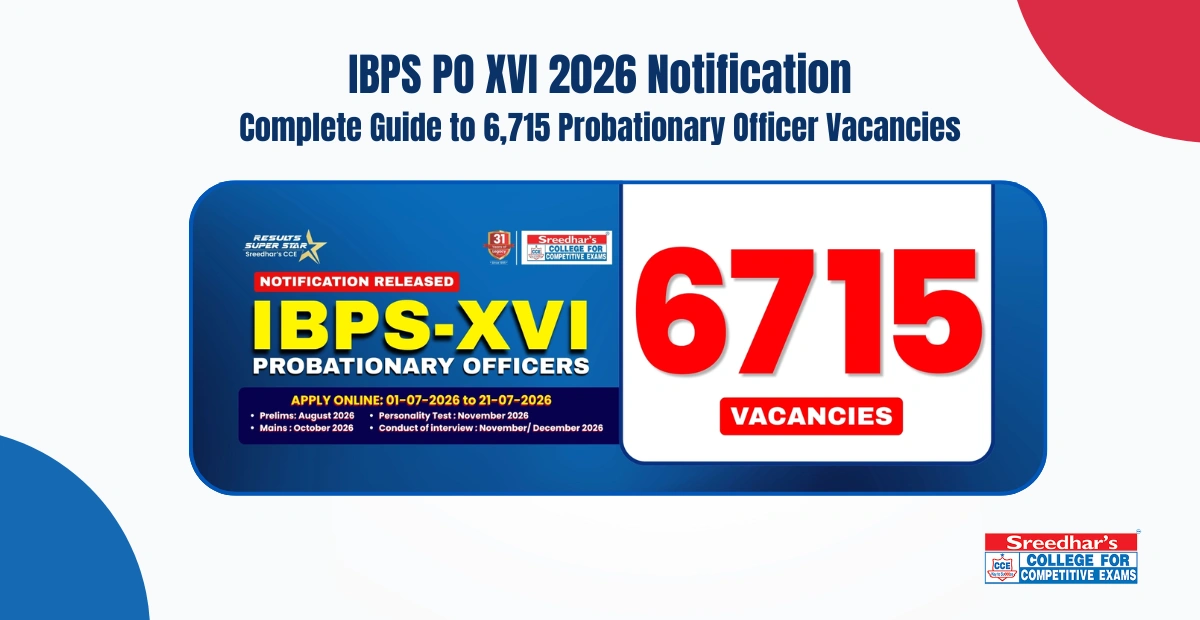
IBPS PO XVI 2026 Notification: Complete Guide to 6,715 Probationary Officer Vacancies
Everything you need to know about the IBPS PO XVI 2026 recruitment, including 6,715 vacancies, eligibility, exam dates, application process, salary, and preparation tips.
The banking recruitment calendar for 2026 has opened with one of the biggest announcements in recent years. The Institute of Banking Personnel Selection has released the IBPS PO XVI notification for the Common Recruitment Process of Probationary Officers and Management Trainees, popularly known as CRP PO/MT XVI. With 6,715 vacancies on offer, this is one of the largest PO recruitment drives conducted by IBPS in the last several years, and it has understandably created a buzz among graduates preparing for a career in public sector banking.
At Sreedhar's College for Competitive Exams, we have guided aspirants through every IBPS PO cycle since 1995, and this notification is shaping up to be a golden opportunity for anyone serious about a stable, well paying government banking job. In this article, we break down everything you need to know about the IBPS PO XVI 2026 recruitment, including the vacancy details, important dates, eligibility conditions, revised exam pattern, salary structure, selection process, and a preparation roadmap that will help you make the most of this opportunity.
What Is IBPS PO and Why It Matters
The Institute of Banking Personnel Selection conducts the Common Recruitment Process every year to recruit Probationary Officers and Management Trainees for Participating Public Sector Banks across India. Started in 2011, this year's cycle is officially the sixteenth edition, hence the name CRP PO/MT XVI. Through a single exam, IBPS shortlists candidates who are then allotted to different public sector banks based on their preference and merit rank.
An IBPS PO job is considered one of the most secure and respected career paths for commerce, arts, and science graduates in India. It offers a government sector salary, promotional growth from Probationary Officer up to General Manager level, job security, and the social standing that comes with a banking career. For lakhs of aspirants from small towns and rural backgrounds, cracking IBPS PO is often the first step toward financial independence and a stable future for their families, which is exactly why Sreedhar's CCE has built its reputation around helping such students succeed.
IBPS PO XVI 2026 Notification: Key Highlights
The detailed notification for CRP PO/MT XVI was released on 30 June and 1 July 2026 on the official IBPS website, ibps.in. Here are the headline points every aspirant should know before diving into preparation.
- Total vacancies announced: 6,715 posts for Probationary Officer or Management Trainee.
- This is an increase of roughly 1,507 vacancies compared to the previous cycle, translating to close to a 29 percent jump in openings.
- The recruitment is being conducted for 11 Participating Public Sector Banks for the 2027-28 recruitment year.
- Online application window: 1 July 2026 to 21 July 2026.
- A two day application correction window has been introduced this year after registration closes, a feature that was not available in earlier cycles.
- The Mains exam pattern has been significantly revised, moving from 145 objective questions to 170 objective questions.
- The earlier Credit History clause has been removed from the eligibility conditions.
- A mandatory Personality Test now precedes the Interview stage.
If you want to track your application status or revisit exam updates at any point, our Free Exams section on the Sreedhar's CCE website is regularly updated with the latest notifications and mock resources for IBPS PO aspirants.
Vacancy Breakup: Understanding the 6,715 Posts
IBPS has indicated 6,715 vacancies across the 11 participating banks, though this number is described as provisional. Three banks, namely Indian Bank, UCO Bank, and Union Bank of India, have not yet reported their final vacancy figures, which means the total count could rise further once these banks confirm their numbers. This has happened in past cycles as well, where the indicative figure at notification stage was eventually revised upward.
The category wise distribution for the vacancies already reported is as follows:
- Unreserved (UR): 2,719
- Other Backward Classes (OBC): 1,816
- Scheduled Castes (SC): 1,009
- Scheduled Tribes (ST): 502
- Economically Weaker Sections (EWS): 669
A separate allocation for Persons with Benchmark Disabilities has also been made within these numbers, totaling 287 posts. This includes 73 posts for Hearing Impairment, 70 for Orthopaedically Challenged candidates, 67 for Visual Impairment, and 77 for Intellectual Disability. Candidates should always cross check the final bank wise and category wise breakup published in the official PDF notification before submitting their application, since regional language requirements and post availability can vary from bank to bank.
For a deeper category wise and bank wise breakdown along with our expert commentary, students can check our detailed vacancy resources on the Purchase Course page, where our IBPS PO batches include continuously updated notification analysis sessions.
Important Dates for IBPS PO XVI 2026
Keeping track of dates is half the battle in any competitive exam. Here is the tentative schedule announced by IBPS for the CRP PO/MT XVI cycle.
- Notification release: 30 June to 1 July 2026
- Online application start date: 1 July 2026
- Online application last date: 21 July 2026
- Application correction window: two days after registration closes
- Preliminary Examination: 22 and 23 August 2026
- Main Examination: 4 October 2026, though some sources list the broader window as October 2026
- Personality Test: November 2026
- Interview process: November or December 2026
Candidates should note that all dates beyond the application window are tentative and subject to confirmation by IBPS closer to each stage. It is a good habit to check the official IBPS website regularly, and to also follow the Sreedhar's CCE Blogs section, where we publish timely updates whenever IBPS releases admit cards, exam city intimation slips, or revised schedules.
Eligibility Criteria
Before applying, it is essential to check whether you meet the eligibility bar set by IBPS. The three broad criteria are nationality, age, and educational qualification.
Nationality
A candidate must be a citizen of India, or a subject of Nepal or Bhutan, or a Tibetan refugee who came to India before 1 January 1962 with the intention of permanently settling here. Persons of Indian origin who migrated from Pakistan, Myanmar, Sri Lanka, East African countries such as Kenya, Uganda, Tanzania, Zambia, Malawi, Zaire, and Ethiopia, or Vietnam, with the intention of permanently settling in India, are also eligible. Such candidates, except Indian citizens, will need an eligibility certificate issued by the Government of India.
Age Limit
Applicants must have been born between 2 July 1996 and 1 July 2006, both dates inclusive. This effectively sets the age band at 20 to 30 years as on the notification date. Age relaxation is available for reserved categories as per government norms, typically 3 years for OBC, 5 years for SC/ST, and additional relaxations for PwBD candidates, ex-servicemen, and other specified categories, as detailed in the official notification.
Educational Qualification
A candidate must hold a graduation degree in any discipline from a recognised university, or an equivalent qualification recognised by the Central Government. The result of the qualifying degree must have been declared on or before 21 July 2026, the last date of application. There is no minimum percentage requirement specified by IBPS for the PO recruitment, which makes this an inclusive opportunity for graduates across streams including commerce, arts, science, and engineering.
If you are unsure whether your degree or final year status qualifies you for this cycle, our counsellors at Sreedhar's CCE can walk you through the fine print. You can reach out through our Contact Us page for a one on one eligibility check.
Application Fee and How to Apply
The application process is entirely online and must be completed through the official IBPS website. Candidates need to register with a valid email ID and mobile number, then proceed to fill in personal, educational, and communication details. Scanned copies of a recent photograph, signature, left thumb impression, and a handwritten declaration need to be uploaded as per the specifications mentioned in the notification.
The application fee, which varies by category, must be paid online only, through debit card, credit card, net banking, IMPS, UPI, or digital wallets. Bank transaction charges, if any, are borne by the candidate. Fees once paid are non-refundable and cannot be adjusted against any other examination or cycle, so candidates should verify all details carefully before making payment.
While filling the form, candidates are also required to rank the participating public sector banks in order of preference. This preference plays an important role at the final allotment stage, since selected candidates are placed in banks based on merit and the preferences indicated at the time of application. It is worth thinking through this ranking carefully rather than filling it in a hurry, since the choice can shape your first posting and career trajectory.
After submission, candidates should download and safely store the confirmation page and payment receipt for future reference, since these are often required at later stages of the recruitment process.
The Revised IBPS PO Exam Pattern for 2026
One of the most talked about changes this year is the revision of the Mains exam pattern. Aspirants who have been preparing with material based on earlier years need to recalibrate their strategy according to the new structure.
Preliminary Examination Pattern
The Preliminary Examination remains largely unchanged and continues to be a screening round whose marks are not counted toward the final merit list. It consists of 100 questions for 100 marks, to be attempted in 60 minutes, split into three sections with individual sectional timers of 20 minutes each.
- English Language: 30 questions for 30 marks
- Quantitative Aptitude: 35 questions for 30 marks
- Reasoning Ability: 35 questions for 40 marks
Candidates must clear both the sectional cut-off and the overall cut-off to be shortlisted for the Mains examination. There is a negative marking of 0.25 marks for every wrong answer, while unattempted questions do not attract any penalty.
Main Examination Pattern: What Has Changed
The Mains exam has undergone a substantial overhaul this year. Previously, the objective section carried 145 questions. This has now been increased to 170 questions, while the total marks for the objective section remain at 200. The new structure is understood to be distributed as follows:
- Reasoning: 40 questions for 60 marks
- General, Economy, Banking, and Digital or Financial Awareness including RBI circulars: 50 questions for 60 marks
- English Language: 40 questions for 20 marks
- Data Analysis and Interpretation: 40 questions for 60 marks
The objective paper is followed by a Descriptive Test of 25 marks to be completed in 30 minutes, consisting of an essay and a comprehension based question. This is a notable shift from earlier years, where the descriptive component often included a letter writing task. The overall Mains examination, combining the objective and descriptive components, now runs to about 225 marks over roughly three hours and ten minutes.
Some points worth remembering about the revised pattern:
- The Reasoning section, which was earlier often clubbed with Computer Aptitude, now appears as a standalone Reasoning section in the revised notification.
- The Awareness section has been expanded to explicitly cover general awareness, economy, banking, digital and financial awareness, and RBI circulars, making current affairs preparation more important than ever.
- Data Analysis and Interpretation and Reasoning continue to carry the highest weightage among the objective sections.
- Negative marking of 0.25 marks per wrong answer applies to both Prelims and Mains objective sections, with no penalty for unattempted questions.
Because this is the first cycle under the revised pattern, students preparing with only old mock tests may find themselves at a disadvantage. This is precisely the kind of shift where structured guidance and updated study material make a real difference, and it is an area our faculty at Sreedhar's CCE have already incorporated into our current batch schedules.
Selection Process: From Prelims to Final Interview
The overall selection under CRP PO/MT XVI happens in four stages.
- Preliminary Examination: A qualifying round that screens out a large section of applicants. Marks scored here are not carried forward to the final merit calculation, but sectional and overall cut-offs must be cleared to proceed.
- Main Examination: This is the stage that carries the maximum weightage in the overall selection process. Both the objective and descriptive components must be cleared, and marks obtained here directly feed into the final merit list.
- Personality Test: A new addition this year. Candidates who qualify the Mains exam will be required to complete a self-report Personality Test. This test is qualifying in nature and does not contribute marks to the final merit, but appearing in it is mandatory to become eligible for the interview. The personality profile generated is placed before the Interview Panel to help assess suitability for a banking career.
- Interview: Conducted by the Participating Bank and coordinated by the Nodal Bank in each state or union territory with the support of IBPS, the interview carries 100 marks. The minimum qualifying mark for the interview is not less than 40 percent, relaxed to 35 percent for SC, ST, OBC, and PwBD candidates.
The final merit list is generated using a weighted combination of the Main Examination score and the Interview score in a ratio of 80:20 respectively. This means that while the interview matters, a strong performance in the Mains exam has a much larger bearing on your final rank and bank allotment. This makes disciplined, sustained preparation for the objective and descriptive Mains paper the single most important factor in securing a good rank.
Salary and Career Growth as an IBPS PO
An IBPS Probationary Officer enjoys one of the more attractive compensation structures among entry level government jobs in India. The basic pay structure for CRP PO/MT XVI has been set at:
₹48,480, rising through increments of 2000 x 7 to ₹62,480, then 2340 x 2 to ₹67,160, and further 2680 x 7 up to ₹85,920.
On top of the basic pay, selected candidates are eligible for a range of allowances and perquisites as per the rules of the allotted Participating Bank, which can include Dearness Allowance, House Rent Allowance, City Compensatory Allowance, medical benefits, and travel allowance. Taking these components together, the approximate gross in-hand monthly salary for a fresh IBPS PO typically works out in the range of ₹74,000 to ₹76,000, though this can vary depending on the posting location and the specific bank's allowance structure.
Beyond the starting pay, an IBPS PO enjoys a clear promotional ladder. A Probationary Officer typically progresses to the role of Manager, then Senior Manager, followed by Assistant General Manager, Deputy General Manager, and eventually General Manager at the TEGS-VII level, subject to performance, seniority, and internal promotion policies of the respective bank. Very few entry level government exams offer this kind of long term career visibility combined with immediate financial stability, which is why IBPS PO remains one of the most sought after exams among Indian graduates year after year.
Participating Banks Under CRP PO/MT XVI
The IBPS PO recruitment drive covers several major public sector banks across the country. Banks known to be participating in this cycle include Bank of Baroda, Bank of India, Bank of Maharashtra, Canara Bank, Central Bank of India, Indian Overseas Bank, Punjab National Bank, and Punjab and Sind Bank, along with Indian Bank, UCO Bank, and Union Bank of India, whose vacancy figures are awaited. Interestingly, this year the maximum vacancies have reportedly come from Bank of Baroda, Bank of Maharashtra, and Canara Bank, making these banks particularly significant for candidates when filling out their bank preference order during application.
Since the final posting bank is decided based on a combination of merit rank and preference order filled at the time of application, it is worth researching each participating bank's typical posting locations, growth culture, and employee reviews before finalising your preference list.
What Makes This Year's IBPS PO Cycle Different
A few structural changes this year deserve special attention from aspirants:
Higher vacancies than recent years. With 6,715 posts, this cycle offers close to 1,500 more openings than the previous year, a nearly 29 percent increase. Combined with the possibility of upward revision once the remaining three banks report their numbers, this is shaping up to be one of the most vacancy rich PO cycles in recent memory.
Revised Mains pattern. As detailed earlier, the shift from 145 to 170 objective questions, along with the restructuring of section wise marks, is the most significant change candidates need to internalise. Anyone relying purely on last year's question papers or coaching material without updating for this shift risks preparing for an exam pattern that no longer exists.
New Personality Test stage. The introduction of a mandatory, qualifying Personality Test ahead of the interview signals that IBPS is placing greater emphasis on behavioural fit, communication style, and overall personal suitability for a customer facing banking role, not just academic and reasoning ability.
Removal of the Credit History clause. Earlier notifications required candidates to declare their credit history status as part of the eligibility conditions. This clause has been dropped this year, which simplifies the eligibility declaration process for applicants.
Application correction window. For the first time, IBPS is offering a two day window after the registration deadline specifically to correct errors in the submitted form. This is a welcome relief for candidates who may have made small mistakes such as incorrect category details or photograph specifications, though it should not be treated as an excuse to rush through the original submission.
How to Prepare: A Roadmap for the Next Few Months
With Prelims scheduled for August 2026 and Mains expected in October 2026, candidates realistically have around six to eight weeks before the Preliminary Examination and a couple of additional months to sharpen Mains level preparation. Here is how we recommend structuring your preparation at this stage.
Step 1: Build Strong Fundamentals
Start with Quantitative Aptitude and Reasoning Ability basics if you have not already covered them. Topics such as simplification, number series, ratio and proportion, percentage, profit and loss, time and work, time and distance, data interpretation, seating arrangement, puzzles, syllogism, and inequalities form the backbone of both Prelims and Mains. English Language preparation should focus on grammar rules, vocabulary building, reading comprehension, and error spotting.
Step 2: Prioritise Speed and Accuracy for Prelims
Since Prelims is a qualifying round with strict sectional timing, your focus in this phase should be building speed without sacrificing accuracy. Attempt timed sectional tests regularly and analyse every mock test to identify recurring mistakes. A percentile above 90 in mock tests is often considered a healthy benchmark before appearing for the actual Prelims exam.
Step 3: Shift Focus to Mains Level Topics Early
Given that Mains carries the maximum weightage in final selection, do not wait until after Prelims to start Mains preparation. Begin building your General, Economy, and Banking Awareness base right away, since this section rewards consistent daily reading rather than last minute cramming. Focus on the last six months of banking and financial current affairs, RBI circulars, government schemes, and important economic developments. This section, once mastered, becomes a reliable score booster since it does not require calculation under time pressure.
Step 4: Practise the Revised Data Analysis and Interpretation Format
Since Data Analysis and Interpretation carries significant weightage in the new Mains pattern, practise a wide variety of formats including table based DI, bar graph DI, caselet based DI, and pie chart based questions. Strong data interpretation skills often separate top rankers from the rest in the Mains stage.
Step 5: Do Not Neglect the Descriptive Paper
With the descriptive section now testing essay writing and comprehension instead of letter writing, candidates should practise writing structured essays on banking, economy, technology, environment, and current social issues at least twice a week. Clarity of thought, grammar accuracy, and the ability to organise ideas under time pressure are what examiners look for in this section.
Step 6: Take Regular Full-Length Mock Tests
Mock tests under exam-like conditions are the single most effective preparation tool available to any serious aspirant. They help you build stamina for the actual exam duration, identify weak areas objectively, and get comfortable with the interface and question distribution. Reviewing every mock test in detail, understanding why an answer was wrong, and avoiding repetition of the same mistake is far more valuable than simply attempting a large number of tests without analysis.
Step 7: Prepare Early for the Personality Test and Interview
Since a Personality Test now precedes the Interview, candidates should start thinking beyond rote preparation and reflect on their communication skills, awareness of the banking sector, and general demeanour well before the Mains results are announced. Being well versed in banking terminology, current developments in the sector, and having clarity about your own career motivations will help you perform confidently at this stage.
Why Choose Sreedhar's CCE for Your IBPS PO Preparation
For close to three decades, Sreedhar's College for Competitive Exams has been among the most trusted names in banking, insurance, police, and state government exam coaching in India. Our approach to IBPS PO preparation is built around experienced faculty, a structured curriculum that is updated in real time with every notification change, and a strong track record of results that speaks for itself. You can browse our track record of successful candidates on the Our Results page.
We understand that this year's revised Mains pattern requires a genuinely updated approach rather than recycled material from previous cycles, and our current batches have already been restructured to reflect the new 170-question format, the expanded awareness syllabus, and the essay and comprehension based descriptive test. With classroom coaching available across multiple locations through our Our Branches network, along with online training options for students who cannot access a physical centre, we aim to make quality preparation accessible regardless of where you are based.
Our commitment has always been to help students from all backgrounds, especially those from rural and underprivileged communities, build a genuine pathway into stable government careers. If you are serious about converting this IBPS PO XVI opportunity into a confirmed offer letter, we encourage you to explore our dedicated banking exam batches through the Purchase Course page, or get in touch with our academic counsellors through Contact Us for personalised guidance on choosing the right course and study plan for your timeline.
Final Thoughts
The IBPS PO XVI 2026 notification, with its 6,715 vacancies and a meaningfully revised exam pattern, represents a significant opportunity for graduates across India who are aiming for a stable and rewarding banking career. The larger vacancy pool combined with structural changes to the Mains examination means that early, well informed preparation will count for more than ever this cycle. Candidates who understand the revised pattern, build strong fundamentals in reasoning, quantitative aptitude, and English, and commit to consistent current affairs reading will be best placed to convert this opportunity into a confirmed offer.
At Sreedhar's CCE, our doors and our faculty have been preparing students for exactly this moment for over thirty years. Whether you are appearing for IBPS PO for the first time or attempting it again with sharper focus, we are here to help you navigate this cycle with the right strategy, updated material, and consistent mentorship. Do not let the application window pass by. Apply before 21 July 2026, start your preparation today, and give yourself the best possible shot at joining the ranks of India's public sector bank officers.
Leave a Comment
Required fields are marked *