



IBPS Clerk Syllabus and Exam Pattern 2026
Master the Latest Syllabus, Crack IBPS Clerk 2026 with Confidence
The IBPS Clerk exam continues to be one of the most sought-after banking recruitment tests in India, opening the door to a stable, respectable career in the public sector banking system. Every year, lakhs of graduates compete for a limited number of Clerk vacancies across participating public sector banks, which makes early and accurate preparation absolutely essential. If you are planning to appear for IBPS Clerk 2026, the very first step is to get a complete, correct picture of the syllabus and exam pattern — because a small misunderstanding here can throw off months of preparation.
This guide breaks down the IBPS Clerk 2026 syllabus and exam pattern in detail, covering the Prelims, Mains, and the Language Proficiency Test (LPT), along with practical preparation tips. At Sreedhar's CCE, we have guided thousands of aspirants through this exact exam for decades, and this article distills that experience into one place.
Overview of IBPS Clerk 2026 Selection Process
The Institute of Banking Personnel Selection (IBPS) conducts the Common Recruitment Process (CRP) for Clerical cadre posts in participating public sector banks across India. There are three stages: Prelims, which is qualifying in nature, Mains, which is 100% merit-based, and finally the Language Proficiency Test (LPT), which is a qualifying test in the regional language of the applied state.
Here's what aspirants need to know about the structure:
- Stage 1 – Preliminary Examination: A screening round to shortlist candidates for Mains.
- Stage 2 – Main Examination: The examination whose marks actually count for the final merit list and provisional allotment.
- Stage 3 – Language Proficiency Test (LPT): A qualifying test conducted by the allotted bank to check your command over the official language of the state you have applied for.
There is no interview in the IBPS Clerk selection process — final selection is based entirely on Mains marks, followed by the LPT. This is great news for candidates who may not interview well but are strong on paper, but it also means you cannot afford to underperform in the Mains exam, since there's no second chance to make an impression.
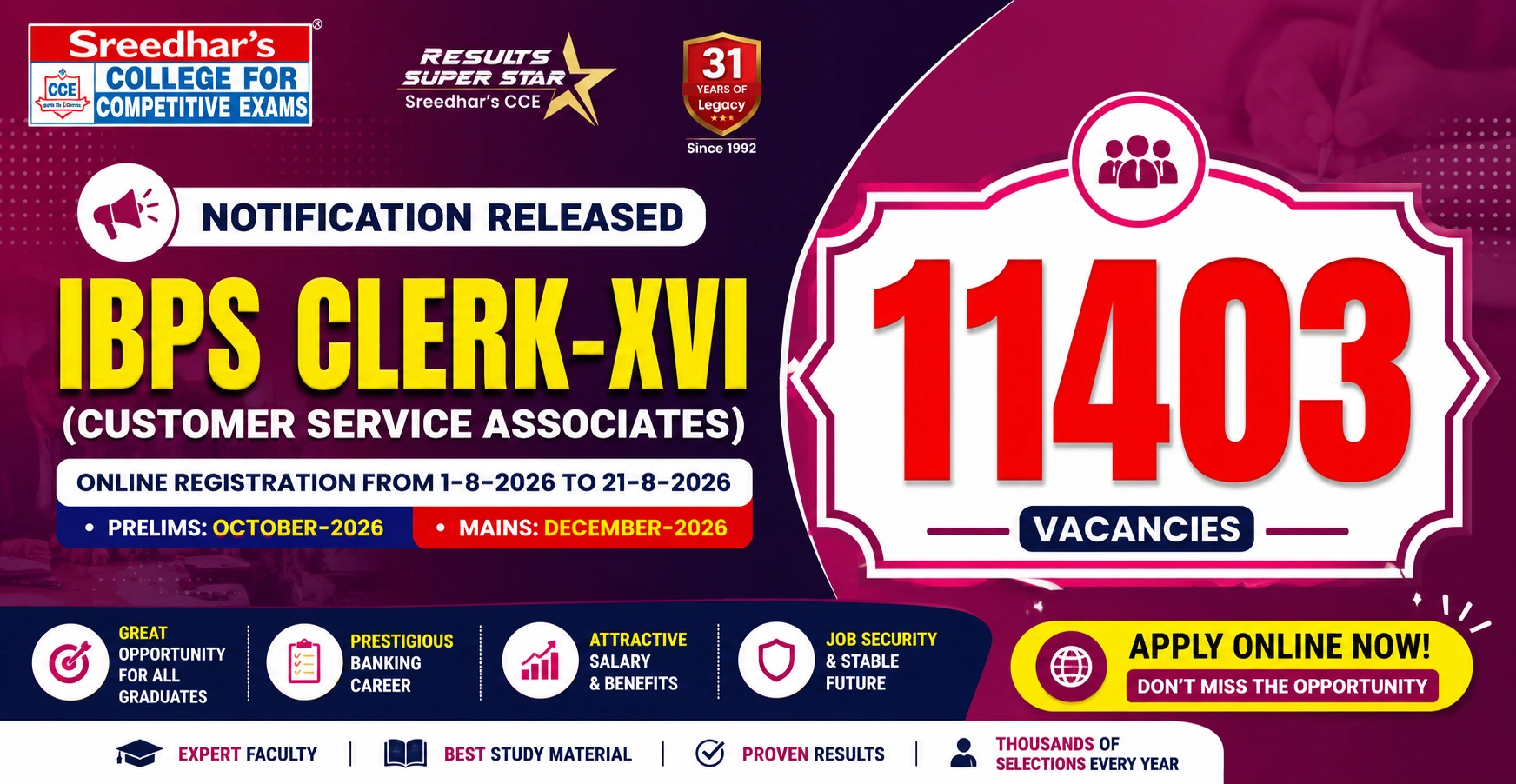
It's worth flagging that the IBPS Clerk 2026 notification is expected to be released around July or August 2026, with the preliminary exam anticipated in August or September 2026, and the Mains likely in October 2026. Some sources also indicate the Prelims could be scheduled later in the year, so candidates should keep tracking the official IBPS website for the confirmed notification and exam calendar rather than relying solely on tentative dates floating around online.
IBPS Clerk Exam Pattern 2026 — Prelims
The Preliminary exam is the first hurdle and is purely a screening test — meaning your Prelims score doesn't get added to your final merit; you simply need to clear the cutoff to move ahead. It is also important to note that each correct response awards 1 mark, while 0.25 marks are deducted for every incorrect answer, so accuracy matters as much as speed.
The Prelims exam pattern is as follows: English Language has 30 questions worth 30 marks in 20 minutes, Numerical Ability has 35 questions worth 35 marks in 20 minutes, and Reasoning Ability has 35 questions worth 35 marks in 20 minutes.
| Section | No. of Questions | Maximum Marks | Duration |
|---|---|---|---|
| English Language | 30 | 30 | 20 minutes |
| Numerical Ability | 35 | 35 | 20 minutes |
| Reasoning Ability | 35 | 35 | 20 minutes |
| Total | 100 | 100 | 60 minutes |
A few important points about the Prelims pattern:
- Each of the three Prelims sections has a fixed sectional time limit of 20 minutes — you cannot borrow extra time from one section to use in another, so time management within each section is critical.
- The exam is conducted entirely online (computer-based test).
- The exam is bilingual, available in both English and Hindi, except for the English Language section.
- There is no sectional cutoff disclosed in advance for Prelims candidates need to clear, but historically candidates need to clear both individual sectional cutoffs and an overall cutoff to qualify.
IBPS Clerk Exam Pattern 2026 — Mains
This is where the real competition happens, since Mains marks are what ultimately decide your selection. IBPS revised the Mains pattern recently, and candidates must prepare according to the updated structure rather than older exam patterns floating around in outdated PDFs.
Under the revised pattern, the number of questions in the Mains exam has been brought down to 155, and the exam duration for Mains is now 2 hours (120 minutes). This is a significant change from the earlier 190-question, 160-minute format, so if you're practising from older mock tests, make sure you switch to updated material.
The Mains exam consists of 155 questions for 200 maximum marks, broken down as: General/Financial Awareness – 50 questions, General English – 40 questions, Reasoning Ability – 60 questions, and Quantitative Aptitude – 40 questions. It's worth noting that different sources show slight variations in the exact question count per section following the revision, so always cross-check the final numbers against the official IBPS notification once released.
| Section | Approx. Questions | Maximum Marks | Approx. Duration |
|---|---|---|---|
| General/Financial Awareness | 50 | 50 | 20 minutes |
| General English | 40 | 40 | 35 minutes |
| Reasoning Ability | 60 | 60 | 35 minutes |
| Quantitative Aptitude | 40 | 40 | 30 minutes |
| Total | ~155 | 200 | 120 minutes |
Some key updates aspirants must know for Mains 2026:
- The time for the General/Financial Awareness section has been reduced from 35 minutes to 20 minutes, the Reasoning section now has 35 minutes (down from 45 minutes for the earlier combined "Reasoning & Computer Aptitude" section), and Quantitative Aptitude time has been cut from 45 minutes to 30 minutes, while General English time remains unchanged at 35 minutes.
- Marks allotted per question may vary as the exam pattern has changed, and negative marking of -0.25 marks applies, with no penalty for unattempted questions.
- The standalone "Computer Aptitude" section has effectively been merged — the section is now called simply "Reasoning Ability," with computer-related concepts integrated within it rather than tested separately.
- Like Prelims, Mains has individual sectional timers, so you cannot reallocate time across sections.
The Language Proficiency Test (LPT)
This is a stage many candidates overlook while planning their preparation, and that's a mistake. The Language Proficiency Test for IBPS Clerk is conducted after the Mains exam to assess a candidate's command over the official language of the state they have applied for, testing skills like reading comprehension, grammar, vocabulary, writing ability, and basic conversation.
Why does this matter so much? Failing the LPT leads to disqualification even after clearing both Prelims and Mains. In other words, you could top the Mains merit list and still lose your selection if you can't demonstrate proficiency in the relevant regional language. Candidates who studied in a different state, or whose medium of instruction was different from the local language, should start practising the regional language well in advance — don't leave this for the last minute just because it feels like a formality.
IBPS Clerk Syllabus 2026 — Section Wise
Now let's get into the actual subject matter. The IBPS Clerk exam syllabus for Prelims and Mains is largely similar for English, Reasoning, and Quantitative Aptitude — the only additional section in Mains is General/Financial Awareness, which assesses general awareness and financial knowledge through topics like current affairs, GDP, economic indices, and financial institutions and instruments. The difficulty level, however, steps up noticeably in Mains.
1. English Language Syllabus
The English section tests grammar, vocabulary, and comprehension skills, and the topic list is fairly consistent across Prelims and Mains, with Mains questions being tougher and more vocabulary-intensive.
Important topics include:
- Reading Comprehension (typically 2 passages with 7–8 questions in Prelims)
- Cloze Test (including new-pattern cloze tests)
- Para Jumbles / Sentence Rearrangement
- Fillers (single, double, and multiple sentence fillers)
- Error Detection / Spotting Errors
- Sentence Correction and Sentence Improvement
- Phrase Replacement
- Fill in the Blanks
- Vocabulary-based questions (synonyms, antonyms, word usage)
- Idioms and Phrasal Verbs
Other recurring topics include Inference, Sentence Completion, Connectors, Paragraph Conclusion, and Phrasal Verb-related questions. Reading comprehension and error detection tend to carry the most weight, so building strong reading habits early in your preparation pays off.
2. Numerical Ability / Quantitative Aptitude Syllabus
The syllabus comprises topics such as Number Series, Data Interpretation, Simplification/Approximation, Quadratic Equation, Data Sufficiency, Mensuration, Average, Profit and Loss, Ratio and Proportion, Time and Work, Time and Distance, Probability, Simple and Compound Interest, and Permutation and Combination.
A quick rundown of high-weightage topics:
- Simplification and Approximation
- Number Series (missing/wrong number series)
- Data Interpretation (tables, bar graphs, pie charts, line graphs, caselets)
- Quadratic Equations
- Data Sufficiency
- Mensuration and Geometry
- Average, Ratio & Proportion, Percentage
- Profit and Loss
- Simple and Compound Interest
- Time, Speed and Distance; Time and Work
- Permutation, Combination and Probability
Data Interpretation is considered the most important and high-weightage topic in the Quant section. In Mains, expect Data Interpretation sets to be more calculation-intensive, often combined with caselets that require careful reading before you even begin solving.
3. Reasoning Ability Syllabus
Reasoning carries the highest number of questions in Mains and demands consistent daily practice. The Reasoning Ability section covers topics like Seating Arrangements, Puzzles, Syllogism, and Blood Relations, among others.
Key topics include:
- Puzzles and Seating Arrangement (linear, circular, and complex puzzles)
- Direction Sense
- Blood Relations
- Syllogism
- Inequality
- Coding-Decoding
- Input-Output
- Alphanumeric Series
- Order and Ranking
- Statement-based reasoning (Statement and Assumption, Course of Action)
- Logical Reasoning
Puzzles are considered the most important topic in Reasoning, often comprising the bulk of questions in both Prelims and Mains. In Mains, reasoning becomes more analytical and logic-based, so candidates should practice advanced puzzles, input-output, and logical reasoning questions to score well.
Since the Reasoning section now also folds in basic computer-related concepts (following the pattern revision), candidates should not skip Computer Aptitude basics even though it's no longer a standalone section.
4. Computer Knowledge (within Reasoning Ability)
Even though Computer Aptitude is no longer tested as an independent section, foundational computer knowledge questions still appear within Reasoning. This portion assesses basic computer knowledge needed for clerical roles, with focus areas including common software, internet basics, and security tools.
Topics to cover:
- Computer fundamentals and history/generations of computers
- Hardware and software basics
- MS Office (Word, Excel, PowerPoint)
- Internet, email, and networking basics
- Number systems and computer abbreviations
- Security tools, viruses, and basic cyber-safety concepts
- Shortcut keys
5. General / Financial Awareness Syllabus (Mains Only)
This section is unique to Mains and rewards candidates who stay updated on current affairs and banking news throughout their preparation rather than cramming at the last moment. The General Awareness section of the IBPS Clerk exam primarily focuses on current events and general knowledge.
Important areas to focus on:
- Current Affairs (last 6–8 months, with strong emphasis on banking and financial news)
- Banking Awareness (RBI functions, monetary policy, banking terms, types of accounts)
- Financial Awareness (Union Budget, GDP, inflation, economic indices, financial institutions and instruments)
- Government Schemes related to banking and finance
- Static GK (important days, headquarters, currencies, awards)
- Abbreviations and full forms used in banking
For General Awareness specifically, banking awareness, current affairs, and static GK are essential focus areas. Since this section now has a tighter 20-minute window, candidates need to be able to recall facts quickly rather than spend time reasoning them out — that comes only from consistent daily revision.
IBPS Clerk Syllabus 2026 at a Glance
| Stage | Sections |
|---|---|
| Prelims | English Language, Numerical Ability, Reasoning Ability |
| Mains | General/Financial Awareness, General English, Reasoning Ability (incl. Computer Knowledge), Quantitative Aptitude |
| LPT | Regional/official language proficiency (reading, writing, grammar, conversation) |
How Difficult Is IBPS Clerk 2026?
IBPS Clerk Prelims is generally of easy to moderate difficulty, with Simplification, Number Series, and basic Reasoning topics on the easier side. Mains, however, is a different ball game — the questions are lengthier, the puzzles more layered, and the DI sets more calculation-heavy. The reduced time limits in the new pattern (especially in General Awareness and Quantitative Aptitude) mean that speed, in addition to accuracy, has become even more important than before.
A candidate who prepares properly with the updated syllabus and exam pattern can realistically crack the exam with good marks in around six months, though this naturally depends on your starting point, consistency, and how well-structured your study plan is.
Preparation Strategy for IBPS Clerk 2026
A few practical pointers to keep in mind as you plan your preparation:
- Start with the syllabus, not random practice questions. Knowing exactly what to study (and what to skip) saves enormous time.
- Practice with sectional time limits from day one. Since both Prelims and Mains impose section-wise timers, practicing without these limits builds false confidence.
- Prioritise high-weightage topics — Puzzles and Seating Arrangement in Reasoning, Data Interpretation in Quant, and Reading Comprehension and Error Detection in English consistently fetch the most marks.
- Don't ignore General Awareness until the last month. Banking and financial awareness needs months of steady reading, not a final sprint.
- Start LPT preparation early if your regional language isn't your strongest. This stage is easy to neglect but can disqualify you even after clearing Mains.
- Take regular full-length mock tests under exam-like conditions to build speed and reduce silly errors from negative marking.
- Revise consistently. A topic studied once and never revisited is, for exam purposes, a topic not studied at all.
Why Choose Sreedhar's CCE for IBPS Clerk 2026 Preparation
Picking the right coaching partner can make a real difference to how efficiently you prepare, and this is where Sreedhar's CCE has built a strong reputation over the years. Here's what sets it apart for IBPS Clerk aspirants:
Decades of Proven Experience
Founded in 1995, Sreedhar's College for Competitive Exams has been at the forefront of competitive exam training for nearly three decades, growing from a modest coaching centre into a highly reputed institution that thousands of aspirants walk through every year. The institute has helped more than 30,000+ students secure government jobs since its inception — a track record few coaching centres in the region can match.
Specialised Banking Exam Faculty
The faculty team consists of experienced mentors who specialise in Banking, SSC, RRB, Railways, and other competitive exams, guiding students with clarity and patience. For an exam like IBPS Clerk, where sectional timing and question-solving techniques matter as much as concepts, having mentors who understand the exam's nuances is invaluable.
Structured, Step-by-Step Training Model
Sreedhar's CCE follows a planned training model that covers concept building, practice, tests, analysis, and revision, so students grow step by step with confidence — rather than being thrown into mock tests without first building a solid foundation in each section.
Updated, Exam-Aligned Study Material
Regularly updated material, topic-wise handouts, and practice sets designed as per the latest exam pattern help students stay ahead of the competition. Given how frequently IBPS revises its Mains pattern (as seen with the 2026 changes), studying from outdated material is one of the most common — and avoidable — mistakes aspirants make.
Realistic, Exam-Like Mock Test Infrastructure
Every branch is equipped with a fully modernised computer lab designed to give students a real-time online exam experience, with systems configured to closely simulate actual Banking, SSC, Railways, Insurance, and other competitive examinations, supported by uninterrupted power backup and high-speed internet. This kind of exam-hall simulation helps reduce exam-day anxiety, since the testing environment already feels familiar.
Dedicated Doubt-Clarification Spaces
Each branch includes a dedicated explanation hall where faculty conduct detailed discussions, doubt-clarification sessions, and exam-oriented problem-solving practice, equipped with large LED screens and quality audio systems for interactive learning.
Flexible Online and Offline Learning
Sreedhar's CCE offers both Bank Online Courses and Bank Offline Classroom Courses — online courses include live and recorded classes, online tests, and doubt clarification, while offline courses are conducted at centres across Andhra Pradesh and Telangana with direct faculty interaction. This means aspirants can choose the mode that fits their schedule and learning style, whether they're based near a physical centre or prefer studying remotely.
Extensive Test Series Modeled on the Latest IBPS Pattern
The institute provides an extensive suite of online sectional tests and full-length mock exams modelled on the IBPS pattern, giving aspirants ample practice to significantly boost their exam preparedness. With the Mains pattern having just been revised for 2026, practising on updated mock tests — rather than outdated ones from previous cycles — is critical, and this is an area Sreedhar's CCE keeps current.
Constant Communication and Tracking
Sreedhar's CCE maintains constant communication with students, sending daily online exam score reports, job notification updates, and other important information directly to registered mobile numbers via SMS service. This ensures aspirants never miss an important notification date or fall out of touch with their own performance trends.
A Strong Regional Presence with a National-Level Track Record
With campuses across multiple locations in Hyderabad and Andhra Pradesh, including Dilsukhnagar, Ashok Nagar, Ameerpet, and Vijayawada, Sreedhar's CCE has produced over 1,070 selections in recent banking exams, making it one of the more accessible and result-oriented options for aspirants in the region.
If you're serious about cracking IBPS Clerk 2026, it's worth exploring the Sreedhar's CCE homepage to look at current batch schedules, course structures, and enrolment details for both online and offline programs.
Final Thoughts
The IBPS Clerk 2026 syllabus, at its core, hasn't changed dramatically — but the exam pattern, especially for Mains, has seen real structural changes that every aspirant must internalise before starting preparation. Knowing exactly how many questions to expect, how much time you'll have per section, and which topics carry the most weight allows you to build a preparation plan that's targeted rather than scattered. Add consistent mock test practice, daily current affairs revision, and early attention to the often-overlooked LPT stage, and you put yourself in a strong position heading into exam day.
Whether you choose to prepare independently or with structured guidance from an experienced institute like Sreedhar's CCE, the fundamentals remain the same: understand the syllabus deeply, respect the sectional timers, and practice relentlessly under real exam conditions.
Note: The IBPS Clerk 2026 official notification, exact exam dates, and final syllabus/pattern details will be released by IBPS on its official website. Candidates are advised to cross-verify all information in this article against the official notification once published.
Leave a Comment
Required fields are marked *