



IBPS SO XVI 2026 Notification: 745 Specialist Officer Vacancies, Full Details, Eligibility and Preparation Guide
Get complete details about the IBPS SO XVI 2026 Notification, including 745 Specialist Officer vacancies, eligibility, exam pattern, syllabus, important dates, and expert preparation tips.
The Institute of Banking Personnel Selection has released the much-awaited IBPS SO 2026 notification, and the banking aspirant community across Andhra Pradesh, Telangana and the rest of India is buzzing with excitement. Under the Common Recruitment Process for Specialist Officers, popularly known as CRP SPL XVI, IBPS has announced 745 vacancies for Scale I Specialist Officer posts in Participating Public Sector Banks. If you have a professional degree in IT, Agriculture, Law, HR or Rajbhasha and you have been waiting for the right opportunity to start a stable, respected banking career, this notification is exactly what you have been preparing for.
At Sreedhar's CCE, we have been guiding banking aspirants to their dream government jobs since 1995, and this article brings together everything you need to know about the IBPS SO XVI 2026 recruitment cycle: vacancy breakup, eligibility criteria, exam pattern, important dates, salary structure, selection process and a preparation roadmap that will help you convert this opportunity into a job offer.
What Is IBPS SO and Why Does It Matter
IBPS SO stands for the Institute of Banking Personnel Selection Specialist Officer recruitment. Unlike the IBPS PO exam, which looks for generalist graduates who can be trained into all round banking roles, the IBPS SO exam is built for candidates who already carry a specialised professional qualification. Banks need experts who can manage their technology systems, handle legal matters, oversee human resource functions, support agricultural lending, and maintain official Hindi correspondence under the Rajbhasha mandate. That is exactly the pool of talent the SO recruitment process is designed to identify.
Because the exam targets a narrower, more qualified audience than PO or Clerk recruitment, competition per seat is often more manageable, provided your fundamentals in your own domain are strong. This makes IBPS SO one of the most efficient entry points into a public sector bank for engineering, agriculture, law, HR and Hindi postgraduates who might otherwise feel that a generalist banking exam does not fully value their specialised education.
IBPS SO XVI 2026: Notification Snapshot
The official notification, released under reference number CRP SPL XVI, confirms the following headline details.
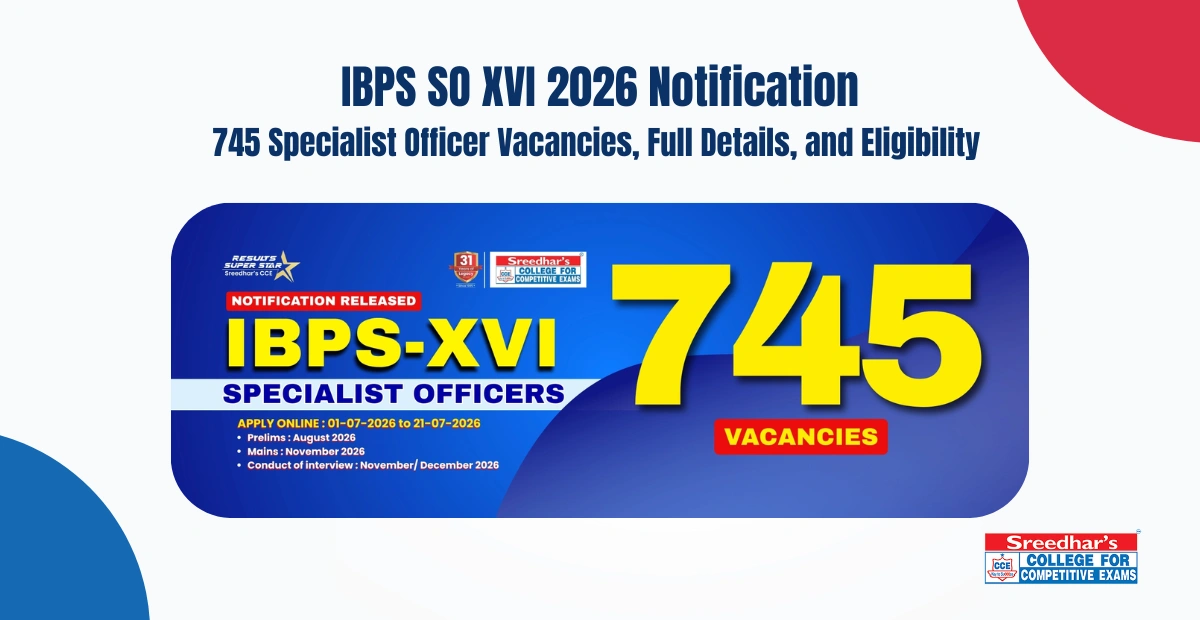
The Institute of Banking Personnel Selection released the Specialist Officers Recruitment 2026 notification on 1 July 2026 at the official website, and the online application process began on the same day and closes on 21 July 2026. The IBPS SO Notification 2026 covers Specialist Officer posts in IT, HR, Law, Agriculture and Rajbhasha, with registrations open at www.ibps.in.
These 745 vacancies belong to the 2027 to 28 recruitment cycle, and according to the official exam calendar the Preliminary Examination will be conducted on 29 August 2026 while the Main Examination is scheduled for 1 November 2026.
Here is a quick reference table summarising the notification.
| Particular | Detail |
|---|---|
| Conducting Body | Institute of Banking Personnel Selection (IBPS) |
| Recruitment Name | CRP Specialist Officers XVI (CRP SPL XVI) |
| Total Vacancies | 745 (indicative) |
| Application Start Date | 1 July 2026 |
| Application Last Date | 21 July 2026 |
| Prelims Exam Date | 29 August 2026 |
| Mains Exam Date | 1 November 2026 |
| Interview | November or December 2026 |
| Mode of Application | Online only, at ibps.in |
| Official Website | www.ibps.in |
If you would like a simulated test environment to get a feel of the actual exam pattern before the real thing, you can explore the free mock tests and practice papers available on our website. Getting comfortable with the interface early takes away a lot of avoidable exam day stress.
Post Wise Vacancy Breakup
The 745 vacancies are distributed across the following streams: IT Officer Scale I with 301 posts, Agricultural Field Officer Scale I with 190 posts, Law Officer Scale I with 105 posts, Rajbhasha Adhikari Scale I with 89 posts, and HR or Personnel Officer Scale I with 60 posts. Marketing Officer is also technically included among the posts covered under CRP SPL XVI, however no Marketing Officer vacancy has been reported for the current recruitment cycle.
It is worth noting that IT Officer continues to be the largest category by a wide margin, accounting for more than 40 percent of the total vacancies. This reflects the accelerating digital transformation inside public sector banks, where core banking systems, cybersecurity, data analytics and digital lending platforms all need dedicated technical officers. Agricultural Field Officer comes in second, a reminder that agricultural credit remains a core priority sector for Indian banks. Law and Rajbhasha postings, while smaller in number, remain consistently in demand every year and are excellent options for candidates with LLB or Hindi postgraduate qualifications who want a focused, lower competition path into banking.
These numbers are indicative and may change slightly as banks finalise their needs, so candidates should always cross check the final figures in the detailed notification released on the official IBPS website.
Eligibility Criteria: Age Limit and Nationality
Before you begin your application, make sure you meet the basic eligibility conditions.
Nationality: You must be a citizen of India, or a subject of Nepal or Bhutan, or a Tibetan refugee who came to India before 1 January 1962 with the intention of permanently settling here, or a person of Indian origin who has migrated from Pakistan, Burma, Sri Lanka, East African countries or Vietnam with the intention of permanently settling in India, subject to the usual eligibility certificate requirements.
Age Limit: The age limit should be between 20 and 30 years for all posts. More precisely, the age limit is 20 to 30 years as on 1 July 2026, meaning a candidate must have been born between 2 July 1996 and 1 July 2006, both dates included.
Age Relaxation: Age relaxation is given as per government rules, with 5 years for SC and ST candidates, 3 years for OBC candidates, and 10 years for Persons with Benchmark Disabilities. Ex-servicemen and other categories notified by the government also receive relaxation as per standard central government norms, so do check the detailed notification for the exact number of years applicable to your category.
Educational Qualification, Post by Post
Each Specialist Officer post has its own distinct educational requirement, because each role demands a different professional background. Below is a simplified summary.
IT Officer Scale I: A four year Engineering or Technology degree in Computer Science, Computer Applications, Information Technology or Electronics streams, or a postgraduate degree in these subjects.
Agricultural Field Officer: A four year degree in Agriculture, Horticulture, Animal Husbandry, Veterinary Science, Dairy, Fishery or a related agricultural field.
Law Officer Scale I: A Bachelor's Degree in Law, either the 3 year or the 5 year LLB, from a recognised university, along with enrolment with the Bar Council.
HR or Personnel Officer Scale I: A graduate degree along with a full time postgraduate degree or diploma in Human Resources, Personnel Management, Industrial Relations, Social Work or Labour Law.
Rajbhasha Adhikari Scale I: A postgraduate degree in Hindi with English as a subject at the degree level, or a postgraduate degree in Sanskrit with English and Hindi as subjects at the degree level. Candidates with a degree in Translation from Hindi to English and vice versa are also considered.
Candidates should hold the qualifying degree as on the last date of application, so if your final semester results are pending, check the detailed notification for the exact provisional eligibility clause before you proceed.
Application Fee
The non-refundable application fee for SC, ST and PwBD category candidates is 175 rupees inclusive of GST, while all other category candidates need to pay 850 rupees inclusive of GST. The fee must be paid online through debit card, credit card or net banking, as no offline forms are accepted by the system.
How to Apply Online: Step by Step
Applicants need to open the official web portal at www.ibps.in and click on the CRP SPL link, then select the option for CRP Specialist Officers XVI to apply online. New candidates should use the new registration option to generate a temporary password and user ID, then fill in all mandatory fields and upload the required documents according to the system specifications. Once the form is complete, candidates must finish the process by paying the fee through the available online channels, and finally take a printout of the system generated application form and the payment receipt for their own records.
Here is the process condensed into simple steps for quick reference.
- Visit www.ibps.in and locate the CRP SPL XVI application link.
- Register with a valid mobile number and email ID to generate your login credentials.
- Fill in personal, academic and category details carefully.
- Upload a recent photograph, signature and any other documents mentioned in the notification, in the specified format and size.
- Select your preferred post, language and exam centre.
- Pay the application fee online.
- Review the entire form before final submission.
- Download and save the confirmation page and fee receipt for future reference.
Since correction windows for online forms are often limited or unavailable altogether, it pays to double check spellings, category details, post preference and photograph quality before you hit submit.
Revised Exam Pattern for 2026
One of the most talked about changes this year is the revision to the exam pattern. The IBPS SO 2026 exam pattern has been revised for both Prelims and Mains, with Professional Knowledge now added to the Prelims stage, which contains 100 questions worth 125 marks over an 80 minute duration. The Prelims exam is qualifying in nature, while the final selection is based on Mains and Interview marks. Candidates must possess a graduation or postgraduation degree in the relevant discipline according to the post applied for, and different posts have different qualification requirements.
This is a significant shift from the earlier pattern, where Prelims for most SO posts tested only Reasoning, English Language and Quantitative Aptitude, with Professional Knowledge reserved exclusively for Mains. Adding a Professional Knowledge component at the Prelims stage itself means that candidates can no longer treat the first stage as a pure aptitude filter. Even at the earliest step of the exam, your domain expertise now carries weight, so preparation has to be integrated from day one rather than staggered.
The Mains examination combines objective and descriptive components and continues to place heavy emphasis on Professional Knowledge relevant to the specific post. This design rewards candidates who have genuinely mastered their subject rather than those relying purely on last minute revision.
Selection Process
The IBPS SO selection process consists of three stages: the Preliminary Examination, the Main Examination and the Interview. Candidates must qualify for each stage to proceed further, with Preliminary Examination marks used only to shortlist candidates for the Main Examination and not included in the final merit calculation. Candidates shortlisted through the Main Examination must also qualify for the Interview.
The final combined score is calculated using 80 percent weightage for the Online Main Examination and 20 percent weightage for the Interview, after which provisional allotment is done based on merit, vacancies and candidate preferences. This weightage structure tells you exactly where to focus your energy. The Mains examination, with its heavy Professional Knowledge component, is the single biggest determinant of your final rank, so it deserves the largest share of your study time over the coming months.
Salary and Perks of an IBPS Specialist Officer
Banking careers are attractive not just for job security but also for a steadily growing pay structure. Specialist Officers are recruited in Scale I, the Junior Management Grade, which carries an attractive basic pay along with a range of bank allowances. The starting basic pay is 48,480 rupees, with a full pay scale of 48,480 to 85,920 rupees.
Apart from the basic pay, officers receive Dearness Allowance, House Rent Allowance, Special Allowance and other benefits, which push the monthly gross pay considerably higher. The approximate in hand salary of an IBPS Scale I officer is around 65,000 to 70,000 rupees per month, depending on the city and the specific bank.
Beyond the monthly pay packet, Specialist Officers also enjoy pension or NPS benefits, medical insurance, leave fare concession, subsidised loans for housing and vehicles, and a clear, seniority linked promotion ladder that can take a Scale I officer up to senior management positions over the course of a career.
Why IBPS SO Is Worth Your Time and Effort
A direct entry into a Scale I officer role in your area of expertise, whether that is IT, Law, Agriculture or HR, offers a specialised banking career track from day one. Specialist Officers often progress quickly given their domain expertise, and the role comes with the job security of a permanent government sector position across 11 participating public sector banks. With six different specialist streams to choose from based on your qualification, there is a wide range of post options available to suit different academic backgrounds.
The evaluation structure rewards specific professional skills rather than general aptitude, which particularly benefits candidates who have built deep domain knowledge during their degree. Another advantage is the relatively rapid selection cycle, which typically moves from registration to provisional allotment in approximately six months, considerably faster than several other central government recruitment processes.
That said, this recruitment is an All India Cadre process, so it may not suit candidates who prefer to work only in a specific local region, since selectees can be placed anywhere depending on dynamic bank vacancies. If mobility across India is something you are comfortable with, this should not be a concern, and in fact it opens up exposure to different regions, languages and banking markets early in your career.
Common Mistakes Aspirants Make While Applying
Every year, a section of otherwise capable candidates loses out simply because of avoidable errors during the application stage. A few of the most common ones include selecting the wrong post out of excitement rather than matching it precisely to their qualification, uploading photographs or signatures that do not meet the specified size and format, missing the last date because of payment gateway issues attempted at the eleventh hour, and not reading the detailed notification carefully enough to understand category specific relaxations. Take an unhurried hour to read the official notification PDF from IBPS in full before you start filling the form, and keep all your scanned documents ready in advance rather than scrambling for them mid application.
Preparation Strategy for IBPS SO Prelims and Mains 2026
With Professional Knowledge now folded into the Prelims itself, a smart, structured preparation plan matters more than ever. Here is how we recommend you approach the months ahead.
Start with your Professional Knowledge foundation. Whatever your post, whether IT, Law, HR, Agriculture or Rajbhasha, go back to your core degree subjects and rebuild a strong conceptual base. Do not treat this as a revision exercise alone; treat it as the primary preparation pillar, since it now influences both stages of the exam.
Build your general aptitude sections in parallel. Reasoning, English Language and Quantitative Aptitude still carry meaningful weightage, particularly at the Prelims stage, and a consistent daily practice routine across these three areas prevents any one section from becoming a bottleneck.
Practice with realistic mock tests. The revised pattern means that older mock papers designed around the previous syllabus may not fully prepare you for the actual exam experience. Look specifically for updated test series that reflect the new 100 question, 125 mark, 80 minute Prelims format. Our structured online and offline courses are updated regularly to reflect exactly these kinds of pattern changes, so you are never practising against an outdated blueprint.
Time your descriptive Mains preparation. For posts like Law and HR, the Mains stage typically includes a descriptive component. Practising answer writing under timed conditions well before the exam date builds the fluency you need on the actual day, when time pressure can otherwise cause even well prepared candidates to underperform.
Track current affairs and banking awareness consistently. Banking and financial awareness sections reward candidates who read a little every single day rather than cramming in the final week. Make this a daily fifteen minute habit rather than an occasional deep dive.
Take sectional tests before full length ones. Building competence section by section, then combining everything into full length simulated exams closer to the date, is a more sustainable approach than attempting full mock tests too early, before your fundamentals are solid.
Review every mistake, not just your score. A mock test is only as useful as the review that follows it. For every test you take, spend time understanding why you got a question wrong, whether it was a concept gap, a silly error or a time management issue, and adjust your next round of preparation accordingly.
How Sreedhar's CCE Supports IBPS SO Aspirants
Since 1995, Sreedhar's CCE has helped thousands of students across Andhra Pradesh, Telangana and neighbouring states convert their banking exam preparation into confirmed job offers. Our approach to Specialist Officer preparation is built around three pillars: subject depth, exam simulation and continuous feedback.
Our faculty teams include mentors experienced in guiding candidates through domain specific Professional Knowledge sections, alongside dedicated trainers for Reasoning, Quantitative Aptitude and English Language. Every branch runs on modern computer labs configured to simulate the real IBPS exam interface, so that by the time you sit for the actual Prelims or Mains, the screen, the timer and the navigation feel completely familiar rather than intimidating.
We also believe strongly in transparency. Sreedhar's CCE is known for publishing authentic, verifiable results with the roll number, candidate name and selected post of every successful student, a practice that reflects our confidence in the outcomes our training delivers. You can browse through our verified selection results to see the track record for yourself.
If you are unsure which course format suits you best, whether that is a fully offline classroom programme at one of our branches, an online batch you can join from home, or a focused short term crash course closer to your exam date, our course options page breaks down everything currently available. You can also check our branch locations if you would prefer classroom learning near you.
For daily updates on new government job notifications, exam pattern changes and preparation tips, our blog section is updated regularly, and it is worth bookmarking if you want to stay ahead of every upcoming banking and government exam cycle. Should you have any specific questions about this notification or about which course would suit your target post, feel free to reach out through our contact page, and our counsellors will guide you personally.
Participating Banks Under CRP SPL XVI
IBPS conducts this common recruitment process on behalf of multiple public sector banks, which then draw their own Specialist Officer allotments from the common merit list generated after the Interview stage. Historically, participating banks under the SO recruitment cycle have included institutions such as Bank of Baroda, Bank of India, Bank of Maharashtra, Canara Bank, Central Bank of India, Indian Bank, Indian Overseas Bank, Punjab National Bank, Punjab and Sind Bank, UCO Bank and Union Bank of India, among others. The exact list, along with the number of vacancies each bank has requisitioned, is confirmed in the detailed notification, so candidates should check this carefully rather than assuming which bank they might be posted to. Since allotment depends on your rank, your post preference and the vacancies each bank has notified, keeping an open mind about location and posting bank will genuinely widen your chances of selection.
Documents You Will Need Before You Apply
Getting your documents ready in advance saves you from a stressful, rushed application closer to the deadline. Keep the following ready in digital format, scanned according to the size and dimension specifications mentioned in the official notification.
A recent passport size photograph with a plain, light background works best, along with your signature scanned on plain white paper, since blurred or oversized uploads are among the most common reasons applications get flagged. You will also need scanned copies of your degree certificate and mark sheets relevant to your chosen post, your category certificate if you are applying under SC, ST, OBC or EWS, your PwBD certificate if applicable, and a valid government issued photo identity proof such as Aadhaar, PAN or passport. Law Officer applicants additionally need proof of enrolment with the Bar Council, while Rajbhasha Adhikari applicants should keep their language qualification certificates handy, since these often need separate verification at a later stage of the recruitment process.
Candidates whose final year results are still awaited should also read the specific clause in the detailed notification regarding provisional eligibility, since different posts sometimes handle this situation differently, and assuming eligibility without checking this clause can lead to disqualification later in the process even after clearing the exam stages.
Final Thoughts
The IBPS SO XVI 2026 notification represents one of the more significant Specialist Officer recruitment cycles in recent years, both in terms of sheer vacancy count and the meaningful shift in exam pattern that now rewards deep professional knowledge from the very first stage. Whether you are an engineering graduate eyeing the largest vacancy pool in IT, an agriculture graduate drawn to the Agricultural Field Officer role, or a law, HR or Hindi postgraduate looking for your specialised entry into public sector banking, this is a genuine, time bound opportunity worth preparing for seriously.
The window is short. Applications close on 21 July 2026, and the Prelims exam is barely a few weeks after that on 29 August 2026, so there is no time to waste on hesitation. Read the official notification thoroughly, confirm your eligibility for your chosen post, complete your application well ahead of the deadline, and channel every remaining week into focused, exam pattern aligned preparation.
At Sreedhar's CCE, we have walked this path with thousands of successful aspirants before you, and we would be glad to walk it with you too. Explore our free practice exams, check out our IBPS SO focused courses, and get in touch with our team through our contact page to begin your preparation the right way. Your Scale I Specialist Officer career in a public sector bank could well begin with the decision you make this month.
Leave a Comment
Required fields are marked *