



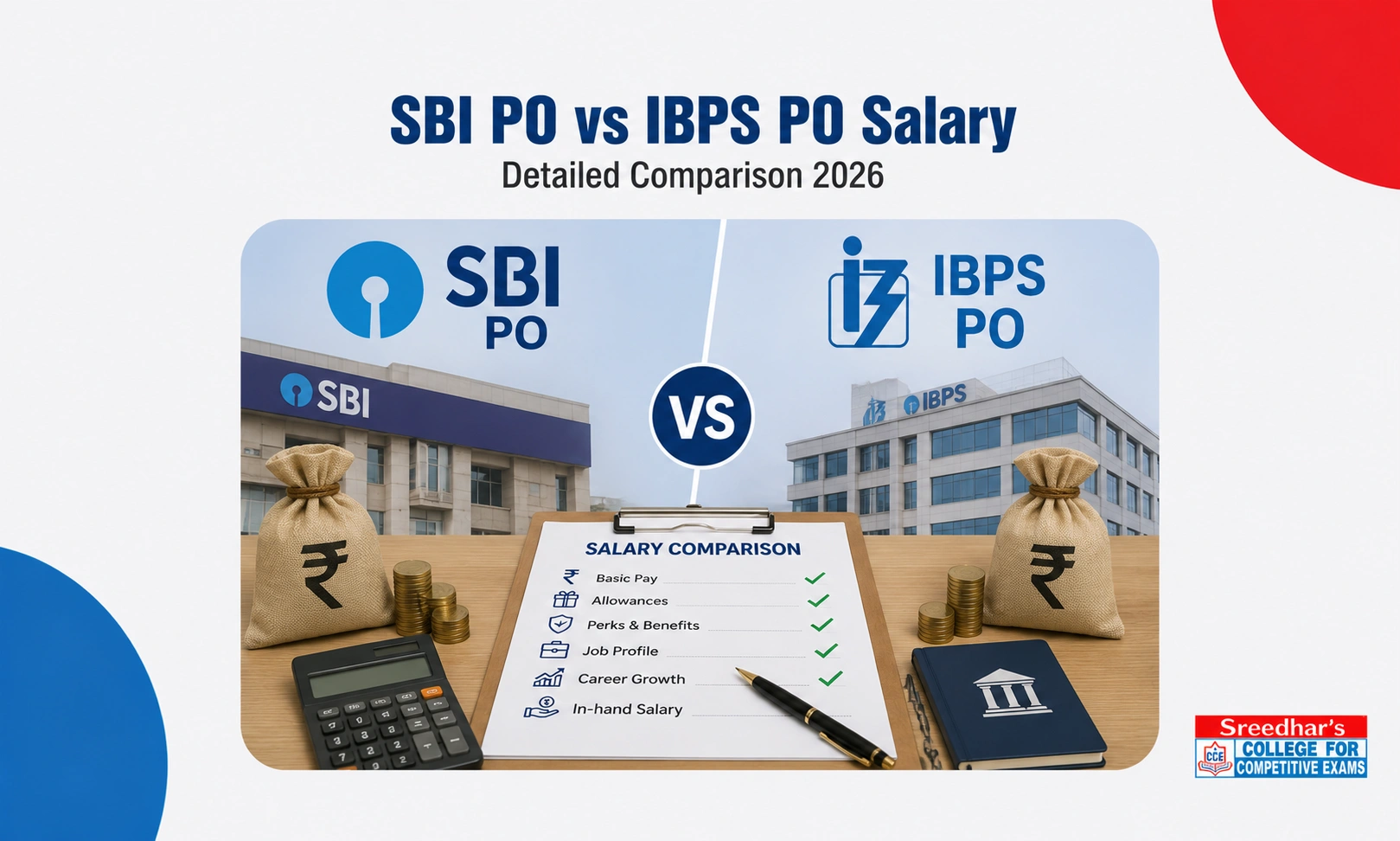
SBI PO vs IBPS PO Salary
SBI PO vs IBPS PO Salary, Difficulty, Selection Process & Career Growth Compared in 2026
For many banking aspirants, choosing between SBI PO and IBPS PO feels less like selecting an examination and more like deciding the direction of an entire career. Both are prestigious public-sector banking jobs, both attract lakhs of applicants every year, and both offer financial security and managerial growth. Yet the debate around “SBI PO vs IBPS PO – which is better?” continues to dominate preparation discussions.
At Sreedhar’s CCE, this question surfaces frequently during counselling sessions. Some students believe SBI PO is automatically superior because of its salary and institutional reputation. Others prefer IBPS PO because of wider recruitment opportunities and what they perceive as a more manageable work environment. The reality is more nuanced. Experienced banking mentors know that career decisions should not be based only on salary screenshots or social-media opinions. While compensation matters, it is only one part of the equation. Work culture, pressure, transfer policies, career growth, and personal priorities matter equally. This is why our mentors at Sreedhar’s CCE encourage aspirants to move beyond simplistic comparisons and ask a more practical question:
Which banking career actually fits my personality, expectations, and long-term goals?
The truth is that both SBI PO and IBPS PO offer excellent careers, but they are not identical journeys.
This guide compares:
-
Salary and allowances
-
Difficulty level
-
Selection process
-
Job profile and work pressure
-
Transfers and postings
-
Promotion opportunities
-
Work-life balance
-
Which exam suits beginners
-
Final career verdict from Sreedhar’s CCE mentors
SBI PO vs IBPS PO: Understanding the Core Difference
At first glance, the two exams appear similar because both recruit candidates for the post of Probationary Officer (PO) in public-sector banks. The syllabus overlaps significantly, covering:
-
Quantitative Aptitude
-
Reasoning Ability
-
English Language
-
General Awareness
-
Banking Awareness
However, the recruitment systems and career environments differ considerably. SBI PO recruits officers exclusively for the State Bank of India, India’s largest public-sector bank with enormous operational scale and customer base. IBPS PO, meanwhile, is a centralized recruitment process conducted for multiple public-sector banks. This distinction influences everything after selection, from branch culture and pressure levels to transfer policies and growth patterns.
Quick Comparison Overview
| Particulars | SBI PO | IBPS PO |
|---|---|---|
| Conducting Body | SBI | IBPS |
| Banks Covered | SBI only | Multiple PSU Banks |
| Recruitment Style | Bank-specific | Common recruitment |
| Competition | Extremely High | High |
| Transfers | Nationwide | Depends on the bank |
| Work Environment | Large-scale, demanding | Varies by bank |
At Sreedhar’s CCE, we explain this clearly to students because many assume that both jobs are practically identical. They are not. While both lead to banking careers, the day-to-day experience can feel very different.
Selection Process Compared
One of the first noticeable differences lies in the recruitment process. Although both exams include prelims and mains, the evaluation philosophy differs.
SBI PO Selection Process
The SBI recruitment process is broader and more personality-focused. It generally includes:
-
Preliminary Examination
-
Main Examination
-
Psychometric Test
-
Group Exercise
-
Interview
This structure reflects SBI’s hiring philosophy. SBI does not merely test aptitude or academic ability. It also evaluates:
-
leadership potential
-
communication
-
emotional maturity
-
managerial suitability
At Sreedhar’s CCE, our mentors often tell aspirants that SBI is recruiting future banking leaders, not just exam toppers. This makes the recruitment process psychologically more demanding.
IBPS PO Selection Process
IBPS PO follows a more streamlined process. Typically:
-
Preliminary Examination
-
Main Examination
-
Interview
The evaluation remains merit-driven and relatively straightforward. This simplicity appeals to many aspirants because preparation and expectations feel more predictable. However, easier structure does not mean easier selection. Competition remains intense.
Which Exam Is More Difficult?
This is perhaps the most searched comparison. The honest answer from Sreedhar’s CCE banking faculty:
SBI PO is generally considered tougher.
But understanding why matters.
SBI difficulty comes largely from unpredictability.
The bank often introduces:
-
unconventional puzzles
-
analytical reasoning
-
difficult DI sets
-
unexpected question patterns
Students who rely only on memorized templates often struggle. IBPS PO, while challenging, usually follows comparatively stable patterns. This creates an important distinction.
- SBI tests adaptability.
- IBPS tests consistency.
Students with a strong analytical temperament and comfort handling surprises often enjoy SBI preparation. Those who prefer structured practice and pattern familiarity may initially feel more comfortable with IBPS. At Sreedhar’s CCE, we advise students not to fear SBI difficulty, but to prepare for it strategically.
SBI PO vs IBPS PO Salary Comparison 2026
Salary is naturally a major factor in career decisions. However, mentors at Sreedhar’s CCE encourage students not to compare salaries in isolation. A higher package usually accompanies greater expectations.
SBI PO Salary 2026
SBI offers a stronger compensation package in many cases.
Approximate in-hand salary may range around:
₹80,000+ per month
depending on:
-
city
-
lease and reimbursement policies
-
allowances
-
deductions
Benefits may include:
-
DA
-
HRA
-
medical support
-
travel benefits
-
pension-related contributions
-
institutional perks
SBI’s scale contributes to its attractive compensation image.
IBPS PO Salary 2026
IBPS-recruited officers also receive highly competitive salaries.
Approximate in-hand salary:
₹65,000–₹75,000+
depending on:
-
bank allotted
-
posting city
-
allowances
-
deductions
While slightly lower in some situations, IBPS PO still offers strong financial security.
Salary Comparison Table
| Particulars | SBI PO | IBPS PO |
|---|---|---|
| Approx In-Hand Salary | ₹80,000+ | ₹65,000–₹75,000+ |
| DA | Yes | Yes |
| HRA | Yes | Yes |
| Medical Benefits | Yes | Yes |
| Pension/NPS | Yes | Yes |
| Additional Perks | Strong | Varies |
At Sreedhar’s CCE, we remind students:
Higher salary should be evaluated alongside workload and career expectations.
Job Profile and Work Pressure
This is where practical differences become visible. Many students assume PO work is identical everywhere. Reality says otherwise.
SBI PO Work Environment
SBI branches often handle:
-
heavy customer traffic
-
large-scale operations
-
strong business targets
Responsibilities may include:
-
customer management
-
loans
-
branch administration
-
cross-selling
-
supervision
Former banking professionals associated with Sreedhar’s CCE frequently describe SBI as:
high-energy and demanding.
This environment suits candidates who enjoy challenge and dynamic work.
IBPS PO Work Environment
IBPS officers join different banks.
Work pressure therefore varies.
Many PSU banks provide:
-
moderate operational load
-
relatively balanced workflow
-
manageable branch culture
This does not mean pressure disappears. Banking remains performance-oriented. But intensity often differs.
Transfer Policies and Posting Reality
Transfers significantly affect professional life. Yet aspirants rarely consider this during preparation.
SBI PO Transfers
SBI follows:
Nationwide transfer policy
Advantages include:
-
broader exposure
-
institutional learning
-
varied experience
Challenges may include:
-
relocation
-
language barriers
-
family adjustments
Candidates comfortable with mobility often adapt well.
IBPS PO Transfers
Depends on bank.
Many banks provide:
-
zonal allocation
-
regional stability
-
comparatively manageable transfer systems
This appeals to aspirants prioritizing family or location stability.
Career Growth and Promotion
Growth exists strongly in both systems.
But institutional culture differs.
SBI Career Growth
Typical pathway:
PO → Manager → Senior Manager → AGM → DGM → Leadership
Advantages:
-
strong hierarchy
-
large-scale exposure
-
prestige
IBPS Career Growth
Typical pathway:
PO → Manager → Branch Manager → Senior Roles
Growth depends on:
-
performance
-
departmental exams
-
bank policies
At Sreedhar’s CCE, we tell aspirants:
Long-term success depends more on performance than recruitment route. Many successful bankers began through IBPS.
Work-Life Balance Comparison
Lifestyle matters. Salary alone cannot sustain career satisfaction.
SBI Work-Life Balance
Due to:
-
customer volume
-
targets
-
operational scale
SBI may involve:
-
longer hours
-
heavier workload
-
greater pressure
Some candidates enjoy this.
Others may not.
IBPS Work-Life Balance
Many candidates report:
-
relatively balanced schedules
-
manageable branch culture
-
more stable routines
This perception contributes to IBPS popularity.
Which Exam Should Beginners Choose?
At Sreedhar’s CCE, we strongly discourage emotional decision-making. The smartest strategy:
Prepare for both.
Why?
Because syllabus overlap remains high.
Integrated preparation creates:
-
flexibility
-
more opportunities
-
stronger confidence
Successful aspirants rarely limit themselves too early.
SBI PO or IBPS PO: Final Verdict
So which is better?
The honest answer:
Neither is universally superior.
Choose SBI PO if you want:
-
stronger compensation
-
high-energy work culture
-
larger institutional exposure
-
aggressive growth
Choose IBPS PO if you want:
-
balanced lifestyle
-
multiple opportunities
-
comparatively stable preparation
-
regional flexibility
At Sreedhar’s CCE, our mentors advise to not prepare emotionally but to prepare strategically.
How Sreedhar’s CCE Helps Banking Aspirants
Banking preparation becomes more effective when students receive structured guidance. At Sreedhar’s CCE, aspirants benefit from:
-
Experienced banking faculty
-
Mock-test analysis
-
Interview guidance
-
Current affairs support
-
Preparation planning
-
Doubt clarification
Our mentors help students understand not just how to crack exams—but how to make informed career decisions.
FAQs
Which is harder: SBI PO or IBPS PO?
Generally, SBI PO is considered tougher because of unpredictability and additional selection stages.
Is SBI PO salary much higher?
SBI usually offers slightly stronger compensation, though both careers are financially rewarding.
Can I prepare for both together?
Yes. Large syllabus overlap makes combined preparation highly effective.
Which offers better work-life balance?
Many candidates perceive IBPS-recruited banks as comparatively balanced.
Are SBI transfers compulsory?
Generally yes, SBI follows nationwide transfers.
Which is better for beginners?
Integrated preparation for both is usually the smartest strategy.
Final Thoughts from Sreedhar’s CCE Experts
The SBI PO vs IBPS PO debate should not become a battle of prestige or popularity. Both careers offer:
-
financial stability
-
professional respect
-
long-term growth
The strongest decisions are made with clarity, not hype. At Sreedhar’s CCE, we encourage aspirants to evaluate:
-
career goals
-
lifestyle expectations
-
professional ambitions
Because successful banking careers are built not just through selection—but through informed choices and disciplined preparation.

Leave a Comment
Required fields are marked *