



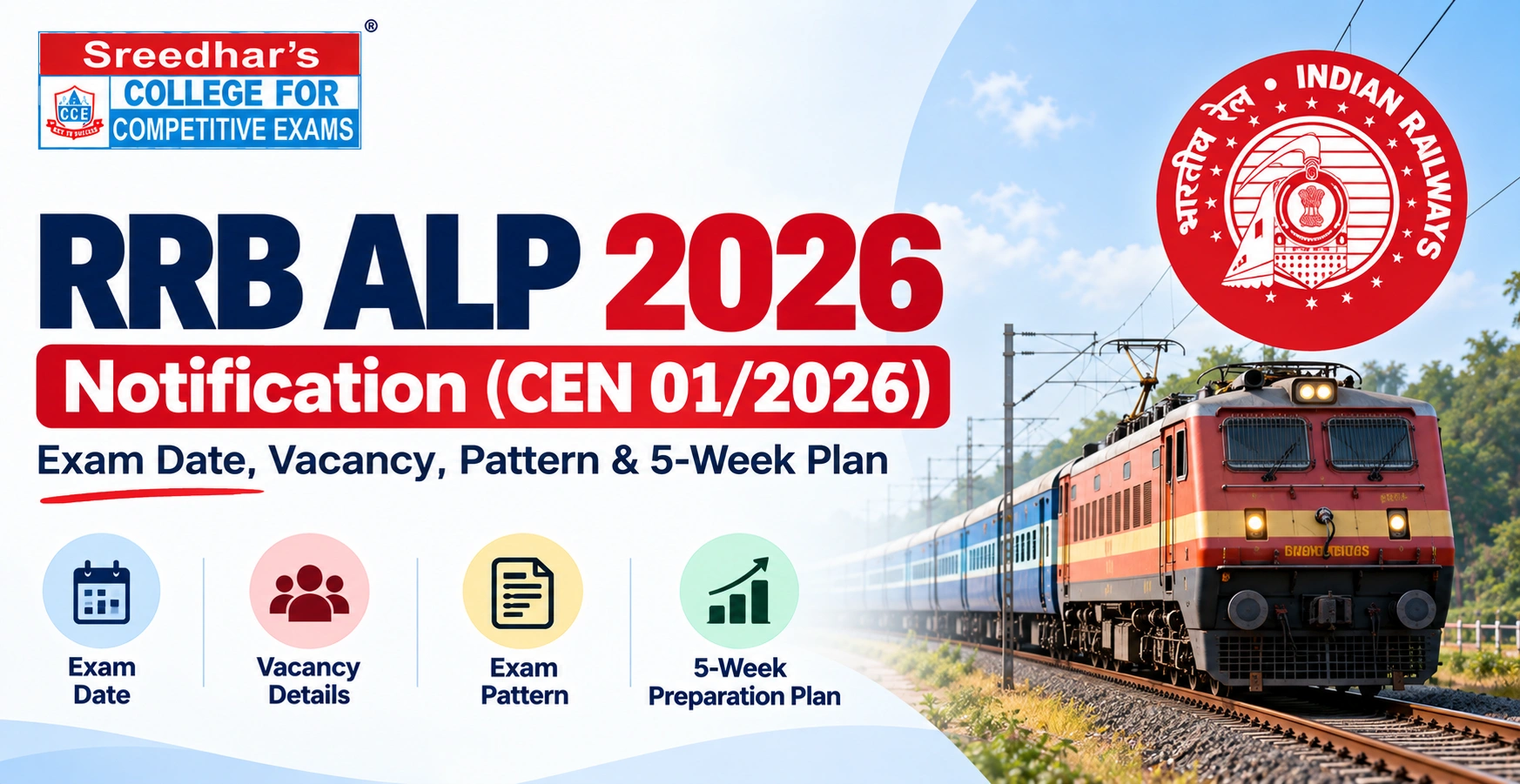
RRB ALP 2026 Notification (CEN 01/2026): Exam Date, Vacancy, Pattern & 5-Week Plan
RRB ALP 2026: Your 5-Week Roadmap to 11,127 Assistant Loco Pilot Vacancies
Short answer: The Railway Recruitment Boards released CEN 01/2026 for 11,127 Assistant Loco Pilot (ALP) vacancies. The application process opened on 15 May 2026 and closed on 14 June 2026. The application fee payment deadline was 16 June 2026. The next major milestone is CBT 1.
According to the examination schedule announced on 21 September 2026, RRB ALP CBT 1 is tentatively scheduled for 3, 4 and 5 November 2026, across multiple shifts. Around 8,40,944 candidates are registered for the examination.
That means the application stage is over. For candidates who successfully submitted their forms, the priority now is preparation for CBT 1.
The city intimation slip is expected approximately 10 days before the candidate's examination date, while the e-call letter or admit card is expected approximately four days before the examination.
There is also an important change in the 2026 recruitment that older RRB ALP preparation material may not reflect.
Under CEN 01/2026, the final merit calculation gives 50% weightage to CBT 2 Part A and 50% to CBAT, replacing the earlier 70:30 structure. Current summaries of the 2026 syllabus also indicate that General Awareness has been removed from the CBT 1 syllabus, leaving Mathematics, Mental Ability and General Science as the core CBT 1 areas.
Candidates should therefore make sure they are studying the 2026 CEN syllabus, rather than blindly following an older ALP preparation plan.
With the exam scheduled for early November, the immediate objective is clear: use the remaining weeks to maximise accuracy and speed in CBT 1 while keeping CBT 2 and the new CBAT weightage in mind.
RRB ALP 2026 – Latest Update
The RRB ALP 2026 recruitment is being conducted under Centralised Employment Notification (CEN) 01/2026.
The detailed notification was published on 14 May 2026, and applications were accepted from 15 May to 14 June 2026. The official RRB Secunderabad employment notice page lists the CEN 01/2026 ALP detailed notification dated 14 May 2026.
The current status is:
| Event | Date/Status |
|---|---|
| Indicative/short notice | March 2026 |
| Detailed notification | 14 May 2026 |
| Application window | 15 May to 14 June 2026 |
| Fee payment deadline | 16 June 2026 |
| Application correction window | 17 to 26 June 2026 |
| Application status | Released in August 2026 |
| CBT 1 schedule notice | 21 September 2026 |
| CBT 1 | 3, 4 and 5 November 2026, tentative |
| Registered candidates | 8,40,944 |
| City intimation slip | Approximately 10 days before examination |
| E-call letter/admit card | Approximately 4 days before examination |
| CBT 2 | To be announced |
| CBAT | To be announced |
| Document Verification | To be announced |
| Medical Examination | To be announced |
| Last updated | 28 September 2026 |
RRB's regional recruitment websites are the primary source for ALP notices. RRB Secunderabad specifically lists CEN 01/2026 among its current Centralised Employment Notices and warns candidates to rely on official RRB websites for recruitment information.
What candidates should do now
Since applications are already closed, candidates should not spend time looking for a new application link.
The immediate checklist should be:
-
Confirm that your application status is accepted.
-
Keep your registration details safe.
-
Check the official RRB website regularly.
-
Watch for the city intimation slip.
-
Download the e-call letter when activated.
-
Continue CBT 1 preparation.
-
Start understanding the CBT 2 syllabus.
-
Do not ignore the revised CBAT weightage.
-
Check your medical eligibility before the later stages.
The last point is particularly important for ALP.
The medical standard is A-1, which has stringent vision and medical requirements. Candidates who have not checked the applicable medical standards should do so before investing months of preparation without understanding the requirements.
RRB ALP 2026 Vacancy
RRB has notified 11,127 Assistant Loco Pilot vacancies under CEN 01/2026.
The vacancies are distributed across different RRBs and railway zones.
The total vacancy figure is:
| Cycle | Notified vacancies |
|---|---|
| CEN 01/2026 | 11,127 |
| CEN 01/2025 | 9,970 |
| CEN 01/2024 | 5,696 initially, subsequently enhanced |
The increase from 9,970 in the 2025 cycle to 11,127 in 2026 represents an increase of 1,157 posts.
However, candidates should avoid treating the vacancy count as a prediction of selection probability.
The recruitment process is conducted RRB-wise and category-wise, and shortlisting depends on the applicable rules, candidate pool and normalized performance.
How many candidates are appearing?
The latest reported figure for CEN 01/2026 is approximately 8,40,944 registered candidates.
With 11,127 vacancies, the simple arithmetic works out to approximately:
8,40,944 ÷ 11,127 ≈ 76 candidates per vacancy
This is only a broad ratio.
It should not be interpreted as an individual probability of selection because:
-
candidates are distributed across RRBs
-
vacancies differ by RRB
-
reservation categories apply
-
CBT 1 is only a screening stage
-
normalization is used for multi-shift examinations
-
not every candidate performs at the same level
-
candidates must satisfy subsequent eligibility, trade, aptitude and medical requirements
The ratio is nevertheless useful for understanding why accuracy matters.
Zone-wise vacancies
The detailed CEN contains RRB-wise and category-wise vacancy information.
Candidates should check the RRB under which their application was submitted and review the relevant vacancy table.
For candidates from Telangana and Andhra Pradesh, the RRB Secunderabad recruitment information is particularly relevant.
The CEN 01/2026 vacancy table lists 874 vacancies under Secunderabad in the published RRB-wise distribution.
Candidates should still rely on the original CEN and their submitted application details when checking their specific RRB and category.
Can vacancies increase later?
The history of ALP recruitment shows that vacancy numbers can change through corrigenda.
The previous ALP recruitment cycle provides a useful example. RRB Secunderabad published a corrigendum in May 2026 concerning enhancement of vacancies under CEN 01/2025.
This means candidates should use 11,127 as the currently notified 2026 figure, while understanding that RRB can issue official corrigenda if administrative requirements change.
Any revision, however, should be treated as official only after RRB publishes it.
RRB ALP 2026 Eligibility (as notified)
Eligibility for RRB ALP 2026 is based on educational qualification, age and medical standards.
Candidates who applied under CEN 01/2026 should refer to the detailed notification for the exact conditions applicable to their qualification and category.
The broad eligibility framework includes:
-
Matriculation/SSLC plus the prescribed ITI qualification or Course Completed Act Apprenticeship
-
or the prescribed engineering diploma/degree route
-
age generally between 18 and 30 years under the notified cut-off
-
applicable category-based age relaxation
-
prescribed medical standard
Educational Qualification
Candidates can qualify through the prescribed technical education routes.
The major routes include:
Route 1: Matriculation/SSLC + ITI
Candidates can apply with Class 10/Matriculation or SSLC along with ITI in one of the trades specified by RRB.
Relevant trades include prescribed technical trades such as:
-
Electrician
-
Fitter
-
Electronics Mechanic
-
Wireman
-
Mechanic Motor Vehicle
-
Mechanic Diesel
-
Turner
-
Machinist
-
Refrigeration and Air-Conditioning Mechanic
-
other trades specified in the CEN
The exact trade mapping should be checked against the qualification and trade table in the official notification.
Route 2: Course Completed Act Apprenticeship
Candidates holding the required Matriculation/SSLC qualification along with a completed Course Completed Act Apprenticeship in an eligible trade can also qualify under the notified conditions.
Route 3: Diploma or Degree
Candidates with the prescribed three-year diploma or degree in:
-
Mechanical Engineering
-
Electrical Engineering
-
Electronics Engineering
-
Automobile Engineering
can qualify under the engineering route specified in the CEN.
This route is particularly relevant to engineering graduates and diploma holders who may not possess an ITI certificate.
Age Limit
The general age range for CEN 01/2026 is:
Minimum age: 18 years
Maximum age: 30 years
The applicable cut-off date is specified in the recruitment notification.
Candidates should calculate their age using the date prescribed by RRB rather than today's date.
Age Relaxation
Applicable relaxation is provided for eligible reserved and special categories according to the recruitment rules.
Depending on the candidate category, this can include relaxation for:
-
OBC-NCL
-
SC
-
ST
-
PwBD
-
Ex-Servicemen
-
candidates with other eligible status under the applicable rules
Candidates should check the exact conditions because age relaxation is not automatically available merely because a candidate belongs to a broad category.
Valid certificates and the prescribed format may be required.
Medical Standard
The ALP post carries a stringent A-1 medical standard.
This deserves special attention.
Candidates often concentrate entirely on the written examination and think about medical requirements only after clearing CBT 2 and CBAT.
That can be risky.
ALP is a safety-sensitive railway position, and the medical requirements reflect the responsibilities associated with locomotive operations.
Vision standards are particularly important.
Candidates should carefully check:
-
distance vision requirements
-
near vision requirements
-
colour vision
-
binocular vision
-
field of vision
-
night vision
-
other applicable medical standards
Candidates should also understand the rules concerning spectacles, refractive correction and previous eye procedures.
The exact medical provisions in the CEN should be treated as authoritative.
If you have any concern about your eyesight or medical eligibility, obtain appropriate professional medical advice early rather than assuming that you will automatically qualify.
This is one area where preparation time cannot compensate for failure to meet a mandatory medical standard.
RRB ALP 2026 Exam Pattern
The RRB ALP selection process consists of multiple stages:
-
CBT 1
-
CBT 2
-
Computer-Based Aptitude Test
-
Document Verification
-
Medical Examination
The important point is that CBT 1 is only a screening examination.
Its marks are not included in the final merit calculation.
The real merit-deciding stages begin with CBT 2 Part A and, for ALP candidates, the CBAT.
CBT 1 (screening)
The first-stage CBT is an objective computer-based examination.
The broad structure is:
| Detail | Value |
|---|---|
| Questions | 75 |
| Maximum marks | 75 |
| Duration | 60 minutes |
| Negative marking | 1/3 mark for each wrong answer |
| Nature | Screening |
| Minimum qualifying percentage | UR/EWS: 40%; OBC-NCL: 30%; SC: 30%; ST: 25% |
RRB's published ALP framework confirms that CBT 1 is a screening examination, with 75 questions in 60 minutes and one-third negative marking.
Important 2026 syllabus change
Candidates using older ALP study material need to be careful.
Current 2026 syllabus summaries indicate that General Awareness has been removed from CBT 1, leaving:
-
Mathematics
-
Mental Ability
-
General Science
as the principal CBT 1 areas.
This changes the preparation priority.
If you have been studying current affairs specifically for CBT 1 because of the older pattern, you can redirect that time toward Mathematics, Reasoning and General Science.
Current affairs and General Awareness remain relevant to broader competitive-exam preparation and the later CBT 2 structure, but candidates should follow the exact CEN 01/2026 syllabus for CBT 1.
Mathematics
Important areas include:
-
number system
-
BODMAS
-
decimals
-
fractions
-
LCM and HCF
-
ratio and proportion
-
percentages
-
averages
-
profit and loss
-
simple and compound interest
-
time and work
-
pipes and cisterns
-
time, speed and distance
-
mensuration
-
algebra
-
geometry
-
trigonometry
-
statistics
-
age problems
-
calendar and clock
-
elementary data interpretation
The goal at this stage is speed plus accuracy.
You do not need to solve every question.
You need to identify questions that can be solved efficiently within the time available.
Mental Ability
Mental Ability or reasoning preparation should include:
-
analogies
-
coding-decoding
-
series
-
syllogism
-
classification
-
Venn diagrams
-
directions
-
relationships
-
analytical reasoning
-
statement and conclusion
-
decision making
-
data interpretation
-
basic puzzles
Because CBT 1 contains only 75 questions in 60 minutes, candidates should practise solving standard question types quickly.
General Science
General Science is based broadly around school-level science.
Focus on:
Physics
-
motion
-
force
-
work and energy
-
heat
-
electricity
-
magnetism
-
light
-
sound
-
measurements
Chemistry
-
atoms and molecules
-
elements
-
compounds
-
acids and bases
-
metals and non-metals
-
chemical reactions
-
periodic classification
-
everyday chemistry
Biology
-
human body
-
nutrition
-
diseases
-
cells
-
plants
-
reproduction
-
ecology
-
basic genetics
NCERT-level understanding is useful for this section.
CBT 2
Candidates who clear the applicable CBT 1 shortlisting criteria move to the second-stage CBT.
CBT 2 has two parts.
| Part | Questions | Duration | Role |
|---|---|---|---|
| Part A | 100 | 90 minutes | Merit |
| Part B | 75 | 60 minutes | Qualifying |
| Total | 175 | 150 minutes | — |
Part A
Part A contains:
-
Mathematics
-
General Intelligence & Reasoning
-
Basic Science & Engineering
The section contains 100 questions and carries 100 marks.
This is a merit-deciding component.
Basic Science & Engineering
This is where candidates with technical qualifications need to be comfortable with applied concepts.
Topics can include:
-
units and measurements
-
engineering mechanics
-
basic electricity
-
basic electronics
-
simple machines
-
levers
-
work and energy
-
heat
-
materials
-
engineering drawing
-
IT literacy
-
basic electrical systems
-
workshop-related fundamentals
Candidates should prepare according to the exact syllabus linked to their CEN rather than relying only on a generic engineering syllabus.
Part B
Part B contains 75 trade-related questions.
It is a qualifying section.
Candidates must score at least 35%, regardless of category, under the applicable ALP recruitment framework.
The trade syllabus depends on the qualification used for eligibility.
For example:
| Qualification area | Relevant trade examples |
|---|---|
| Electrical | Electrician, Wireman, Instrument Mechanic, related specified trades |
| Electronics | Electronics Mechanic, Mechanic Radio & TV |
| Mechanical | Fitter, Turner, Machinist, Mechanic Diesel, Mechanic Motor Vehicle, related trades |
| Automobile | Mechanic Motor Vehicle, Tractor Mechanic, Mechanic Diesel, Heat Engine, related trades |
Candidates should select and prepare the trade permitted under their qualification as specified in the notification.
Why Part B should not be ignored
Some candidates make the mistake of focusing almost entirely on Part A because Part B is qualifying.
That is risky.
A candidate who performs exceptionally well in Part A but fails to secure the minimum qualifying marks in Part B cannot proceed as required.
The correct strategy is:
Clear Part B comfortably while maximising Part A marks.
Do not aim merely for 35%.
CBAT (Computer-Based Aptitude Test)
CBAT is one of the most important stages of ALP selection.
It is designed to assess aptitude relevant to the responsibilities associated with train operation.
The test is not simply another academic examination.
It assesses cognitive and perceptual abilities such as:
-
concentration
-
memory
-
perception
-
reaction
-
following instructions
-
spatial understanding
-
speed and accuracy
Minimum T-score
Candidates must obtain a minimum T-score of 42 in each test battery.
There is no category-based relaxation in this requirement.
This means candidates should not assume that a high CBT 2 score can compensate for failing one CBAT battery.
Each required battery must meet the prescribed standard.
Major 2026 change: CBAT now carries 50% weightage
This is the most important change candidates need to understand.
Earlier ALP recruitment used a 70% CBT 2 Part A + 30% CBAT final merit structure.
For CEN 01/2026, the final merit calculation has changed to:
50% CBT 2 Part A + 50% CBAT
Current 2026 recruitment summaries and reports identify this as a major change to the ALP selection process.
This has a direct preparation implication.
CBAT is no longer something candidates should treat as a small final hurdle after written examinations.
It now has equal weight with CBT 2 Part A in the final merit calculation.
Therefore, candidates who clear CBT 1 should begin CBAT preparation early.
RRB ALP 2026 Selection Process
The complete selection process can be understood as five stages.
Stage 1: CBT 1
CBT 1 is the screening examination.
Its marks are used to shortlist candidates for CBT 2.
CBT 1 marks do not form part of final merit.
Stage 2: CBT 2
CBT 2 consists of:
Part A: Merit-deciding
Part B: Qualifying trade examination
Candidates need to qualify Part B while performing strongly in Part A.
Stage 3: CBAT
Candidates shortlisted for ALP-specific aptitude testing appear for CBAT.
Each required test battery has to meet the minimum T-score.
For CEN 01/2026, CBAT contributes 50% of final merit.
Stage 4: Document Verification
Candidates shortlisted according to the final merit and vacancy requirements proceed to Document Verification.
They need to produce original documents supporting:
-
educational qualification
-
age
-
category
-
identity
-
other applicable eligibility requirements
Candidates should keep their certificates organised well before this stage.
Stage 5: Medical Examination
The ALP post requires the applicable A-1 medical standard.
Candidates must satisfy the prescribed medical requirements before appointment.
This is why medical eligibility should be checked before or during preparation rather than only after final written selection.
RRB ALP 2026 Salary
The Assistant Loco Pilot post is placed at Pay Level 2 under the 7th Central Pay Commission.
The initial basic pay is:
₹19,900 per month
This is the basic pay and not the complete monthly compensation.
An ALP can receive additional allowances depending on applicable railway rules and duties.
These can include:
-
Dearness Allowance
-
House Rent Allowance
-
Transport-related allowances
-
Running Allowance
-
Night Duty Allowance, where applicable
-
other admissible railway allowances
Running Allowance
One distinctive component of ALP compensation is the running-related allowance associated with locomotive duties.
The amount depends on the applicable railway rules, kilometres and duty conditions.
Therefore, candidates should not assume that every ALP receives exactly the same monthly salary.
Posting, duty pattern and allowances can influence gross and take-home compensation.
Career progression
ALP is not necessarily the endpoint of the operating career.
Depending on the applicable service rules, experience, vacancies and promotion requirements, an employee can progress through roles such as:
Assistant Loco Pilot → Senior ALP → Loco Pilot/Goods → Loco Pilot/Passenger → higher operating responsibilities
The exact progression and timelines depend on railway rules, departmental requirements and vacancies.
Candidates should therefore evaluate the post as a long-term railway career rather than focusing only on the starting basic salary.
RRB ALP 2026: 5-Week Plan to CBT 1
With CBT 1 scheduled for 3 to 5 November 2026, the remaining preparation period should be highly focused.
The goal is not to finish every book available.
The goal is to maximise marks in the subjects that actually appear in the 2026 CBT 1 syllabus.
Week 1: Mathematics Core
Focus on:
-
percentages
-
ratio and proportion
-
averages
-
profit and loss
-
time and work
-
time, speed and distance
-
simple and compound interest
-
mensuration
-
number system
Target approximately 40 quality questions per day.
But do not simply solve questions.
After every practice session, record:
-
questions answered incorrectly
-
formulas forgotten
-
calculation mistakes
-
questions taking too long
Create a compact error log.
Week 2: Reasoning and Mental Ability
Focus on:
-
series
-
coding-decoding
-
analogy
-
classification
-
syllogism
-
directions
-
relationships
-
statement-based reasoning
-
analytical reasoning
-
basic puzzles
Begin full mocks during this week.
A full mock every two days can help you identify whether your speed is sufficient for the 60-minute examination.
Week 3: General Science
Revise Class 10-level:
Physics
-
electricity
-
light
-
sound
-
motion
-
force
-
work and energy
Chemistry
-
chemical reactions
-
acids and bases
-
metals and non-metals
-
atoms
-
elements and compounds
Biology
-
human systems
-
cells
-
diseases
-
nutrition
-
reproduction
-
environment
Use concise revision notes rather than attempting to read multiple textbooks from the beginning.
Week 4: Full Mocks and Error Correction
By Week 4, your objective should shift from learning large numbers of new concepts to improving exam performance.
Take a full CBT 1 mock every day.
After each mock:
-
Calculate your accuracy.
-
Identify questions lost due to carelessness.
-
Identify questions lost because of weak concepts.
-
Identify questions that consumed too much time.
-
Revise those topics.
-
Retest them.
The error log becomes more important than adding new books.
Week 5: Revision
The final week should be about consolidation.
Do not attempt to learn an entirely new syllabus.
A practical schedule could be:
Morning: Mathematics revision
Afternoon: Reasoning practice
Evening: General Science revision
Night: Error-log review
You can take one or two mocks a day depending on stamina, but avoid exhausting yourself.
The goal is to arrive at the examination with:
-
stable accuracy
-
reliable time management
-
familiarity with the interface
-
confidence in standard question types
Attempt strategy
CBT 1 has 1/3 negative marking.
Therefore, random guessing can reduce your score.
Instead, divide questions into three groups:
Group 1: Immediate attempts
These are questions where you know the method and can solve quickly.
Group 2: Solvable but time-consuming
Return to these after completing the easier questions.
Group 3: Uncertain or excessively lengthy
Skip unless you can eliminate options confidently.
There is no benefit in spending two or three minutes on a single difficult question while several easier questions remain unanswered.
Should you attempt 60 to 65 questions?
A target of 60 to 65 attempts can be a useful practice benchmark, but it should not become a rigid rule.
Your ideal number of attempts depends on accuracy.
For example:
If you attempt 65 questions with 58 correct and 7 incorrect:
Score = 58 − 7/3 = 55.67
But if you attempt 70 with only 55 correct and 15 incorrect:
Score = 55 − 15/3 = 50
This demonstrates why the goal should be high-quality attempts, not simply a high attempt count.
The actual cut-off will depend on the examination, RRB, category, normalization and candidate performance.
What to Do After CBT 1
Do not wait for the CBT 1 result before starting CBT 2 preparation.
This is particularly important because CBT 2 contains technical and trade-related material.
Immediately after CBT 1, shift your study balance.
A possible structure is:
40%: CBT 2 Part A
40%: Trade theory for Part B
20%: CBAT familiarisation and practice
As CBT 2 approaches, increase the emphasis on trade theory.
Trade preparation
Your trade preparation should be based on your eligible trade.
For an electrician, for example, focus on:
-
electrical fundamentals
-
wiring
-
machines
-
measurements
-
circuits
-
safety
-
electrical tools
For mechanical trades:
-
workshop practice
-
machines
-
fitting
-
engines
-
tools
-
measurements
-
mechanical systems
The exact syllabus must follow the CEN and the trade selected.
CBAT preparation
Do not leave CBAT until after CBT 2.
The 2026 50:50 final merit structure makes CBAT strategically important.
Begin with understanding the format and types of aptitude tasks.
Practise:
-
concentration
-
reaction speed
-
memory
-
spatial perception
-
following instructions
-
visual discrimination
The objective is not memorising answers.
It is becoming comfortable with the test environment and performing consistently under time pressure.
RRB ALP 2026 Preparation Strategy for Working Candidates
Many ALP candidates are already employed or completing technical education.
A working candidate does not necessarily need to study for eight hours a day.
A consistent two to three-hour schedule can be productive.
Weekday schedule
45 minutes: Mathematics
45 minutes: Reasoning
30 minutes: General Science
30 minutes: Mock/error analysis
This can be adjusted according to your strengths.
If Mathematics is weak, allocate additional time there.
If Reasoning is already strong, move some of that time to Science.
Weekend schedule
Use weekends for:
-
full-length mock
-
detailed analysis
-
revision
-
General Science
-
formula revision
-
previous-year questions
One high-quality mock followed by two hours of analysis can be more valuable than taking several mocks without reviewing mistakes.
Common Mistakes to Avoid
Studying old syllabus blindly
This is particularly important in 2026 because the CBT 1 syllabus has changed.
Always use CEN 01/2026 as your primary syllabus reference.
Ignoring medical eligibility
A candidate may spend months preparing and then discover a medical issue at a later stage.
Check the A-1 requirements early.
Preparing only for CBT 1
CBT 1 is only a screening stage.
Start thinking about CBT 2 from the beginning.
Ignoring trade theory
Part B is qualifying, but failing it can stop your progression.
Treating CBAT as a formality
The 2026 final merit structure gives CBAT 50% weightage.
That makes it a major part of the selection process.
Chasing attempts instead of accuracy
Negative marking makes reckless attempts risky.
Ignoring mock analysis
Your score alone does not tell you why you are losing marks.
Analyse every mistake.
RRB ALP 2026 FAQs
When is RRB ALP CBT 1 2026?
RRB has announced CBT 1 for 3, 4 and 5 November 2026, on a tentative basis, under CEN 01/2026. Around 8,40,944 candidates are registered for the stage.
Candidates should continue checking their regional RRB website for the final examination communication.
How many vacancies are in RRB ALP 2026?
RRB has notified 11,127 Assistant Loco Pilot vacancies under CEN 01/2026.
The vacancies are distributed across the participating RRBs and railway zones.
When will the RRB ALP city intimation slip come?
The city intimation slip is expected approximately 10 days before the candidate's examination date.
For example, candidates scheduled on 3 November are expected to receive city information around 25 October, subject to the official release schedule.
The city slip generally provides information such as the examination city and related scheduling details.
It is not the same as the admit card.
When will the RRB ALP admit card come?
The e-call letter or admit card is expected approximately four days before the candidate's examination date.
The admit card contains the more detailed examination information required to appear at the centre.
Candidates should download it as soon as the regional RRB activates the link.
Can I still apply for RRB ALP 2026?
No.
The CEN 01/2026 application window closed on 14 June 2026 at 23:59 hours.
The application fee payment deadline was 16 June 2026.
Candidates who did not submit an application during the notified period cannot submit a fresh application for this recruitment unless RRB officially announces an additional application opportunity.
What is the RRB ALP negative marking?
For CBT 1, one-third of the mark is deducted for every incorrect answer.
The applicable negative-marking rule also applies to objective questions in CBT 2 under the recruitment framework.
Therefore, candidates should avoid blind guessing.
What is the RRB ALP salary?
The Assistant Loco Pilot post carries Pay Level 2 under the 7th CPC, with an initial basic pay of ₹19,900 per month.
Additional admissible allowances can increase total compensation.
Running-related allowances can be particularly relevant for ALP because the job involves locomotive operating duties.
Actual gross and take-home compensation varies based on posting, allowances, deductions and duty conditions.
What is the RRB ALP medical standard?
The prescribed medical standard for ALP is A-1.
This is a stringent standard because the position involves safety-sensitive operational responsibilities.
Candidates should review the exact medical requirements in CEN 01/2026, particularly vision-related provisions.
What is the RRB ALP CBT 1 syllabus in 2026?
The 2026 syllabus differs from older ALP patterns.
Current CEN 01/2026 summaries indicate that CBT 1 focuses on:
-
Mathematics
-
Mental Ability
-
General Science
General Awareness has been removed from the CBT 1 syllabus under the revised 2026 pattern.
Candidates should therefore avoid relying on old ALP books that place General Awareness as a CBT 1 section.
What is the RRB ALP CBT 2 pattern?
CBT 2 consists of:
Part A: 100 questions, 100 marks, 90 minutes
Part B: 75 questions, 75 marks, 60 minutes
Part A is merit-deciding.
Part B is qualifying and requires a minimum of 35%.
What is the new RRB ALP CBAT weightage in 2026?
Under CEN 01/2026, the final merit calculation uses:
50% CBT 2 Part A + 50% CBAT
This replaces the earlier 70% CBT 2 Part A and 30% CBAT structure.
What is the minimum CBAT score required?
Candidates must obtain a minimum T-score of 42 in each test battery.
There is no category-based relaxation for this minimum CBAT requirement.
Does CBT 1 count in final merit?
No.
CBT 1 is a screening examination used to shortlist candidates for CBT 2.
The marks obtained in CBT 1 are not added to the final merit score.
How many candidates are registered for RRB ALP 2026?
The reported registration figure for CEN 01/2026 is 8,40,944 candidates.
They are scheduled across the three CBT 1 examination dates and multiple shifts.
Is General Awareness required for RRB ALP CBT 1?
Under the revised CEN 01/2026 CBT 1 syllabus, General Awareness has been removed from CBT 1.
Candidates should therefore prioritise Mathematics, Mental Ability and General Science for the immediate CBT 1 examination.
Should I start CBAT preparation before CBT 2?
Yes.
You do not need to spend most of your current study time on CBAT while CBT 1 is still pending, but you should understand the test and begin familiarisation.
This becomes particularly important after CBT 1 because the 2026 recruitment gives CBAT 50% weightage in final merit.
Final Word
The RRB ALP 2026 recruitment has moved well beyond the application stage.
Under CEN 01/2026, RRB has notified 11,127 Assistant Loco Pilot vacancies, applications have closed, and the first-stage examination is tentatively scheduled for 3, 4 and 5 November 2026.
The immediate focus for registered candidates should therefore be CBT 1.
However, candidates should prepare according to the 2026 pattern, not simply recycle previous-year ALP preparation material.
Two changes are particularly important.
First, the CBT 1 syllabus has been revised, with current 2026 summaries indicating that General Awareness has been removed, leaving Mathematics, Mental Ability and General Science as the main CBT 1 areas.
Second, the final merit calculation has changed.
For CEN 01/2026, CBT 2 Part A and CBAT each carry 50% weightage.
That makes CBAT significantly more important than it was under the earlier 70:30 structure.
For the next five weeks, candidates should keep the strategy simple.
Build speed in Mathematics.
Improve accuracy in Mental Ability.
Revise Class 10-level General Science thoroughly.
Take regular CBT 1 mocks.
Maintain an error log.
Do not waste time on topics removed from the 2026 CBT 1 syllabus.
And most importantly, do not stop preparing after CBT 1.
The recruitment continues through CBT 2, CBAT, Document Verification and the A-1 Medical Examination.
Candidates who clear CBT 1 should immediately shift towards Part A, trade-specific Part B and CBAT preparation.
The official RRB websites should remain the final source for examination dates, city intimation slips, e-call letters, corrigenda and subsequent recruitment notices. RRB Secunderabad specifically advises candidates to rely on official RRB websites and be cautious about unofficial recruitment information.
For candidates preparing with Sreedhar's CCE, the most useful approach now is to treat the remaining weeks as a focused CBT 1 sprint, followed by a rapid transition to CBT 2 trade preparation and CBAT practice after the first-stage examination.
With the examination approaching, the objective is no longer to cover everything.
It is to revise the right syllabus, solve accurately, manage the 60-minute paper intelligently and arrive at the examination with a tested strategy.
Leave a Comment
Required fields are marked *