



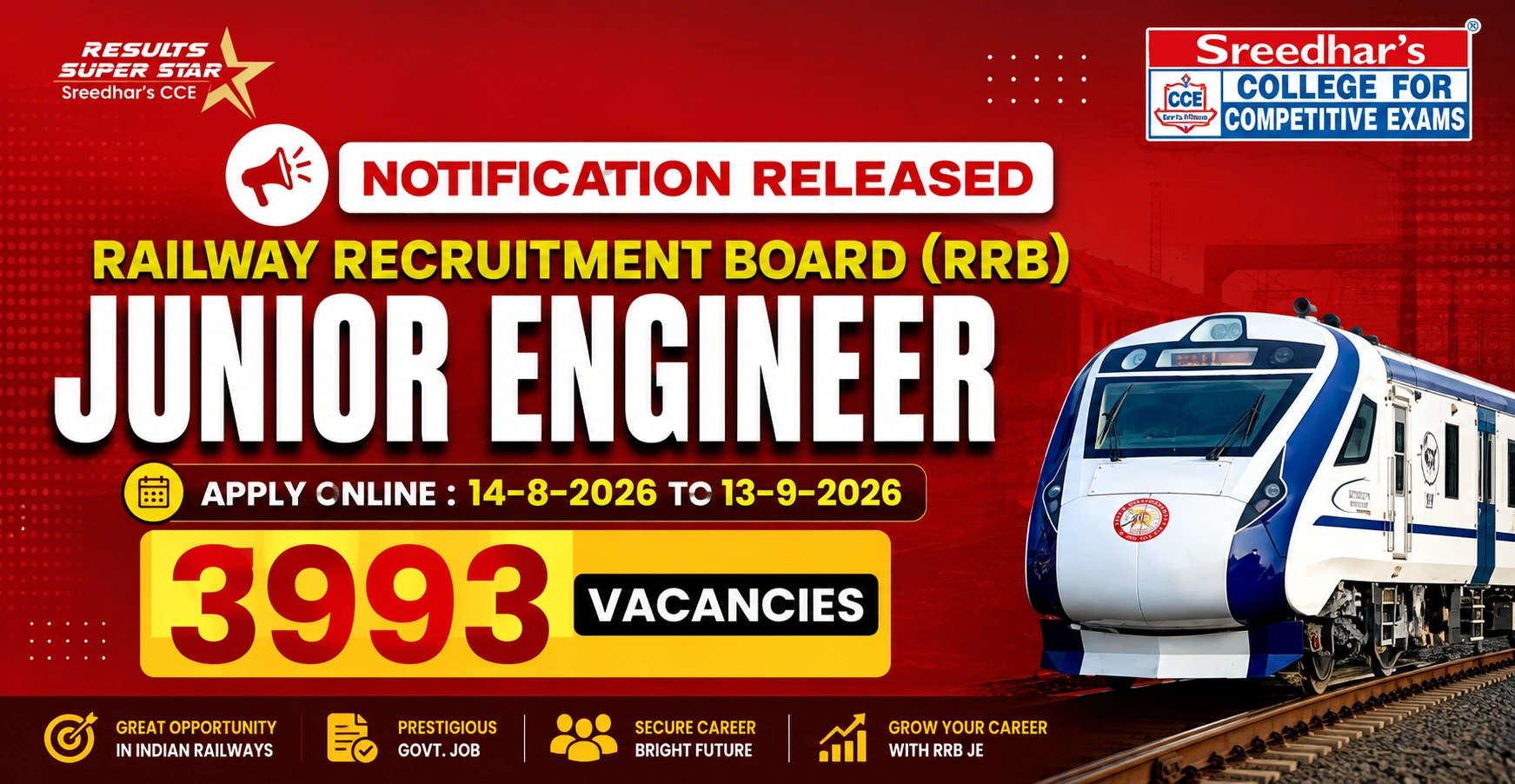
RRB JE Recruitment 2026 (CEN 04/2026)
3993 Vacancies, Apply Online, Exam Dates, Eligibility & Syllabus
Quick Answer: The Railway Recruitment Boards (RRB) have released the RRB JE Notification 2026 (CEN No. 04/2026) for 3,993 vacancies of Junior Engineer (JE) and Depot Material Superintendent (DMS) across 21 RRBs and 37 post categories. Online applications are open from 14 August 2026 to 13 September 2026. Selection involves two CBT stages, Document Verification, and a Medical Examination, with an initial pay of ₹35,400 (Level 6, 7th CPC).
The Railway Recruitment Boards (RRBs), under the Ministry of Railways, Government of India, have officially opened the application window for one of the year's biggest technical recruitment drives — RRB JE Recruitment 2026. Released under Centralised Employment Notice (CEN) No. 04/2026, this notification brings 3,993 vacancies for Junior Engineer and Depot Material Superintendent posts across Electrical, Mechanical, Civil, Electronics, Signal & Telecommunication, and Stores departments of Indian Railways.
For diploma and engineering degree holders looking for a stable, well-paying central government job, this is one of the most significant opportunities of 2026. In this article, we cover everything you need to know — important dates, RRB-wise vacancy distribution, eligibility criteria, application fee, exam pattern, syllabus, salary structure, and a practical preparation roadmap. If you're serious about clearing this exam, structured guidance like the RRB JE preparation support at Sreedhar's CCE can help you convert this notification into an offer letter.
RRB JE 2026 Highlights
Here's a quick snapshot of the notification before we get into the details.
Quick Overview
| Particular | Details |
|---|---|
| Recruiting Body | Railway Recruitment Boards (RRBs), Ministry of Railways |
| Advertisement No. | CEN No. 04/2026 (JE/DMS) |
| Posts | Junior Engineer (36 categories) & Depot Material Superintendent (1 category) |
| Total Vacancies | 3,993 |
| Number of RRBs | 21 |
| Application Mode | Online only |
| Application Start Date | 14 August 2026 |
| Application Last Date | 13 September 2026 (23:59 hrs) |
| Selection Process | 1st Stage CBT → 2nd Stage CBT → Document Verification → Medical Examination |
| Pay Level | Level 6, 7th CPC (Initial Pay ₹35,400) |
| Age Limit | 18–33 years (as on 01.01.2027) |
| Official Website | rrb.indianrailways.gov.in / rrbapply.gov.in |
RRB JE recruitment doesn't happen every year — the last major cycle was conducted in 2019 for over 13,000 posts. That makes this 2026 notification an especially important opportunity for engineering diploma and degree holders who've been waiting for a fresh drive. Aspirants preparing at Sreedhar's CCE are already being guided through structured batches built specifically around this notification's exam pattern and timeline.
RRB JE 2026 Important Dates
Since this is a time-bound application process, keeping track of every date is critical. Missing the closing date or the fee-payment deadline means losing the opportunity entirely, as RRB does not accept offline or late applications.
| Event | Date |
|---|---|
| Indicative Notice in Employment News | 25 July 2026 |
| Detailed Notification (CEN 04/2026) Released | 13 August 2026 |
| Online Application Start Date | 14 August 2026 |
| Online Application Closing Date | 13 September 2026, 23:59 hrs |
| Last Date for Fee Payment | 15 September 2026 |
| Application Modification Window | 16 September 2026 – 25 September 2026 |
| Scribe Details Submission Window | 26 September 2026 – 30 September 2026 |
| 1st Stage CBT | To be announced |
| 2nd Stage CBT | To be announced |
| Document Verification & Medical Examination | To be announced |
Note: All dates related to the CBT exams, admit card release, and results will be announced separately on the respective RRB regional websites closer to the exam. Candidates should regularly check their chosen RRB's official portal and avoid relying solely on third-party sources for exam-date updates.
RRB JE 2026 Vacancy Details
The 3,993 vacancies are distributed across 21 Railway Recruitment Boards covering every major railway zone in the country. Below is the RRB-wise breakup of total vacancies as per the official CEN.
| RRB | Total Vacancies |
|---|---|
| Ahmedabad | 143 |
| Ajmer | 252 |
| Bengaluru | 298 |
| Bhopal | 113 |
| Bhubaneswar | 86 |
| Bilaspur | 124 |
| Chandigarh | 183 |
| Chennai | 362 |
| Gorakhpur | 198 |
| Guwahati | 329 |
| Jammu-Srinagar | 152 |
| Kolkata | 457 |
| Malda | 30 |
| Mumbai | 411 |
| Muzaffarpur | 17 |
| Patna | 73 |
| Prayagraj | 340 |
| Ranchi | 122 |
| Secunderabad | 110 |
| Siliguri | 92 |
| Thiruvananthapuram | 101 |
| Total | 3,993 |
Vacancies are further split community-wise (UR, SC, ST, OBC-NCL, EWS) and post-category-wise (36 Junior Engineer categories plus Depot Material Superintendent) in Annexures A and B of the official notification. As per the overall distribution, roughly 1,699 posts are Unreserved, 913 are OBC-NCL, 624 are SC, 394 are EWS, and 363 are ST. Candidates are strongly advised to download the detailed CEN PDF and check the exact vacancy count for their chosen RRB, post category, and community before applying, since these figures directly affect cut-offs and competition levels.
Important: All vacancy numbers are provisional. The notification explicitly states that RRBs reserve the right to increase, decrease, or nullify vacancies in any category based on actual requirements from Railway Administration.
RRB JE 2026 Eligibility Criteria
Before applying, make sure you meet both the educational and age eligibility requirements for your chosen post and RRB.
Educational Qualification
| Post | Qualification |
|---|---|
| Junior Engineer (all 36 categories) | Three-year Diploma in Engineering (or combination of sub-streams) in the discipline mapped to the Exam Group — Mechanical, Electrical, Civil, or Electronics & Allied Engineering — from a recognised university/institute. A higher qualification such as B.E./B.Tech in the same discipline is also accepted. |
| Depot Material Superintendent (DMS) | Three-year Diploma in Engineering in any discipline from a recognised university/institution (or an equivalent higher qualification such as B.E./B.Tech). |
Discipline / Exam Group Mapping
Your diploma or degree stream determines which Exam Group you're eligible to apply under. This matters because the 2nd Stage CBT's technical section is Exam Group-specific.
| Exam Group | Eligible Diploma/Degree Streams |
|---|---|
| Mechanical & Allied Engineering | Mechanical, Production, Automobile, Manufacturing, Mechatronics, Industrial, Machining, Tools & Die Making Engineering (or combination of sub-streams) |
| Electrical & Allied Engineering | Electrical Engineering (or combination of sub-streams) |
| Electronics & Allied Engineering | Electronics, Instrumentation & Control, Communication, Computer Science & Engineering, Computer Engineering, Computer Science, Information Technology (or combination) |
| Civil & Allied Engineering | Civil Engineering, B.Sc. in Civil Engineering (3 years), or combination of sub-streams |
If your qualification maps to more than one Exam Group, you can choose only one Exam Group for the entire application and must restrict your post preferences to that group. Candidates applying for DMS whose diploma discipline doesn't fit neatly into the above chart must still select one Exam Group during registration.
Citizenship
Applicants must be citizens of India, citizens of Nepal, subjects of Bhutan, or persons of Indian origin who migrated from Pakistan, Burma, Sri Lanka, or specified East African/other countries with the intention of permanently settling in India, subject to the necessary eligibility certificate where applicable.
Age Limit
| Category | Details |
|---|---|
| General Age Limit | 18 to 33 years |
| Age Reckoning Date | 01 January 2027 |
| DOB Not Born After (Lower Limit) | 01.01.2009 (all communities) |
| DOB Not Earlier Than – UR/EWS | 02.01.1994 |
| DOB Not Earlier Than – OBC-NCL | 02.01.1991 |
| DOB Not Earlier Than – SC/ST | 02.01.1989 |
Age Relaxation
| Category | Relaxation |
|---|---|
| SC & ST | 5 years |
| OBC (Non-Creamy Layer) | 3 years |
| Ex-Servicemen (UR & EWS) | 3 years (after deducting length of service from actual age) |
| Ex-Servicemen (OBC-NCL) | 6 years (after deduction of service) |
| Ex-Servicemen (SC & ST) | 8 years (after deduction of service) |
| PwBD – UR & EWS | 10 years |
| PwBD – OBC-NCL | 13 years |
| PwBD – SC & ST | 15 years |
Additional relaxations apply to serving Group C/erstwhile Group D Railway staff, Quasi-Administrative office employees, and widowed/divorced/judicially separated women candidates, as detailed in the official CEN. These relaxations are not cumulative — a candidate eligible under more than one ground receives only the single highest applicable relaxation.
RRB JE 2026 Application Fee
| Category | Fee | Refund |
|---|---|---|
| UR/OBC-NCL/EWS | ₹500 | ₹400 refunded after appearing in the 1st Stage CBT |
| SC/ST/PwBD/Ex-Servicemen/Female/Transgender/Minority/EBC | ₹250 | Fully refunded after appearing in the 1st Stage CBT |
The fee must be paid online through net banking, debit/credit card, or UPI. No offline payment mode is accepted. Since a significant portion of the fee is refundable, candidates are encouraged to appear for the CBT even if they feel underprepared, purely to claim the refund and gain valuable exam experience for future attempts.
RRB JE 2026 Selection Process
Selection for Junior Engineer and DMS posts happens across four stages, and candidates must clear each stage to move to the next.
- 1st Stage Computer-Based Test (CBT) – A common, screening-level exam for all Exam Groups.
- 2nd Stage Computer-Based Test (CBT) – A discipline-specific exam based on the candidate's chosen Exam Group.
- Document Verification (DV) – Conducted based on merit in the 2nd Stage CBT and the candidate's post/RRB preferences; the number of candidates called for DV equals the number of vacancies (plus a small buffer).
- Medical Examination (ME) – A post-specific medical fitness test (Medical Standards A-3, B-1, B-2, or C-1 depending on the post).
There is no interview round in the RRB JE selection process — final selection is purely merit-based on the 2nd Stage CBT score, subject to clearing Document Verification and the Medical Examination. Candidates found medically unfit for their opted post are not offered any alternative appointment, so it's worth reviewing the medical standard for your target post before applying.
RRB JE 2026 Exam Pattern
Both CBT stages are objective-type (Multiple Choice Questions) and computer-based, with a uniform negative marking scheme across both.
1st Stage CBT (Common, Screening)
| Section | Questions | Marks |
|---|---|---|
| Mathematics | 30 | 30 |
| General Intelligence & Reasoning | 25 | 25 |
| General Awareness | 15 | 15 |
| General Science | 30 | 30 |
| Total | 100 | 100 |
- Duration: 90 minutes (120 minutes for scribe-eligible PwBD candidates)
- This stage is purely a screening test. The normalized score is used only to shortlist candidates for the 2nd Stage CBT, at approximately 15 times the community-wise vacancy for each RRB and post preference.
2nd Stage CBT (Discipline-Specific)
| Section | Questions | Marks |
|---|---|---|
| General Awareness | 15 | 15 |
| Physics & Chemistry | 15 | 15 |
| Basics of Computers and Applications | 10 | 10 |
| Basics of Environment and Pollution Control | 10 | 10 |
| Technical Abilities (Exam Group specific) | 100 | 100 |
| Total | 150 | 150 |
- Duration: 120 minutes (160 minutes for scribe-eligible PwBD candidates)
- A virtual on-screen calculator is provided during the exam.
- Negative marking: 1/3rd mark is deducted for every incorrect answer in both CBT stages.
- Minimum qualifying marks: UR & EWS – 40%, OBC-NCL & SC – 30%, ST – 25% (relaxable by up to 2 marks for PwBD candidates in cases of shortfall against reserved vacancies).
The 100-mark Technical Abilities section in the 2nd Stage CBT carries the heaviest weight in the entire selection process, which is why candidates should dedicate the bulk of their preparation time to core subjects from their diploma/degree stream rather than spreading effort too thin across general sections.
RRB JE 2026 Syllabus (Overview)
While the detailed, section-wise syllabus runs into considerable depth, here's a broad view of what to expect in each section, useful for planning your study schedule.
- Mathematics (1st Stage): Number systems, BODMAS, decimals, fractions, LCM/HCF, ratio-proportion, percentages, mensuration, time-work, time-speed-distance, SI/CI, profit-loss, algebra, geometry, trigonometry, statistics.
- General Intelligence & Reasoning (1st Stage): Analogies, alphabetical/number series, coding-decoding, mathematical operations, relationships, syllogism, jumbling, data interpretation/sufficiency, conclusions/decision-making, similarities/differences, analytical reasoning, classification, directions, statement-argument.
- General Awareness (both stages): Current affairs, Indian geography, culture, history (especially freedom struggle), Indian polity, economics, environmental issues, sports, general scientific and technological developments.
- General Science (1st Stage): Physics, Chemistry, and Life Sciences at a 10th/12th-standard level.
- Physics & Chemistry (2nd Stage): Slightly more advanced topics than 1st Stage General Science, testing core scientific concepts relevant to engineering applications.
- Basics of Computers and Applications: Fundamentals of computer architecture, operating systems, MS Office applications, internet and networking basics.
- Basics of Environment and Pollution Control: Environmental science fundamentals, pollution types and control measures, sustainability concepts relevant to engineering and industrial operations.
- Technical Abilities (Exam Group specific): Core diploma/degree-level subjects from your chosen Exam Group — for example, Strength of Materials, Surveying, and Building Construction for Civil; Thermodynamics, Machine Design, and Fluid Mechanics for Mechanical; Circuit Theory, Electrical Machines, and Power Systems for Electrical; and Digital Electronics, Microprocessors, and Communication Systems for Electronics & Allied.
Since the Technical Abilities section alone accounts for 100 of the 150 marks in the 2nd Stage CBT, revisiting your diploma/degree-level core subjects thoroughly — rather than relying only on generic online question banks — tends to make the biggest difference to your final score. Coaching support such as the technical-subject-focused batches at Sreedhar's CCE can help structure this revision efficiently, especially for candidates who completed their diploma a few years ago and need a refresher.
RRB JE 2026 Salary and Pay Scale
| Particular | Details |
|---|---|
| Pay Level | Level 6, 7th Central Pay Commission |
| Initial Basic Pay | ₹35,400 per month |
| Additional Benefits | Dearness Allowance (DA), House Rent Allowance (HRA), Travel Allowance (TA), and other railway allowances as applicable |
| Medical Standard | Post-specific (A-3, B-1, B-2, or C-1) |
Beyond the basic pay, RRB JE and DMS employees are entitled to a range of railway-specific benefits, including free/concessional travel passes, medical facilities under Railway Health Services, provident fund and pension benefits under the National Pension System (NPS), and periodic promotions within the Railway hierarchy. The role also offers strong long-term career progression, with opportunities to move up to Senior Section Engineer and higher technical/administrative grades over time.
How to Apply for RRB JE 2026
Follow these steps carefully — a single mistake, like applying to more than one RRB, can lead to rejection of all your applications.
- Visit the official RRB website or rrbapply.gov.in and locate the link for CEN No. 04/2026 (JE/DMS).
- Create an Account using a valid personal mobile number and email ID — these details cannot be changed later. If you've registered for an earlier RRB CEN, use your existing login credentials.
- Optionally authenticate your identity via DigiLocker/Aadhaar at the account-creation stage for smoother verification in later stages.
- Choose only one RRB and indicate your order of preference for Railway Zones/Production Units and eligible post categories.
- Fill in your personal and educational details, and select your medium of examination and Exam Group.
- Capture a live photograph through the application module — pre-existing photos are not accepted — and upload your signature in JPG/JPEG format (30–49 KB).
- SC/ST candidates seeking a free train travel pass for the exam must upload their SC/ST certificate in PDF format (under 400 KB).
- Pay the examination fee online via net banking, debit/credit card, or UPI.
- Submit the application and note down your Registration Number for future reference and communication.
- Use the modification window (16–25 September 2026) if corrections are needed, on payment of a ₹250 modification fee per occasion.
Important: Submitting multiple applications — either to different RRBs or more than one to the same RRB — leads to rejection of all your applications and possible debarment from future RRB/RRC examinations. Apply carefully, only once, and double-check every detail before final submission.
Documents Required
Keep the following documents ready, scanned and formatted as per RRB specifications, before you begin your application:
- Original Diploma/Degree certificates and mark sheets, along with two sets of self-attested photocopies
- Matriculation/SSC/SSLC certificate as proof of date of birth
- Category certificate (SC/ST/OBC-NCL/EWS/EBC) in the prescribed annexure format, where applicable
- Persons with Benchmark Disabilities (PwBD) certificate and UDID, where applicable
- Ex-Servicemen discharge/employment certificate and self-declaration, where applicable
- No Objection Certificate (NOC) from your present employer, if you're a serving Central/State Government or PSU employee
- Aadhaar/DigiLocker details for identity verification
- Colour passport-size photograph, not older than two months, required at each stage (CBT, DV, and Medical Examination)
- Scribe-related certificates and undertaking letters, for eligible PwBD candidates using scribe assistance
Important Conditions to Keep in Mind
- You must possess the prescribed educational qualification as on the closing date of application; candidates awaiting final results are not eligible to apply.
- All vacancies are provisional and can increase, decrease, or become nil based on Railway Administration's actual requirements.
- Negative marking of 1/3rd mark applies for every wrong answer in both stages of the CBT.
- Requests to change your exam centre, date, or shift will not be entertained under any circumstances.
- Candidates found medically unfit for their opted post will not be offered any alternative appointment.
- Once empanelled against a post/Railway/category, you forfeit the right to be considered for any other post/category within the same Pay Level.
- RRBs reserve the right to modify, cancel, or reschedule any stage of the recruitment process, including changing the number of vacancies, at any point.
- Use of unfair means, impersonation, or submission of false information leads to lifetime debarment from all RRB/RRC examinations and potential legal action.
RRB JE 2026 Preparation Strategy
With over 3,993 vacancies but likely lakhs of applicants (the previous cycle in 2019 saw intense competition for even higher vacancy counts), a structured preparation plan is essential to stand out. Here's a practical roadmap based on the exam pattern above.
Build Your Foundation First (Weeks 1–4)
Since the 1st Stage CBT covers Mathematics, Reasoning, General Awareness, and General Science at a relatively accessible level, use the early weeks to strengthen your basics across these four areas. Even if you're confident in your technical subjects, don't neglect this stage — it's a qualifying round, and a low score here means you never get to showcase your technical strength in Stage 2.
Prioritize Your Technical Subjects Early (Weeks 3–8, running parallel)
Given that Technical Abilities alone carries 100 of the 150 marks in the 2nd Stage CBT, start revising your diploma/degree-level core subjects from the very beginning rather than treating them as a "later" priority. If it's been a few years since you studied these subjects formally, budget extra time for revision, since exam-level recall often needs more reinforcement than fresh classroom learning.
Practice Previous Papers and Mock Tests (Weeks 6 onward)
Once your syllabus coverage is reasonably complete, shift toward timed practice. Attempt full-length mock tests under exam-like conditions to build speed and accuracy, particularly important given the 1/3rd negative marking scheme, which penalizes guesswork heavily. Analyze every mock test to identify weak areas and revisit them before your next attempt.
Focus on Speed and Accuracy in the Final Phase
In the last few weeks before your CBT, prioritize accuracy over attempting every question. Since both stages carry negative marking, a disciplined approach — attempting only questions you're reasonably confident about — often yields a better net score than attempting everything and losing marks to wrong guesses.
Don't Neglect the General Sections in Stage 2
While Technical Abilities dominates the 2nd Stage CBT, the remaining 50 marks (General Awareness, Physics & Chemistry, Computers, and Environment) are relatively easy to secure with consistent daily revision. Many candidates lose easy marks here simply by under-preparing for what they assume is a "minor" section.
Structured, exam-mapped coaching — such as the technical and general-studies batches at Sreedhar's CCE — can help you follow this kind of phased plan with expert guidance, regular mock tests, and doubt-clearing support, rather than navigating the syllabus alone.
RRB JE vs Other Railway Exams: Where It Fits
If you're also considering other railway recruitment options, it helps to understand how RRB JE compares. RRB NTPC (Non-Technical Popular Categories) recruits for administrative and clerical posts and doesn't require a technical/engineering background, making it accessible to graduates from any stream. RRB Group D recruits for Level 1 posts like Track Maintainer and Helper, requiring only a 10th pass or ITI qualification, with a comparatively simpler exam pattern. RRB JE, by contrast, is specifically for diploma/degree holders in engineering and offers a significantly higher pay level (Level 6 vs Level 1 or Level 2 for NTPC/Group D), along with more technical, engineering-focused responsibilities on the job.
For engineering diploma or degree holders, RRB JE represents one of the best pay-to-qualification ratios among railway recruitment options, which is exactly why competition for these 3,993 vacancies is expected to be intense.
Why RRB JE Is a Sought-After Career Choice
Indian Railways is one of the largest employers in the world, and Junior Engineer posts sit at the heart of its technical operations — from maintaining tracks, signals, and rolling stock to overseeing electrical systems and civil infrastructure across zones. For engineering diploma and degree holders, choosing RRB JE over a private-sector technical role often comes down to a handful of clear advantages:
- Job security: As a central government post, RRB JE offers long-term stability that's difficult to match in most private-sector engineering roles, especially during economic downturns.
- Structured career growth: Junior Engineers have a defined promotion pathway into Senior Section Engineer and higher technical/managerial grades over the course of their career, based on seniority, departmental exams, and performance.
- Comprehensive benefits: Beyond the basic pay of ₹35,400, employees receive DA, HRA, TA, free/concessional railway travel passes, medical coverage under Railway Health Services, and pension benefits under the National Pension System.
- Nationwide postings, but home-region preference: Since recruitment happens through 21 regional RRBs, candidates typically get postings within or close to the railway zones under their chosen RRB, which many aspirants see as a meaningful quality-of-life advantage over private-sector jobs that may require relocation to metro cities.
- Diverse technical exposure: Junior Engineers across Civil, Mechanical, Electrical, and Electronics streams get hands-on exposure to large-scale infrastructure and systems that few private employers can offer at a similar career stage.
This combination of stability, structured growth, and strong compensation relative to the entry qualification (a diploma) is exactly why RRB JE notifications consistently attract intense competition — often several hundred applicants for every single vacancy in popular zones like Kolkata, Chennai, and Mumbai.
Common Mistakes to Avoid While Applying
Every recruitment cycle sees thousands of otherwise-eligible candidates lose their chance due to avoidable errors during the application process. Keep these common pitfalls in mind:
- Applying to multiple RRBs: As highlighted earlier, this is the single most damaging mistake — it results in rejection of all applications and can lead to debarment from future RRB exams. Choose your RRB carefully before you begin.
- Selecting the wrong Exam Group: Since your Exam Group determines the Technical Abilities section of the 2nd Stage CBT, choosing a group that doesn't match your strongest subject area can hurt your score significantly. Double-check the discipline mapping table before finalizing your choice.
- Uploading incorrect photo/signature formats: RRB applications are strict about image specifications (live photograph capture, signature file size and format). Applications with non-compliant uploads can face rejection at the verification stage.
- Ignoring the modification window: If you spot an error after submission, use the modification window (16–25 September 2026) rather than assuming it can be corrected later — most fields, including mobile number and email ID, cannot be changed at all after account creation.
- Missing the fee payment deadline: Submitting the form without completing fee payment by 15 September 2026 renders your application incomplete and invalid.
- Not verifying qualification cut-off dates: Candidates whose diploma/degree results are still awaited as of the closing date are not eligible to apply — don't assume a "provisional" or "expected" qualification will be accepted.
- Relying only on unofficial sources for updates: While aggregator sites are useful for a first read, always cross-verify exam dates, admit card releases, and result announcements directly on your chosen RRB's official website.
Avoiding these mistakes is largely about slowing down during the application process and treating every field as final. A rushed application, submitted in the last few hours before the deadline, is one of the most common reasons genuinely eligible candidates miss out on this opportunity.
RRB Zones and Regional Postings
RRB JE recruitment is conducted region-wise, meaning your choice of RRB during application directly influences which Railway Zones and Divisions you could be posted to after selection. India's railway network is divided into 21 zones (17 territorial zones plus additional Production Units), each headquartered in a major city and further divided into operational divisions. For instance, candidates applying under RRB Secunderabad are typically considered for postings within the South Central Railway zone, covering divisions like Secunderabad, Hyderabad, Guntakal, Vijayawada, and Nanded. Similarly, RRB Mumbai candidates fall under Central and Western Railway postings, covering divisions such as Mumbai, Nagpur, Bhusawal, Pune, Vadodara, and Ahmedabad.
Understanding this regional structure matters for two reasons: first, it helps you choose the RRB that best matches where you'd prefer to work and live long-term; and second, it explains why vacancy counts vary so significantly between RRBs — larger, more industrially active zones like Kolkata (457 vacancies), Mumbai (411), and Chennai (362) naturally have higher technical staffing needs than smaller zones like Muzaffarpur (17) or Malda (30).
How many vacancies are there in RRB JE Recruitment 2026?
There are 3,993 total vacancies for Junior Engineer and Depot Material Superintendent posts across 37 post categories, spread across 21 Railway Recruitment Boards under CEN No. 04/2026. These vacancies are further divided community-wise and post-category-wise in the detailed annexures of the official notification, so candidates should check the exact split for their chosen RRB and Exam Group before applying.
What is the last date to apply for RRB JE 2026?
The online application window closes on 13 September 2026 at 23:59 hrs, with fee payment allowed until 15 September 2026. A modification window follows from 16 to 25 September 2026 for candidates who need to correct any details in their submitted form, subject to a modification fee.
What is the educational qualification required for RRB JE 2026?
A three-year Diploma in Engineering (or equivalent B.E./B.Tech) in the discipline mapped to your Exam Group — Mechanical, Electrical, Civil, or Electronics & Allied Engineering. For Depot Material Superintendent, a three-year Diploma in Engineering in any discipline is accepted.
What is the age limit for RRB JE 2026?
Candidates must be between 18 and 33 years of age as on 1 January 2027, with age relaxation applicable for SC/ST, OBC-NCL, Ex-Servicemen, and PwBD candidates as per government norms.
What is the selection process for RRB JE 2026?
Selection involves a 1st Stage CBT (screening), a 2nd Stage CBT (discipline-specific), Document Verification, and a Medical Examination. There is no interview round.
What is the salary of an RRB Junior Engineer?
RRB JE posts fall under Pay Level 6 of the 7th Central Pay Commission, with an initial basic pay of ₹35,400 per month, plus applicable railway allowances.
Is there negative marking in the RRB JE exam?
Yes, 1/3rd mark is deducted for every incorrect answer in both the 1st Stage CBT and the 2nd Stage CBT.
Can I apply to more than one RRB for the same notification?
No. Candidates can apply to only one RRB with a single application. Submitting multiple applications to different RRBs, or more than one to the same RRB, leads to rejection of all applications and possible debarment from future RRB/RRC exams.
What is the application fee for RRB JE 2026?
The fee is ₹500 for UR/OBC-NCL/EWS candidates (₹400 refundable after appearing in the 1st Stage CBT) and ₹250 for SC/ST/PwBD/Ex-Servicemen/Female/Transgender/Minority/EBC candidates (fully refundable after appearing in the CBT).
Where can I download the RRB JE 2026 official notification PDF? The official notification (CEN No. 04/2026) is available on the RRB website, rrb.indianrailways.gov.in, and the application portal, rrbapply.gov.in.
With 3,993 vacancies on offer and a well-defined, four-stage selection process, RRB JE 2026 is a genuine opportunity for engineering diploma and degree holders to land a stable, well-paying central government job. For structured, exam-mapped preparation — covering both the general sections and discipline-specific technical subjects — explore the RRB and Railways coaching programs at Sreedhar's CCE, trusted by thousands of aspirants across Banking, SSC, and Railway exams.
Leave a Comment
Required fields are marked *