



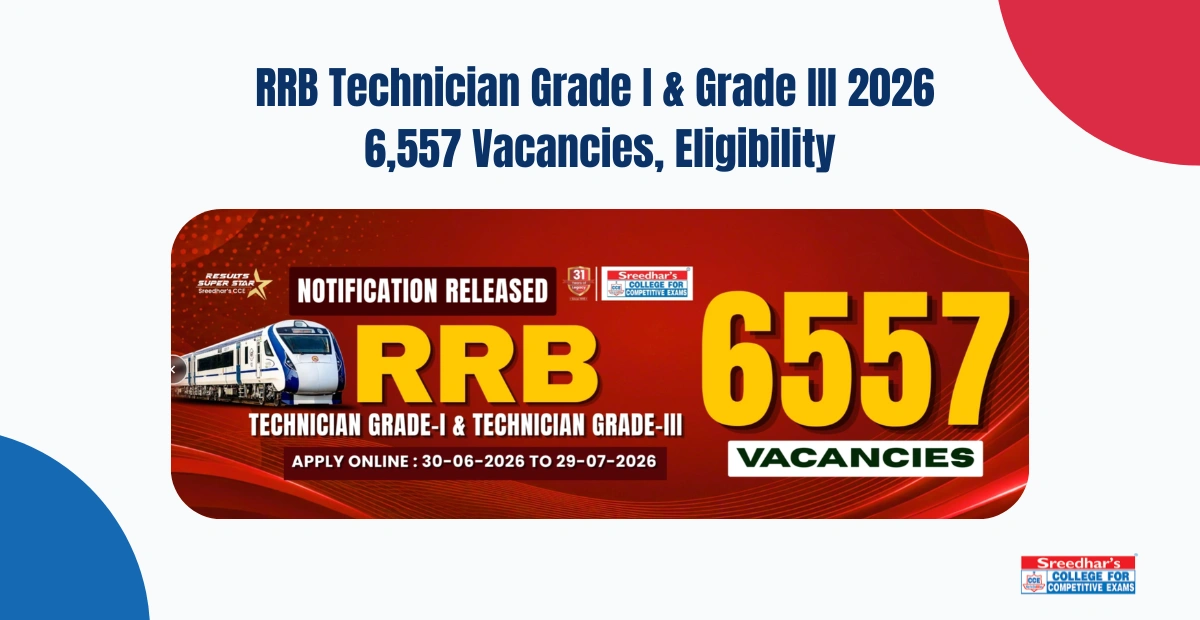
RRB Technician Grade I & Grade III 2026: 6,557 Vacancies, Eligibility
Your complete guide to the RRB Technician 2026 recruitment, covering 6,557 vacancies, eligibility, exam pattern, salary, syllabus, important dates, and preparation tips.
The Railway Recruitment Board has opened one of the biggest technical hiring drives of the year. Under Centralised Employment Notice CEN 02/2026, RRB is inviting applications for 6,557 posts of Technician Grade I Signal and Technician Grade III across Indian Railways zones. If you have an ITI certificate, a diploma, a B.Sc, or an engineering degree, this notification deserves your full attention, because government railway jobs of this scale do not come around every month.
At Sreedhar's College for Competitive Exams, we track every RRB, SSC, and bank notification closely so that our students never miss an application window or a preparation head start. You can read more about our three decades of coaching experience on our About Us page. This article breaks down everything you need to know about the RRB Technician 2026 recruitment, from vacancy distribution and eligibility to exam pattern, salary, and a preparation roadmap that actually works.
RRB Technician 2026 Notification: Quick Overview
The detailed notification was released on 29 June 2026 under CEN No. 02/2026, and the online application window opened on 30 June 2026. Candidates can apply until 29 July 2026, and the fee payment window closes a couple of days later. This recruitment cycle is being conducted by all 21 Railway Recruitment Boards across the country, and each candidate must apply through the RRB of their choice for each pay level.
| Particular | Details |
|---|---|
| Conducting Body | Railway Recruitment Board (RRB) |
| Notification Number | CEN 02/2026 |
| Posts | Technician Grade I Signal, Technician Grade III |
| Total Vacancies | 6,557 |
| Application Start Date | 30 June 2026 |
| Application Last Date | 29 July 2026 |
| Mode of Application | Online only |
| Selection Process | Computer-Based Test, Document Verification, Medical Examination |
| Official Website | rrbapply.gov.in and regional RRB portals |
This year's vacancy count is noticeably higher than the previous cycle, which had notified close to 6,238 posts, so the competition, while still intense, comes with a wider opening for qualified candidates.
Vacancy Breakup: Grade I Signal and Grade III
RRB Technician recruitment covers two separate pay levels, and the vacancy split between them is heavily skewed toward Grade III.
- Technician Grade I Signal: 323 vacancies, placed at Pay Level 5, primarily for candidates with a science or engineering background who will work in the signalling department. This role covers installation, maintenance, inspection, and troubleshooting of railway signalling systems, which are critical to safe train operations.
- Technician Grade III: 6,234 vacancies, placed at Pay Level 2, spread across departments such as Mechanical, Electrical, Engineering, and Signal & Telecommunication. Within Grade III, the largest single category is Fitter (PU & WS) with over 1,100 posts, followed by Carriage and Wagon with around 500 posts. Other notified trades include Electrician, Wireman, Machinist, Welder, Blacksmith, Carpenter, Painter, Trimmer, and various Track Machine branches.
Because the vacancy distribution also varies zone by zone, candidates should download the official CEN 02/2026 PDF and check Annexure B, which lists the precise zone-wise and community-wise seat allocation. Choosing the right RRB zone during application matters, since a candidate can select only one RRB per pay level, and that choice is final once submitted.
If you are also tracking other railway and government notifications, our Free Exams section is updated regularly with fresh vacancy alerts, so you do not have to hunt across multiple websites.
Eligibility Criteria for RRB Technician 2026
Eligibility for this recruitment depends on three factors: nationality, age, and educational qualification. Each factor has its own conditions, and missing even one can lead to rejection at the document verification stage, so read this section carefully before you fill the form.
Nationality
Candidates must be a citizen of India, or a subject of Nepal or Bhutan, or a Tibetan refugee who came to India before 1 January 1962 with the intention of permanently settling here, or a person of Indian origin who migrated from Pakistan, Burma, Sri Lanka, or specified East African countries with the same intention of permanent settlement in India.
Age Limit
The minimum age for both posts is 18 years. The upper age limit differs by grade.
- Technician Grade I Signal: 18 to 33 years
- Technician Grade III: 18 to 30 years
Age is calculated as on 1 July 2026, and the usual government relaxations apply for SC, ST, OBC-NCL, PwBD, and other reserved categories as specified in the official notification.
Educational Qualification
Technician Grade I Signal requires a B.Sc with Physics, Electronics, Computer Science, Information Technology, or Instrumentation, or a three-year diploma in Engineering, or a full engineering degree in a relevant discipline from a recognised institution.
Technician Grade III requires Matriculation or SSLC along with an ITI certificate in the relevant trade from an NCVT or SCVT recognised institute, or Matriculation with a Course Completed Act Apprenticeship in the relevant trade. For the Grade III Signal & Telecom posts specifically, candidates who have completed 10+2 with Physics and Mathematics are also eligible, without needing a separate ITI qualification.
All eligibility conditions, including educational qualification, must be met on or before the closing date of 29 July 2026. Candidates who are still waiting for their final results are not eligible to apply, so make sure your certificates are in hand before you start the online form.
Application Fee and How to Apply
The application process is entirely online through the regional RRB websites listed under rrbapply.gov.in. Here is the basic step-by-step process.
- Visit the official website of your chosen RRB zone and locate the link for CEN No. 02/2026 (Technician).
- Register with your basic details, including a valid mobile number and email ID, and generate your login credentials.
- Fill in your personal information, address, category, and educational or technical qualification details carefully, since these will be verified later against your original certificates.
- Upload scanned copies of your photograph, signature, and any category or educational certificates in the prescribed format and size.
- Pay the application fee through Debit Card, Credit Card, Net Banking, or UPI.
- Review every entered detail before final submission, since corrections after submission are usually not permitted, and download the confirmation page for your records.
General and OBC category candidates typically pay a higher application fee compared to SC, ST, PwBD, women, and other reserved categories, and a portion of this fee is often refunded to candidates who appear for the CBT, as per the terms mentioned in the official notification. Always confirm the exact fee slab from the CEN 02/2026 PDF before making the payment, since fee structures can be revised.
If you would like personal guidance while filling your application or choosing the right RRB zone, you can always reach out through our Contact Us page, and our counsellors will walk you through it.
Selection Process: CBT, Document Verification, Medical Test
Unlike some other railway posts such as Assistant Loco Pilot, the RRB Technician recruitment does not include a Psycho Aptitude Test or a second CBT stage. Selection is based on a single Computer Based Test, which makes the process comparatively simpler, but it also means every mark in that one exam counts heavily toward your final rank.
Stage 1: Computer Based Test (CBT) The CBT consists of 100 objective-type multiple-choice questions carrying 100 marks, to be completed within 90 minutes. There is a negative marking of one-third mark for every wrong answer, while unattempted questions carry no penalty. The question paper is available in English, Hindi, and thirteen regional languages including Telugu, Tamil, Kannada, and Malayalam, so language should not be a barrier for most candidates in Andhra Pradesh and Telangana.
Minimum qualifying marks are generally set at 40 percent for General/UR category, with relaxed cutoffs for SC, ST, and OBC-NCL candidates as per government norms. There is no separate psycho test for Technician posts, so your CBT score alone determines whether you move to the next stage.
Stage 2: Document Verification Shortlisted candidates are called for document verification, where they must present original certificates along with two sets of self-attested photocopies. This includes your Matriculation and educational qualification certificates, ITI or Apprenticeship certificates where applicable, caste or category certificates in the prescribed annexure format, a valid original photo ID, and a No Objection Certificate if you are already employed in a government job.
Stage 3: Medical Examination Candidates must meet post-specific medical fitness standards laid down by the Railway Administration, since Technician roles involve physically demanding and safety-critical work. The exact vision and physical standards vary depending on the department and trade, and these are listed in detail in the official CEN 02/2026 notification.
There is no interview at any stage of RRB Technician recruitment, which means your preparation should be entirely focused on maximising your CBT score.
Exam Pattern and Syllabus Breakdown
The syllabus is broadly similar for both grades, but Grade I Signal includes two additional subjects that Grade III does not.
Technician Grade I Signal Syllabus covers five subjects: Mathematics, General Intelligence & Reasoning, General Awareness, Basics of Computers & Applications, and Basic Science & Engineering. The Basic Science & Engineering section typically carries the highest weightage and includes topics such as basic electronics, digital electronics, electronic devices and circuits, microprocessors, electronic measurements, and measuring instruments like the cathode ray oscilloscope.
Technician Grade III Syllabus covers four subjects: Mathematics, General Intelligence & Reasoning, General Science, and General Awareness & Current Affairs. There is no separate engineering or computer section for Grade III, and the General Science portion, covering Physics, Chemistry, and Life Sciences at a 10th standard level, carries the highest weightage here.
Because both exams are essentially at the level of Class 10, Class 12, or ITI/Diploma standard depending on the post, a structured, syllabus-first approach works better than random practice. Our Purchase Course page has dedicated RRB Technician batches that walk you through every subject with topic-wise tests, so you are not guessing which chapters matter most. You can also browse our Pages section for study material and exam-wise resources organised by category.
Salary and Career Growth
Pay for both posts follows the 7th Central Pay Commission structure.
- Technician Grade I Signal starts at a basic pay of Rs. 29,200, placed at Pay Level 5.
- Technician Grade III starts at a basic pay of Rs. 19,900, placed at Pay Level 2.
On top of the basic pay, selected candidates receive Dearness Allowance, House Rent Allowance, Transport Allowance, medical facilities, pension benefits under the National Pension System, and other Central Government perks such as free or concessional railway passes for self and family. During the initial training period, candidates receive a stipend rather than full pay, so it helps to plan your finances accordingly for the first few months.
Career progression is also a strong draw for this post. A Technician can move up to Senior Technician, then Junior Engineer, and further up the ladder through Limited Departmental Competitive Examinations and General Departmental Competitive Examinations. Combined with pan-India postings and the option to express a zonal preference during application, this makes Technician a genuinely long-term career, not just an entry-level job.
Why RRB Technician Is Worth Your Time
A few features of this recruitment make it particularly attractive compared to other government exams that ITI, diploma, and degree holders typically target.
Single-stage exam. Most competitive government exams involve two or three stages of written tests. RRB Technician needs just one CBT, which shortens your preparation timeline considerably.
No psycho test. Aspirants who have attempted RRB ALP know how unpredictable the CBAT stage can be. Technician recruitment skips this entirely, and your written test score is the only thing that decides your selection.
Large vacancy base. With 6,557 posts spread across 21 zones, your odds improve simply because of the sheer scale of hiring this year compared to previous cycles.
Clear qualification pathway. Whether you have completed ITI, a diploma, 10+2 with Science, or an engineering degree, there is a Technician category that matches your qualification, which is not always true for other railway or PSU exams.
Common Mistakes Candidates Should Avoid
Every recruitment cycle, a noticeable number of applications get rejected or candidates lose easy marks due to avoidable errors. Keep these points in mind.
Do not submit more than one application for the same pay level, even across different RRB zones, since this leads to disqualification. Choose your RRB zone thoughtfully at the start, because that selection is final and cannot be changed later. Double-check your educational qualification details against your actual certificates before submission, since mismatches surface during document verification and can cost you the post even after clearing the CBT. Keep your category and community certificates in the exact annexure format prescribed by RRB, since a generic certificate is often rejected. Finally, do not wait until the last few days to apply, since server load close to the deadline often causes payment failures and incomplete submissions.
A Suggested 60-Day Preparation Plan
Since the CBT is a single-stage exam, a focused 60-day plan is enough for most candidates who already have their base subject knowledge from school or ITI.
Weeks 1 and 2: Cover the complete syllabus at a basic level, subject by subject. Start with Mathematics and General Intelligence & Reasoning, since these carry consistent weightage across both grades and improve fastest with practice.
Weeks 3 and 4: Move into General Science for Grade III aspirants, or Basic Science & Engineering plus Computer Basics for Grade I Signal aspirants. This is usually the most syllabus-heavy portion and needs steady daily revision rather than last-minute cramming.
Weeks 5 and 6: Dedicate this phase to General Awareness and Current Affairs, along with your first few full-length mock tests. Reviewing your mistakes after every mock is more valuable than simply attempting more tests.
Weeks 7 and 8: Focus entirely on timed mock tests, previous year question papers, and speed-building drills. Since the CBT allows only 90 minutes for 100 questions, accuracy under time pressure becomes the deciding factor between a good score and an average one.
Our Our Results page shows how structured, test-driven preparation has consistently helped Sreedhar's CCE students clear railway and government exams, and the same discipline applies well to RRB Technician preparation.
How Sreedhar's CCE Can Help
Preparing alone for a government exam is possible, but it is slower and often less efficient than learning within a structured system that tracks your weak areas and corrects them in time. At Sreedhar's College for Competitive Exams, our RRB Technician batches are designed around the actual CEN 02/2026 syllabus, with subject-wise classes, weekly tests, and doubt-clearing sessions led by faculty who have guided thousands of students through railway recruitment exams over the past three decades.
We currently run batches across multiple locations, and you can check which centre is closest to you on our Our Branches page. If you are new to our teaching style or want to sample our content before enrolling, our Blogs section carries detailed exam strategy articles, subject notes, and updates on upcoming government vacancies, all written to help you prepare smarter rather than longer.
Zone-Wise Application: What to Keep in Mind
India's railway network is divided into 21 zones, each managed by its own Railway Recruitment Board, from RRB Ahmedabad and RRB Bangalore to RRB Secunderabad and RRB Chennai. For candidates based in Andhra Pradesh and Telangana, RRB Secunderabad is usually the most relevant zone to track, though you are free to apply to any RRB zone in the country as long as you meet that zone's specific vacancy requirements.
Vacancy numbers differ from zone to zone based on local operational needs, so it is worth comparing the zone-wise breakup in Annexure B of the notification before deciding where to apply. A zone with fewer vacancies but also fewer applicants from your state might actually offer better odds than a zone with a larger number of posts but heavier competition. This is a strategic decision, and it is one area where guidance from experienced faculty who track cutoff trends across zones can make a real difference to your final choice.
Keep in mind that once you select an RRB zone and submit your application for a given pay level, that choice is locked in and cannot be revised. So take the time to research zone-wise vacancy numbers, previous cutoffs, and the specific trades on offer before you finalise your form. Our Home page and Free Exams section are updated as soon as RRB releases zone-wise cutoffs, so bookmark these for quick reference closer to results.
Normalisation and How Your Score Is Calculated
Since the CBT for such a large-scale recruitment is conducted across multiple dates and shifts to accommodate lakhs of candidates, RRB applies a normalisation formula to ensure fairness. Your raw marks are adjusted based on the overall difficulty of the shift you appeared in, compared to other shifts held on the same or different days. This means your final normalised score, not your raw score, is what actually gets used for merit ranking and shortlisting.
Candidates often worry unnecessarily about getting a "tougher" shift, but the normalisation process is specifically designed to neutralise this variation. What you can control is your own preparation and accuracy, so it makes more sense to focus your energy on strengthening weak topics and practising under timed conditions rather than worrying about which shift you might be allotted.
Documents to Keep Ready Before You Apply
Before you begin filling the online application, it helps to have the following documents scanned and ready in the correct format and file size as specified in the notification.
Your Matriculation or SSLC certificate showing date of birth is required as proof of age, along with your highest educational qualification certificate relevant to the post you are applying for, whether that is an ITI certificate, a diploma, a B.Sc marks memo, or an engineering degree certificate. You will also need a recent passport-size photograph and a scanned signature in the prescribed dimensions, along with your caste or category certificate in the Central Government format if you are claiming reservation benefits. Candidates with disabilities should also keep their disability certificate ready in the prescribed format if applying under the PwBD category.
Keeping these documents organised in advance saves considerable time during the actual filling of the form and reduces the risk of last-minute errors that could affect your application. If you are enrolled with us, you can also log in through our Login portal to access checklists and application walkthroughs prepared by our faculty.
Final Word
The RRB Technician Grade I and Grade III 2026 notification is one of the largest technical recruitment drives this year, and with the application window open only until 29 July 2026, there is no reason to delay. Whether your background is ITI, diploma, or engineering, there is a clear pathway into Indian Railways through this recruitment, along with long-term job security, a respectable starting salary, and a defined career progression.
Read the official CEN 02/2026 notification carefully, confirm your eligibility, gather your documents, and apply well before the deadline. And if you want expert guidance through your preparation journey, from syllabus planning to mock tests to the final CBT, Sreedhar's CCE is ready to help you turn this opportunity into a confirmed government job.
Leave a Comment
Required fields are marked *