



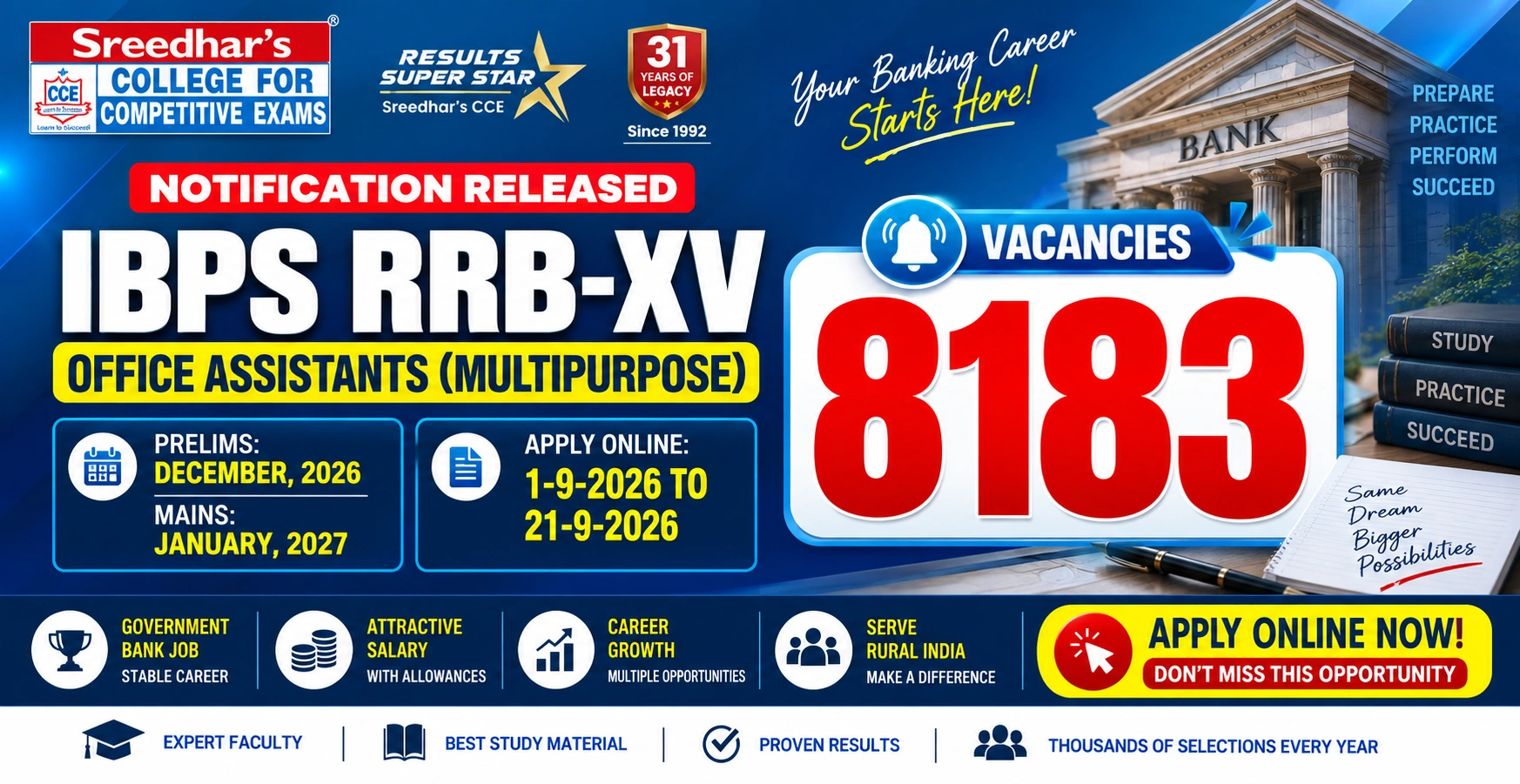
IBPS RRB XV 2026 Office Assistant (Multipurpose) Notification
8,183 Vacancies, Full Eligibility, Exam Pattern, Syllabus & Preparation Guide
The Institute of Banking Personnel Selection (IBPS) has released the much-awaited CRP RRBs-XV 2026 notification for recruitment of Office Assistants (Multipurpose) — commonly called IBPS RRB Clerk — in Regional Rural Banks (RRBs) across India. With 8,183 vacancies on offer, this is one of the biggest banking recruitment drives of the year and a golden opportunity for graduates who want a secure, respectable government banking career without the pressure of an interview round.
At Sreedhar's CCE, we have been guiding aspirants toward banking and government job success for over three decades. In this in-depth guide, we break down everything you need to know about the IBPS RRB XV Office Assistant recruitment — from vacancy details and eligibility to the exam pattern, syllabus, salary structure, and a proven preparation roadmap.
IBPS RRB XV 2026 Notification: Quick Overview
The IBPS RRB XV notification was officially released on 31 August 2026, and the online application window opened on 1 September 2026, remaining active until 21 September 2026. This year's recruitment drive covers two broad categories of posts — Group "A" Officers (Scale-I, II and III) and Group "B" Office Assistants (Multipurpose) — across 28 participating Regional Rural Banks spread throughout the country.
While the Officer posts (often referred to as IBPS RRB PO) attract a large number of applicants every year, the Office Assistant (Multipurpose) post remains the most sought-after entry point into public sector banking because of its simpler two-stage selection process, lower educational bar, and the sheer number of vacancies on offer. If you are exploring your options across banking exams, our Free Exams section lets you try mock tests before committing to a full course.
| Particulars | Details |
|---|---|
| Conducting Body | Institute of Banking Personnel Selection (IBPS) |
| Recruitment Name | CRP RRBs-XV (15th Common Recruitment Process) |
| Post | Office Assistant (Multipurpose) |
| Total Indicative Vacancies | 8,183 |
| Application Start Date | 1 September 2026 |
| Application End Date | 21 September 2026 |
| Prelims Exam Dates | 6, 12 and 13 December 2026 |
| Mains Exam Date | 30 January 2027 (tentative) |
| Selection Stages | Preliminary Exam + Main Exam (no interview) |
| Official Website | ibps.in |
What is IBPS RRB CRP-XV?
CRP RRBs stands for Common Recruitment Process for Regional Rural Banks. Instead of every Regional Rural Bank conducting its own recruitment drive, IBPS conducts a single, standardised examination once a year on behalf of all participating RRBs. Candidates who clear the exam and meet the cut-offs are provisionally allotted to a specific RRB based on their preferences, merit, and vacancy availability in that state.
This is the 15th edition of the process (hence "XV"), and it continues the same broad framework that has been used for over a decade — a Preliminary Examination that acts as a screening round, followed by a Main Examination whose score alone determines the final merit list and provisional allotment. Aspirants preparing for multiple bank exams simultaneously can compare formats and strategies across exams on our Exams page.
Vacancy Details: 8,183 Office Assistant Posts
According to the indicative vacancy figures published in Annexure-I of the official notification, the Office Assistant (Multipurpose) post accounts for the single largest chunk of vacancies in this year's CRP RRBs-XV cycle — 8,183 posts, out of a combined total of over 13,700 vacancies across all posts (Officer Scale-I, II, III and Office Assistant). These are described as indicative numbers, meaning the final figures can shift slightly as participating RRBs confirm their actual manpower requirements closer to the exam date.
The vacancies are distributed state-wise and category-wise (SC, ST, OBC-NCL, EWS, General, along with reservations for PwBD and Ex-Servicemen/Dependents of Ex-Servicemen candidates) across the 28 participating RRBs. Some states have only a handful of openings — for instance, smaller states like Tripura have a modest allocation — while larger agrarian states with a bigger RRB network naturally see proportionally higher numbers.
Key takeaway for aspirants: Because vacancies are spread across so many states and RRBs, candidates who are flexible about their preferred posting location generally have a meaningfully better chance of selection than those who restrict themselves to just one or two RRB choices.
Important Dates You Cannot Miss
Keeping track of the recruitment calendar is half the battle in a fast-moving process like this. Here is the complete timeline as released by IBPS:
| Event | Date |
|---|---|
| Notification Release | 31 August 2026 |
| Online Application Begins | 1 September 2026 |
| Last Date to Apply Online | 21 September 2026 |
| Last Date for Fee Payment | 21 September 2026 |
| Prelims Admit Card Release | Expected November 2026 |
| Preliminary Examination | 6, 12 and 13 December 2026 |
| Prelims Result Declaration | Expected January 2027 |
| Mains Admit Card Release | Expected mid-January 2027 |
| Main Examination | 30 January 2027 (tentative) |
| Provisional Allotment | To be announced |
Note that IBPS reserves the right to revise these dates, so candidates should regularly check the official IBPS RRB page and cross-check with our Blogs section, where we post real-time updates on every stage of the recruitment cycle.
Eligibility Criteria
Before applying, every candidate must carefully verify that they meet the age, nationality, and educational requirements laid down in the official notification. Applying without meeting these conditions can lead to rejection at any stage, even after clearing the exam.
Nationality
A candidate must be either:
- A citizen of India, or
- A subject of Nepal or Bhutan, or
- A Tibetan refugee who came to India before 1 January 1962 with the intention of permanently settling in India, or
- A person of Indian origin who has migrated from Pakistan, Myanmar, Sri Lanka, East African countries, or other specified nations with the intention of permanently settling in India (subject to possession of an eligibility certificate from the Government of India).
Age Limit
Candidates must be between 18 and 28 years of age as on 1 September 2026. This means a candidate must have been born not earlier than 2 September 1998 and not later than 1 September 2008 (both dates inclusive).
Age relaxation is available for reserved categories as per government norms:
| Category | Age Relaxation |
|---|---|
| SC/ST | 5 years |
| OBC (Non-Creamy Layer) | 3 years |
| Persons with Benchmark Disabilities (PwBD) | 10 years |
| Ex-Servicemen/Commissioned Officers | As per government rules |
| Widows, divorced women, and women judicially separated who have not remarried | Up to 9 years (as per applicable rules) |
Educational Qualification
Candidates must possess a Bachelor's Degree in any discipline from a university recognised by the Government of India, or an equivalent qualification recognised as such by the Central Government.
Additionally — and this is a distinctive requirement for RRB recruitment — candidates must have:
- Proficiency in the official language of the state/UT for which they are applying (i.e., the ability to read, write, speak, and understand the local language). This is verified later through the Language Proficiency Test (LPT).
- Preference is often given to candidates who have studied the local language as a subject at the Matriculation/Xth standard level, though the exact requirement can vary slightly by RRB, so always check the specific RRB's requirement in the detailed notification.
Computer literacy — basic knowledge of computer operations is compulsory, as banking today is almost entirely digitised.
Application Fee and How to Apply
Application Fee Structure
| Category | Fee |
|---|---|
| General / OBC / EWS | ₹850 |
| SC / ST / PwBD / Ex-Servicemen | ₹175 (intimation charges only) |
Payment can be made online through debit card, credit card, net banking, or UPI. No offline payment mode is accepted.
Step-by-Step Application Process
- Visit the official IBPS website, ibps.in, and navigate to the CRP RRBs-XV section on the homepage.
- Click on "Click here to apply online for CRP-RRB-XV Office Assistant (Multipurpose)."
- Complete the New Registration step by entering your basic details — name, date of birth, email ID and mobile number — to generate a provisional registration number and password.
- Log in using your credentials and fill out the complete application form, including personal details, educational qualifications, and category information.
- Upload the required documents in the specified format and size:
- Recent passport-size photograph
- Signature
- Left thumb impression (if applicable)
- A handwritten declaration (as specified in the notification)
- Select your RRB preferences carefully — you can typically choose more than one RRB, and preference order matters for allotment.
- Pay the applicable application fee online.
- Review the entire form before final submission, since no edits are allowed after submission.
- Download and save a copy of the completed application form and the fee payment receipt for future reference.
Candidates who also wish to attempt Officer-level posts under this same cycle must note that a separate application and separate fee is required, and they may only apply for one post among Officer Scale-I, Scale-II, and Scale-III (in addition to Office Assistant, if they choose to apply for both categories of posts).
If you'd rather have expert guidance while filling your form or choosing RRB preferences strategically, our counsellors at Sreedhar's CCE can walk you through the entire process branch-wise.
Exam Pattern: Prelims and Mains
The IBPS RRB Office Assistant selection process consists of two objective-type online examinations — there is no interview for this post, which makes the written exams the sole determinant of your selection.
Stage 1: Preliminary Examination
| Section | No. of Questions | Marks | Duration |
|---|---|---|---|
| Reasoning Ability | 40 | 40 | 25 minutes |
| Numerical Ability | 40 | 40 | 20 minutes |
| Total | 80 | 80 | 45 minutes |
- The Prelims exam has sectional time limits — you cannot spend all 45 minutes on one section.
- Each wrong answer attracts a negative marking of 0.25 marks.
- Prelims marks are not counted for final merit — the exam is purely a screening/qualifying stage. Only candidates who clear the cut-off proceed to the Main Examination.
- There is no separate section for English/Hindi language in the Prelims for Office Assistant — a distinctive difference compared to many other bank clerical exams.
Stage 2: Main Examination
| Section | No. of Questions | Marks | Duration |
|---|---|---|---|
| Reasoning | 40 | 50 | 30 minutes |
| Numerical Ability | 40 | 50 | 30 minutes |
| General Awareness | 40 | 40 | 20 minutes |
| Computer Knowledge | 40 | 20 | 20 minutes |
| English / Hindi Language | 40 | 40 | 30 minutes |
| Total | 200 | 200 | 120 minutes |
- Candidates choose either English or Hindi as their language paper.
- Negative marking of 0.25 marks applies for every wrong answer in Mains as well.
- The Main Examination score alone forms the basis of the final merit list, subject to sectional and overall cut-offs.
- Both Prelims and Mains are conducted in bilingual mode (English and Hindi), except for the English Language section itself and certain other sections as specified.
For candidates who want to practice full-length, sectional, and topic-wise mock tests that simulate the real exam interface, Sreedhar's CCE's Purchase Course page offers structured test series designed specifically around the IBPS RRB pattern.
Detailed Syllabus
Reasoning Ability (Prelims + Mains)
- Puzzles and Seating Arrangement (linear, circular, and complex puzzles)
- Syllogism
- Inequalities
- Blood Relations
- Direction Sense
- Coding-Decoding
- Alphanumeric Series
- Ranking and Order
- Data Sufficiency
- Input-Output
- Logical Reasoning (statement and assumption, course of action, cause and effect)
Numerical Ability (Prelims + Mains)
- Simplification and Approximation
- Number Series
- Quadratic Equations
- Data Interpretation (tabular, bar graph, line graph, pie chart, caselet)
- Data Sufficiency
- Arithmetic Word Problems: Percentage, Profit & Loss, Simple & Compound Interest, Time & Work, Time-Speed-Distance, Ratio & Proportion, Averages, Ages, Mixtures & Alligations, Partnership, Boats & Streams
- Mensuration
- Permutation, Combination & Probability (occasionally)
General Awareness (Mains only)
- Current Affairs (last 6 months, with strong emphasis on banking and financial news)
- Banking and Financial Awareness: RBI functions, monetary policy, repo/reverse repo rate, types of accounts, negotiable instruments, banking terminology
- Static GK: important days, government schemes, books & authors, headquarters of organisations
- Financial and Economic news, Union Budget highlights
- Agriculture-related schemes and rural banking initiatives (given the RRB context)
Computer Knowledge (Mains only)
- Basics of computer hardware and software
- Operating systems and MS Office (Word, Excel, PowerPoint)
- Internet, networking, and email fundamentals
- Computer abbreviations and shortcuts
- History and generations of computers
- Basic cybersecurity and data protection concepts
English Language (Mains only)
- Reading Comprehension
- Cloze Test
- Error Detection/Spotting
- Sentence Improvement and Rearrangement
- Fill in the Blanks
- Vocabulary-based questions (synonyms, antonyms, phrase replacement)
Hindi Language (Mains only, alternative to English)
- अपठित गद्यांश (Reading Comprehension)
- रिक्त स्थान भरना (Fill in the Blanks)
- वाक्य शुद्धि (Sentence Correction)
- मुहावरे और लोकोक्तियाँ (Idioms and Phrases)
- पर्यायवाची व विलोम शब्द (Synonyms and Antonyms)
Selection Process
The final selection for the Office Assistant (Multipurpose) post follows a straightforward two-stage structure:
- Preliminary Examination – Qualifying in nature. Candidates must clear both sectional and overall cut-offs to advance. Marks are not added to the final score.
- Main Examination – This is the deciding round. The marks scored here (out of 200) directly determine your position on the final merit list.
- Provisional Allotment – Based on merit, category, and RRB preference, along with a Language Proficiency Test (LPT) and document verification.
Unlike the Officer posts, which include a separate interview round conducted with the involvement of NABARD, the Office Assistant post has no interview. This makes it comparatively less stressful and more merit-transparent, since your written test score is the only factor (besides local language proficiency and document verification) that decides your fate.
Salary and Perks of an Office Assistant
One of the biggest draws of this post is the combination of job security, respectable pay, and steady career growth that comes with a public-sector banking job. Based on the current pay scale structure applicable to Office Assistants in RRBs:
- Basic Pay: Starts at approximately ₹15,000-₹24,000, depending on the specific pay scale slab and increments applicable.
- Gross monthly emoluments (including Dearness Allowance, House Rent Allowance, Special Allowance, and other components) typically bring the total in-hand salary to approximately ₹30,000 to ₹40,000 per month, though this varies based on posting location (rural vs. semi-urban) and the specific RRB's allowance structure.
Additional Benefits
- Pension under the New Pension Scheme (NPS)
- Medical insurance/reimbursement for self and dependents
- LFC (Leave Fare Concession) for travel
- Provident Fund contributions
- Annual increments as per pay scale
- Promotional avenues into Officer cadre over time, subject to internal promotion exams and eligibility
- Lower cost of living in rural and semi-urban postings, which often makes the effective purchasing power of the salary higher than the nominal figure suggests
Given the stability, pension benefits, and long-term promotional prospects, an Office Assistant post in an RRB is widely regarded as one of the best "value for effort" government jobs available to any graduate today, particularly for candidates from rural and semi-urban backgrounds who already have local language proficiency.
Language Proficiency Test (LPT)
Because RRBs operate at the grassroots level and interact daily with a largely local, often non-English-speaking rural clientele, proficiency in the official/local language of the state is treated as a mandatory, knockout condition — separate from the written exam.
- Candidates who have studied the local language as a subject up to the Matriculation (10th) level are usually exempted from a separate LPT and can submit their mark sheet as proof.
- Candidates who do not meet this criterion will have to undergo a Language Proficiency Test conducted by the allotted RRB before final appointment.
- Failure to clear the LPT can lead to disqualification even after clearing both Prelims and Mains, so this is a step aspirants should never take lightly.
This is precisely why Sreedhar's CCE, with its strong regional presence and branch network across multiple cities, places equal emphasis on language readiness alongside written exam preparation. You can check your nearest centre on our Our Branches page.
Preparation Strategy: How to Crack IBPS RRB in Your First Attempt
With roughly three months between the notification and the Prelims exam, a structured, disciplined study plan makes all the difference. Here is a strategy that has worked for thousands of successful candidates who have trained with us over the years.
Phase 1 (September–October): Foundation Building
- Cover all core Reasoning and Quantitative Aptitude topics from scratch, focusing on concept clarity rather than shortcuts at this stage.
- Start reading a good newspaper or banking-focused current affairs digest daily — Current Affairs cannot be crammed in the last month, so consistency from day one is essential.
- Begin basic Computer Knowledge revision alongside, since it is a high-scoring, low-effort section if prepared early.
Phase 2 (November): Prelims-Focused Practice
- Shift almost entirely to timed sectional tests in Reasoning and Numerical Ability.
- Solve at least one full-length Prelims mock test every alternate day, and thoroughly analyse mistakes afterward — analysis matters more than the number of tests attempted.
- Work on speed and accuracy simultaneously; remember, sectional time limits mean you cannot "borrow" time from a stronger section.
- Focus heavily on puzzles and seating arrangement, since this topic alone typically accounts for the largest chunk of Reasoning marks.
Phase 3 (Post-Prelims to Mains): Deep Mains Preparation
- Once Prelims is done, immediately shift focus to General Awareness, Computer Knowledge, and English/Hindi Language, since these are unique to Mains and need dedicated attention.
- Revise Banking Awareness thoroughly — RBI functions, monetary policy tools, types of banking instruments, and recent policy changes are recurring favourites.
- Increase the difficulty level of your Reasoning and Numerical Ability practice, since Mains-level questions are noticeably tougher than Prelims.
- Attempt full-length Mains mocks under strict exam conditions at least twice a week in the final month.
General Tips
- Sectional cut-offs matter as much as overall cut-offs — do not neglect any section, even ones you find difficult, since failing even one section disqualifies you regardless of your total score.
- Maintain an error log — a notebook or spreadsheet where you track every mistake made in mock tests, along with the reason (silly error, conceptual gap, time pressure), and revisit it weekly.
- Don't ignore the Local Language Test requirement — start brushing up on your reading/writing skills in the local language early if you don't already meet the Matriculation-level exemption.
- Join a structured test series rather than relying only on random free tests online, since a well-designed series mirrors the actual difficulty trend and reporting format of the real exam.
You can benchmark your current preparation level for free through our Free Exams mock test series before deciding on a paid course.
Common Mistakes Aspirants Make
Even well-prepared candidates often lose out due to avoidable errors. Watch out for these:
- Ignoring sectional cut-offs and over-focusing on their "favourite" section while neglecting a weaker one.
- Underestimating the local language requirement and realising too late that they don't meet the Matriculation-level exemption.
- Applying to only one RRB/state, which drastically narrows the odds of selection compared to candidates open to multiple states.
- Delaying Current Affairs preparation until the last month before Mains, when 4-6 months of news needs to be covered.
- Not practising with sectional timers during Prelims preparation, leading to poor time management on exam day.
- Skipping the declaration/document-upload instructions carefully, resulting in application rejection over avoidable technical errors.
- Neglecting Computer Knowledge, assuming it's "easy," and then scoring poorly simply due to lack of revision.
Why Choose Sreedhar's CCE for IBPS RRB Preparation
For over three decades, Sreedhar's College for Competitive Exams has been a trusted name for banking and government exam aspirants, particularly across Andhra Pradesh and Telangana. Here's what sets our IBPS RRB preparation programs apart:
- Experienced faculty who specialise in Reasoning, Quantitative Aptitude, Banking Awareness, and English/Hindi Language, with a deep understanding of the IBPS RRB pattern specifically.
- Structured batches for both Prelims and Mains, with clear timelines mapped against the official IBPS RRB XV exam calendar.
- Extensive test series replicating the real exam interface, sectional timing, and difficulty distribution.
- Regional language support, which is especially valuable given the mandatory Language Proficiency Test requirement for RRB recruitment.
- Multiple branches across the region, so you can choose a centre close to home — see our full list on the Our Branches page.
- A strong track record of results, with thousands of our students successfully placed in RRBs, public sector banks, and other government institutions — browse our Our Results page to see verified selections.
- Regularly updated current affairs and banking awareness material, curated specifically for the Mains General Awareness section.
Whether you're a first-time aspirant or someone re-attempting after a near miss last cycle, our IBPS RRB batches are designed to take you from foundation to final selection in a structured, time-bound manner. Explore our course options on the Purchase Course page, or read more exam-specific strategy articles on our Blogs section.
Office Assistant vs. Officer Scale-I: Which One Should You Choose?
Many first-time bank exam aspirants get confused about whether they should apply for Office Assistant (Multipurpose), Officer Scale-I (Assistant Manager), or both. Since the notification allows you to apply for both posts (with separate fees), it helps to understand the practical differences before you decide where to invest your preparation time.
| Parameter | Office Assistant (Multipurpose) | Officer Scale-I (Assistant Manager) |
|---|---|---|
| Role Type | Clerical / operational | Supervisory / managerial |
| Selection Stages | Prelims + Mains (no interview) | Prelims + Mains + Interview |
| Starting Pay Scale (approx.) | ₹15,000+ basic | ₹36,000+ basic |
| Vacancies (CRP RRBs-XV) | 8,183 | 4,256 |
| Age Limit | 18–28 years | 18–30 years |
| English/Language Paper | Only in Mains | Only in Mains |
| Ease of Preparation | Comparatively easier; narrower syllabus | Broader, includes agriculture/rural focus for GA |
| Career Growth | Promotable to officer cadre over time | Direct entry into managerial track |
Our advice: If you're a first-time aspirant, especially one balancing preparation with college finals or another job, the Office Assistant post is the more time-efficient route to your first banking job, given the absence of an interview stage and a comparatively narrower syllabus. Ambitious candidates with more preparation time on their hands, however, should seriously consider applying for both, since the core Reasoning and Numerical Ability preparation overlaps significantly between the two posts. You can explore officer-level preparation resources as well on our Exams page.
Participating Regional Rural Banks: What "RRB Preference" Really Means
A detail that trips up many first-time applicants is the concept of RRB preference during the application process. Since CRP RRBs-XV is a common process conducted on behalf of 28 different Regional Rural Banks spread across nearly every state and union territory, your final posting depends heavily on:
- Which RRBs you selected as your preferences at the time of application (you typically cannot add or change these later).
- Your rank in the merit list relative to other candidates who chose the same RRB.
- The category-wise vacancy distribution within each RRB.
A common strategic mistake is selecting only the RRB of one's home state, assuming it maximises the chance of a "local" posting. In reality, RRBs in your home state often see the highest number of applicants (since local language proficiency is a natural advantage for residents), which can make competition fiercer there than in an RRB from a state you may be less attached to but where the vacancy-to-applicant ratio is more favourable. Weigh this trade-off carefully — familiarity and language comfort versus statistical odds of selection — before finalising your preference order.
A Sample 12-Week Study Timetable
To make the preparation phases described earlier more actionable, here is a week-by-week breakdown you can adapt to your own schedule between now and the Prelims exam:
| Week | Focus Area |
|---|---|
| 1–2 | Reasoning basics: Coding-Decoding, Blood Relations, Direction Sense, Alphanumeric Series; begin daily current affairs reading |
| 3–4 | Numerical Ability basics: Simplification, Number Series, Percentages, Profit & Loss, Averages |
| 5–6 | Puzzles and Seating Arrangement (all variants); Data Interpretation basics |
| 7 | Full syllabus revision + first full-length Prelims mock test |
| 8 | Sectional mock tests (Reasoning and Numerical Ability) with strict sectional timers |
| 9 | Two full-length Prelims mocks per week + error log review |
| 10 | Final Prelims revision, formula sheets, shortcut techniques |
| 11 (Post-Prelims) | Shift to General Awareness, Banking Awareness, and Computer Knowledge for Mains |
| 12 | English/Hindi Language practice + full-length Mains mocks |
This is only a template — adjust the pacing based on your existing strength in each subject, but avoid the temptation to skip weeks 7 and 8, since building mock-test discipline early is what separates high scorers from average performers by exam day.
Commons Questions for IBPS RRB XV Preparation
Q1. What is the total number of Office Assistant vacancies in IBPS RRB XV 2026? A total of 8,183 indicative vacancies have been announced for the Office Assistant (Multipurpose) post under CRP RRBs-XV.
Q2. What is the age limit for IBPS RRB Office Assistant 2026? Candidates must be between 18 and 28 years of age as on 1 September 2026, with relaxations available for reserved categories.
Q3. Is there an interview for the Office Assistant post? No. Selection is based purely on performance in the Preliminary and Main written examinations, along with document verification and a Language Proficiency Test.
Q4. What is the application fee for IBPS RRB Office Assistant? ₹850 for General/OBC/EWS candidates, and ₹175 for SC/ST/PwBD/Ex-Servicemen candidates.
Q5. What is the exam pattern for Prelims and Mains? Prelims consists of 80 questions (Reasoning and Numerical Ability) for 80 marks in 45 minutes. Mains consists of 200 questions across five sections (Reasoning, Numerical Ability, General Awareness, Computer Knowledge, and English/Hindi Language) for 200 marks in 120 minutes.
Q6. Is there negative marking? Yes, 0.25 marks are deducted for every wrong answer in both Prelims and Mains.
Q7. What is the expected in-hand salary for an Office Assistant? The approximate in-hand salary ranges from ₹30,000 to ₹40,000 per month, depending on posting location and applicable allowances.
Q8. Can I apply for both Officer and Office Assistant posts in the same cycle? Yes, but you can only choose one Officer post (Scale-I, II, or III) in addition to Office Assistant, and you must submit separate applications with separate fees for each.
Q9. What is the Language Proficiency Test (LPT)? It's a mandatory check of your proficiency in the local/official language of the state where your allotted RRB operates. Candidates who studied the local language up to Matriculation level are typically exempted.
Q10. When are the Prelims and Mains exams scheduled? Prelims: 6, 12, and 13 December 2026. Mains: 30 January 2027 (tentative), subject to confirmation by IBPS.
16. Final Word
The IBPS RRB XV 2026 Office Assistant recruitment, with its 8,183 vacancies, represents one of the most accessible and rewarding entry points into a stable banking career in India today. With no interview stage, a well-defined syllabus, and vacancies spread generously across states, this is an exam where consistent, focused preparation can genuinely translate into selection — even for first-time aspirants.
The window between now and the Prelims exam in December is your most valuable resource. Use it wisely: build strong fundamentals in Reasoning and Numerical Ability, start your Current Affairs habit today, and don't leave your local language readiness to the last minute.
At Sreedhar's CCE, we've helped generations of aspirants convert this kind of opportunity into a confirmed banking career. Explore our Purchase Course options, take a free diagnostic test on our Free Exams page, or visit your nearest branch to speak with our counsellors today.
All dates, vacancy numbers, and fee details mentioned in this article are based on the official IBPS RRB CRP-XV notification released on 31 August 2026 and related updates as of mid-September 2026. Candidates are strongly advised to cross-check the final figures and any amendments on the official IBPS website, ibps.in, before applying.

Leave a Comment
Required fields are marked *