



How to Prepare for Banking Exams: A Complete Guide to IBPS, SBI, RBI, RRB, Local Bank Officer and Co-operative Bank Recruitment (2026-27)
Banking Exam Preparation 2026-27: Build the Right Strategy for IBPS, SBI, RBI, RRB & More
A glance at the banking exams list shows how wide this field is. There are national recruiters such as IBPS and SBI, regulators such as the RBI, public sector banks that hire Local Bank Officers and Credit Officers, private banks such as Karnataka Bank and South Indian Bank, development-focused lenders such as IDBI, and a long list of regional and co-operative institutions, including APCOB, the district co-operative central banks, TSCAB and the Vizag Co-operative Bank. The posts range from Staff Assistant and Clerk to Probationary Officer, Assistant Manager, Specialist Officer and RBI Grade B officer.
This variety looks intimidating, but the preparation underneath is surprisingly unified. Almost every banking exam is built from the same five blocks: English language, quantitative aptitude (with data interpretation at higher levels), reasoning (including puzzles and seating arrangements), general and financial awareness, and computer aptitude. Officer-level exams add descriptive writing and an interview. Regional and local-bank exams add a local language requirement. If you build a strong common base, you can serve IBPS PO, SBI PO, RRB Officer Scale I, co-operative bank exams and many others with one study plan, and then fine-tune for each notification.
This guide explains where the banking calendar stands right now, summarises the pattern of each family of exams, builds the common foundation, goes subject by subject, and then gives exam-specific strategies, mock-test methods, interview advice and study plans. It is written for the serious aspirant who wants a practical roadmap rather than a list of facts.
Where the Banking Calendar Stands Today
Banking recruitment runs almost non-stop through the year. Here is the picture as of 7 October 2026, drawn from the official IBPS calendar and recent notices.
IBPS PO / MT (CRP PO/MT-XVI). The Prelims were scheduled for 22 and 23 August 2026 and the Mains for 4 October 2026. The Mains has just been held, so the next stages are results, call letters and the interview. If you appeared, start interview preparation now; if you did not, use this cycle as an early start for the next one.
IBPS SO (CRP SPL-XVI). The Prelims took place on 29 August 2026 and the Mains is scheduled for 1 November 2026.
IBPS Clerk / Customer Service Associate (CRP CSA-XVI). The notification came out in August 2026 with a vacancy count reported at more than 11,000. The Prelims is scheduled for 10 and 11 October 2026, which is days away, and the Mains for 27 December 2026.
IBPS RRB (CRP RRBs-XV). The notification was released on 31 August 2026 with about 13,700 vacancies, including roughly 8,183 Office Assistant posts and 4,256 Officer Scale I posts. The Officer Scale I Prelims is on 21 and 22 November 2026, the Officer Scale I Mains and the Scale II and III single exam are on 20 December 2026, the Office Assistant Prelims are on 6, 12 and 13 December 2026, and the Office Assistant Mains is on 30 January 2027.
SBI PO. The notification arrived on 18 June 2026 for about 1,500 posts. The Prelims was held on 1 and 2 August 2026 and the Mains was tentatively scheduled for 12 September 2026.
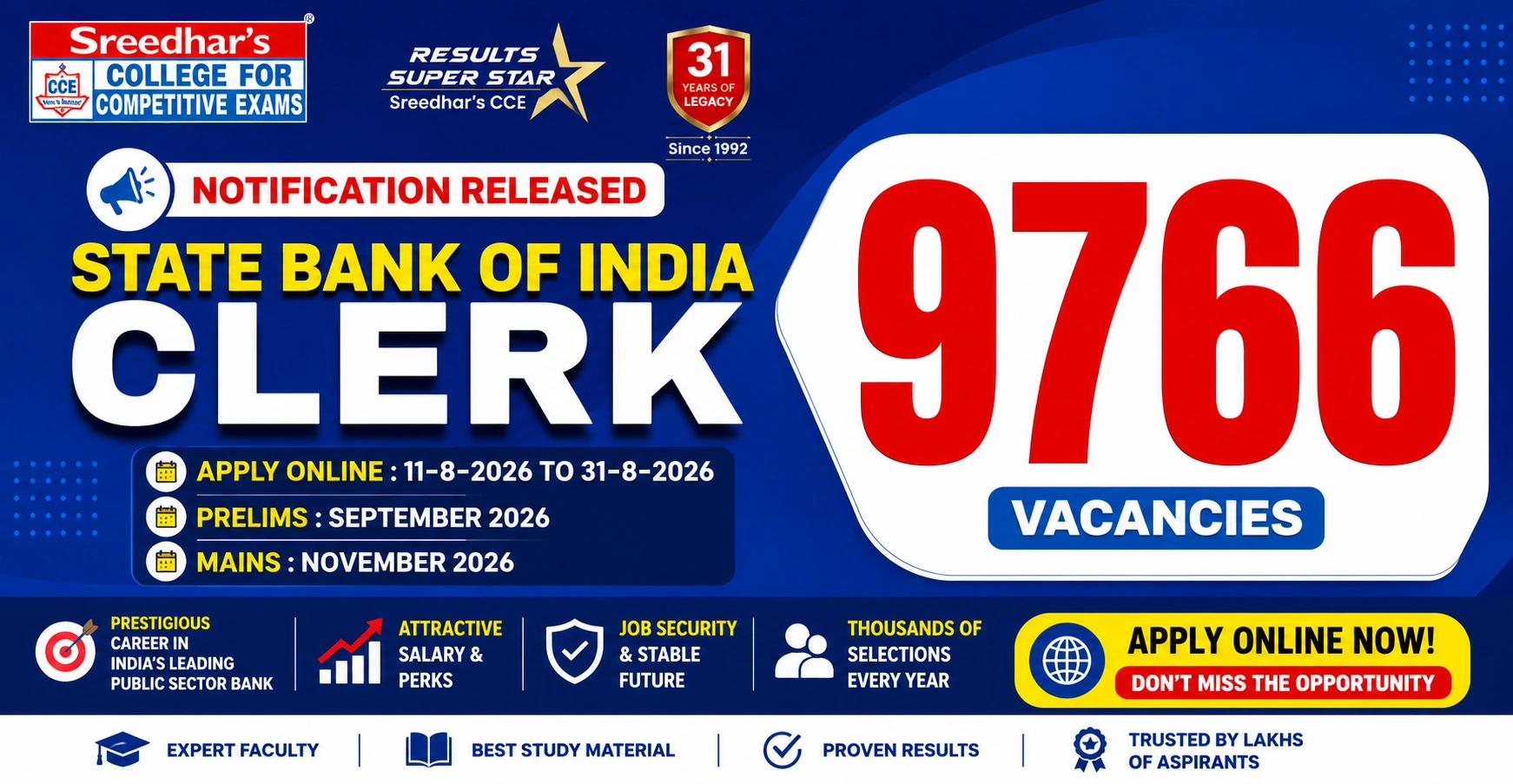
SBI Clerk (Junior Associate). The notification was released on 11 August 2026 for 9,766 vacancies (7,680 regular), with a very large pool of applicants reported. The Prelims was held in late September, with some sources also listing early October dates, and the Mains is tentatively set for November 2026.
RBI Grade B. The 2026 notification appeared on 29 April 2026, Phase I was held on 13 June and Phase II on 25 July 2026. The next notification is likely around April 2027, so the time to start is now.
Bank of Baroda Local Bank Officer. The notification was released on 18 August 2026 for 2,482 posts across 20 states, with applications closing on 7 September. The online test was tentatively expected in October 2026, followed by a language proficiency test. Other banks such as Union Bank, Canara, Indian Bank, UCO and Punjab and Sind Bank have run similar LBO drives in past cycles, so watch for their notices.
Andhra Pradesh co-operative banks. APCOB and six district co-operative central banks released a notification on 24 July 2026 for 338 Staff Assistant and Assistant Manager posts. The online test was announced for 25 September 2026.
Two lessons come out of this timeline. First, something is always open, so an aspirant who has built a solid base can pivot quickly. Second, the heaviest recruiters, IBPS and SBI, release their notifications at predictable times each year, so you can plan a calendar around them. Treat the dates here as a guide and verify them on ibps.in, sbi.bank.in, rbi.org.in and each bank's careers page.
The Exams at a Glance
Before planning, you must know what you are preparing for. The summaries below are based on the most recent patterns reported, and they are a guide rather than a substitute for the notification.
IBPS PO
IBPS PO has three stages. The Prelims is an online test of 100 questions for 100 marks in 60 minutes: English (30 questions), Quantitative Aptitude (35) and Reasoning Ability (35), with a separate 20-minute timer for each section and negative marking of one-fourth of a mark. It is a screening stage, and both overall and sectional cut-offs matter.
The Mains is where selection is built. The objective part has about 155 questions for 200 marks in three hours, with separate timers for Reasoning and Computer Aptitude, General, Economy and Banking Awareness, English, and Data Analysis and Interpretation. A descriptive test of two questions (typically a letter and an essay) for 25 marks follows in 30 minutes. Shortlisted candidates face an interview of 100 marks, and the final merit combines Mains and interview in an 80 to 20 ratio.
IBPS Clerk (Customer Service Associate)
The Prelims has 100 questions for 100 marks in 60 minutes: English (30), Numerical Ability (35) and Reasoning (35), 20 minutes for each, with a 0.25 penalty for wrong answers. The Mains is the deciding stage, and there is no interview. The traditional Mains had four sections (General and Financial Awareness, General English, Reasoning Ability and Computer Aptitude, and Quantitative Aptitude) with 190 questions in 160 minutes. One recent coaching source reports a revised Mains of about 155 questions in two hours, while others still show the older format, so confirm the pattern in the notification. Depending on the state, a Language Proficiency Test follows.
IBPS RRB (Office Assistant and Officer Scale I, II and III)
Office Assistant and Officer Scale I follow a Prelims and Mains structure. The Prelims is a short online test of Reasoning and Numerical Ability of about 80 questions in 45 minutes, and the Mains is a longer test across reasoning, quantitative aptitude, language, general awareness and computer knowledge. Officer Scale I candidates also face an interview, while Office Assistant has none. Officer Scale II and III take a single exam, which for specialist cadres includes professional knowledge. Negative marking of 0.25 applies, and knowledge of the local language is an important requirement for many posts.
IBPS SO
The Specialist Officer exam recruits IT Officers, Agricultural Field Officers, Rajbhasha Adhikari, Law Officers, HR or Personnel Officers and Marketing Officers. It has a Prelims (English, Reasoning and a general-awareness or quantitative component), a Mains with professional knowledge and a descriptive test in some cases, and an interview. Professional knowledge decides most of the result, so your subject expertise matters more than anything else.
SBI PO
SBI PO follows the Prelims, Mains and Phase III model. The Prelims mirrors IBPS: 100 questions, 100 marks, one hour, three sections with 20 minutes each and 0.25 negative marking. The Mains has an objective test of reasoning and computer aptitude, data analysis and interpretation, general, economy and banking awareness and English, plus a 30-minute descriptive English test of 50 marks. Phase III includes a psychometric test, a group exercise and a personal interview.
SBI Clerk (Junior Associate)
The Prelims is 100 questions in one hour. The Mains is a longer objective test of around 190 questions in 2 hours and 40 minutes, covering general English, reasoning and computer aptitude, general and financial awareness, and quantitative aptitude. A Local Language Proficiency Test follows for candidates who have not studied the local language at school.
SBI Circle Based Officer
CBO recruitment is state-wise, requires prior experience as an officer in a scheduled commercial bank, and typically has an online test, a descriptive test, a screening and an interview, with local language knowledge required. I could not verify a current 2026 notice during my research, so read the notification when it appears.
RBI Grade B
The RBI officer exam has three phases. Phase I is an objective screening of about 200 questions in 120 minutes covering General Awareness, English, Quantitative Aptitude and Reasoning, with 0.25 negative marking. Phase II has three papers: Economic and Social Issues, English (writing skills) and Finance and Management, combining objective and descriptive questions. The final phase is an interview. Phase II and the interview decide the rank.
Local Bank Officer (Bank of Baroda, Union Bank, Indian Bank, Canara, UCO, Punjab and Sind Bank, Punjab National Bank, Indian Overseas Bank)
LBO exams recruit officers in the Junior Management Grade for a specific state, require graduation and, in recent notices, a year of relevant experience in a scheduled commercial bank, and require proficiency in the local language. The online test usually covers banking knowledge, general awareness and economy, English, data analysis and interpretation, reasoning and computer aptitude, followed by a psychometric test or group discussion and interview and a Local Language Proficiency Test. Patterns differ by bank, so check each notice.
IDBI Bank (Assistant Manager, Junior Assistant Manager, Executive)
IDBI recruitment commonly uses an online test with sections on logical reasoning, data analysis and interpretation, English language, quantitative aptitude and general, economy and banking awareness, followed by document verification and a medical check, and, for the PGDBF-linked posts, a year of training at a partner institute. Executive posts follow a similar online pattern with interview or document stages. Verify in the current notice.
Credit Officer and Specialist Officer posts in public sector banks (Bank of India, Central Bank of India, Punjab National Bank)
These recruitment drives are bank-specific and often include an online test, with professional knowledge for specialist posts, and a group discussion or interview. The PGDBF-linked credit officer posts add a training year. Many of these exams share a common core with IBPS-style tests.
Private banks (Karnataka Bank, South Indian Bank)
Private bank exams usually include an online test followed by an interview, and some include a descriptive or language component. Karnataka Bank, for example, recruits clerks and probationary officers, and South Indian Bank recruits probationary clerks and probationary officers through the PGDBF route. Patterns are lighter than IBPS in some years and heavier in others, so rely on the specific notification.
Co-operative banks (APCOB, AP and Telangana DCCBs, TSCAB, Vizag Co-operative Bank, Kakinada Co-operative Town Bank)
These are important for candidates in Andhra Pradesh, Telangana and neighbouring states. The AP DCCB Staff Assistant exam has 200 questions for 200 marks in 120 minutes, covering Reasoning, Quantitative Aptitude, English, General Awareness and Computer Knowledge. The Assistant Manager exam has 200 questions for 200 marks in 150 minutes with sectional timing. The Telangana DCCB Staff Assistant exam is reported at 160 questions in 120 minutes, with sections on general and financial awareness including credit co-operatives, English, reasoning and numerical ability. Negative marking of 0.25 is commonly applied, and there is typically no interview for the clerical and Assistant Manager posts in the AP drive. Because the co-operative sector has its own awareness syllabus, preparation includes basics of co-operative banking, the role of NABARD, credit co-operatives and rural finance.
The Common Foundation: Principles That Work for Every Banking Exam
1. Treat the notification as your textbook
Banking patterns change faster than most people expect. Sectional timing, revised question counts and new descriptive formats have all appeared in recent years. Rely on the latest official notification, not on an old video or blog.
2. Prepare for Prelims and Mains together from day one
The most common mistake in IBPS and SBI preparation is to treat Prelims as the only goal and start Mains subjects after clearing it. That leaves you with only a few weeks, because the gap between stages is short. Build your Mains skills, such as data interpretation, puzzles, banking awareness and descriptive writing, in the background while you sharpen Prelims speed.
3. Respect sectional cut-offs and sectional timing
In IBPS PO and many other exams, each section has its own timer and you must clear sectional as well as overall cut-offs. That means you cannot sacrifice one subject for another. Aim for balanced performance, with no section below a comfortable margin.
4. Accuracy over blind speed
A quarter-mark penalty feels small but adds up across 100 questions. Learn which question types to attempt immediately, which to hold for a second look, and which to skip. A smart attempt rate with high accuracy usually beats a high attempt rate with many errors.
5. Use previous year questions and memory-based papers
Banking exams repeat question types, puzzle structures, data interpretation formats and banking awareness themes with a high degree of consistency. Analyse the last three to five years of papers, shift by shift, to learn the difficulty level and topic weight.
6. Keep an error log
For every mock and every practice set, note the question type, the reason for the error (concept, calculation, misreading, time pressure), the right method and a revision date. Review it weekly.
7. Consistency beats intensity
Banking preparation is a long game, often six to twelve months. A steady three to five hours of focused study every day, with a weekly review, outperforms bursts of exhaustion.
Subject-Wise Preparation
Quantitative Aptitude and Data Interpretation
Banking quant is arithmetic-heavy and speed-driven, and data interpretation is the single most important Mains skill for officer exams.
Core topics. Simplification and approximation, number series, quadratic equations, percentage, ratio and proportion, average, profit and loss, simple and compound interest, time and work, time, speed and distance, mixtures and alligation, partnership, permutation and combination, probability, mensuration and data sufficiency. For DI: tables, bar graphs, line graphs, pie charts, caselets, radar charts, mixed graphs and missing-data DI.
How to prepare.
- Build calculation speed first. Squares up to 30, cubes up to 15, fractions and their percentage equivalents, and multiplication tricks must be automatic.
- Treat simplification, number series and quadratic equations as scoring areas for Prelims. These can be solved in under 30 seconds each with practice, which saves time for arithmetic word problems.
- Practise approximation, not exact calculation, in DI. Banking DI rewards estimation, and an answer within the right option range is enough.
- For Mains, practise one or two DI sets every day, including caselets and data sufficiency. Choose sets by difficulty, not just count.
- Learn to skip lengthy questions in Prelims. Time-consuming arithmetic or mixed-chart items can wait.
- For clerk-level and co-operative exams, concentrate on arithmetic and simplification because the difficulty is lower and accuracy matters more.
Reasoning Ability and Puzzles
Reasoning is the most differentiating section in banking exams because puzzles and seating arrangements can be long, and a bad choice costs minutes.
Core topics. Puzzles (floor, box, day, month, scheduling, comparison), seating arrangements (linear, circular, square, rectangular, uncertain direction), syllogism, inequality, coding-decoding, blood relations, direction sense, order and ranking, input-output (machine), data sufficiency, logical reasoning (statements and assumptions, course of action, strengthening and weakening arguments) and, for Mains, higher-order thinking questions.
How to prepare.
- Begin with the quick-scoring types: syllogism, inequality, coding-decoding, blood relations and direction sense. These secure the first 10 to 15 marks in Prelims.
- Practise puzzles in a graded way. Start with simple single-variable puzzles and then move to double-variable and conditional ones. Always draw a clean table or diagram.
- In an exam, scan the puzzles, pick the one with the most definite statements first, and skip any that look ambiguous. One difficult puzzle can eat ten minutes.
- Train for the computer aptitude component in Mains: basics of hardware and software, operating systems, MS Office, internet, networking, security and common abbreviations. It is a short topic that rewards an hour of daily revision over a few weeks.
- In the 20-minute sectional window, aim to attempt a safe number of questions and keep the last few minutes for review.
English Language
English decides many cut-offs because it is both a sectional hurdle and a scoring section for prepared candidates.
Core topics. Reading comprehension, cloze test, error spotting, sentence improvement, fill in the blanks, para jumbles, sentence rearrangement, phrase replacement, connectors, vocabulary, one-word substitution, idioms and, in Mains, descriptive writing.
How to prepare.
- Build grammar fundamentals: tenses, subject-verb agreement, articles, prepositions, conjunctions, modifiers and parallelism.
- Read a quality English newspaper daily, especially editorials and business pages, which also help with banking awareness. Note new words, with their usage.
- For comprehension, learn to read the passage quickly for the central idea and then verify answers against the text. Banking passages often come from economics, finance, technology and social issues.
- Practise cloze tests and para jumbles under time pressure because these are common time-eaters.
- Keep a vocabulary notebook and revise it weekly. Quality beats quantity: ten words learned thoroughly are better than fifty skimmed.
- For officer exams, add letter and essay writing practice. A formal letter (complaint, request, inquiry) and an essay on economic or social topics should each be written in 15 minutes.
General, Economy and Banking Awareness
This is the section where many candidates either waste marks or gain an edge. It becomes a Mains weight in IBPS PO, SBI PO, IBPS Clerk and RRB, and the core of RBI Grade B Phase II.
Banking awareness. History and structure of Indian banking, types of banks, RBI and its functions, monetary policy tools (repo, reverse repo, CRR, SLR, MSF), financial inclusion, payment systems (UPI, NEFT, RTGS, IMPS), digital banking, NPAs and recovery mechanisms, Basel norms, KYC and anti-money-laundering basics, insurance and pension, capital markets, financial regulators (SEBI, IRDAI, PFRDA, NABARD, SIDBI, NHB, EXIM) and recent banking reforms and mergers.
Economy. Basic macroeconomic concepts, inflation, GDP, fiscal policy, the Union Budget, Economic Survey highlights, international institutions, trade and balance of payments, and government schemes.
Current affairs. The last six to nine months of national and international events, appointments, awards, sports, summits, reports and indices, science and technology, and important days.
How to prepare.
- Create a banking awareness notebook that you build once and revise often. Include the RBI's latest policy rates and key announcements, new regulations and major schemes.
- Use monthly current affairs compilations, and revise them weekly rather than reading each day's news in isolation.
- Link static and current topics. When you read about a rate decision, revisit how repo and reverse repo work.
- Practise topic-wise questions and take one awareness mock a week.
- For co-operative bank exams, add the structure of co-operative credit (the three-tier short-term structure, PACS, DCCBs, state co-operative banks and the role of NABARD).
- For RBI Grade B, go deeper on economic and social issues, including growth and development, globalisation, poverty and inclusion, and read the RBI's annual report and monetary policy statements.
Descriptive Writing
Descriptive tests carry marks in IBPS PO, SBI PO and many officer exams, and they can be a differentiator when objective scores are close.
- Practise letters and essays in 30 minutes, handwritten or typed, depending on the mode. Many exams are typed on the computer, so build typing speed in English.
- Use a simple structure: introduction, two or three body paragraphs and a conclusion for essays; a clear subject line, opening, body and closing for letters.
- Choose themes that recur: digital payments, financial inclusion, inflation, climate and the economy, artificial intelligence in banking, unemployment, education and women in the workforce.
- Aim for clear sentences, correct grammar and balanced arguments. Quality of expression matters more than length.
Exam-Specific Strategies
IBPS PO and SBI PO: The Officer Track
Probationary Officer exams are the flagship of banking recruitment. They carry strong pay, fast promotions and a long career path, and they are also the most layered to prepare for.
- Plan a three-stage journey. Prelims decides entry, Mains decides rank, and the interview and Phase III decide the final list. Because the Mains-to-interview weighting in IBPS PO is 80 to 20, a strong Mains score is hard to overcome with an interview alone, yet a poor interview can undo a good Mains.
- Make data interpretation your priority. In the IBPS PO Mains, DI and reasoning together account for a large share of marks. Practise mixed caselets and puzzles from the first month.
- Keep the descriptive test alive. Write one letter and one essay each week. Time yourself and have someone review them if possible.
- Study SBI separately in the last stretch. SBI Mains adds a longer descriptive English test, and SBI interviews and Phase III reward composure, ethics and banking awareness. Study SBI-specific topics such as its recent initiatives, financial results and schemes.
- Set targets for each stage. For Prelims, aim to attempt a comfortable number with high accuracy and clear each sectional cut-off with a margin. For Mains, aim for a score well above previous cut-offs for your category, not just on the line.
- Start interview preparation when Mains is done, not when the result arrives. Results and call letters often arrive within weeks.
IBPS Clerk and SBI Clerk: The Customer-Facing Track
Clerk exams attract very large numbers of applicants, and the difficulty level is lower than officer exams, so the difference between selection and rejection is often accuracy and speed.
- Treat Prelims as qualifying and Mains as everything. In IBPS Clerk, final merit rests on the Mains alone, so the sooner you start Mains subjects the better.
- Master the basics deeply. Simplification, number series, percentage, ratio, average, profit and loss, time and work, simple interest, inequality, syllogism, coding-decoding, seating arrangements and basic puzzles cover most of the paper.
- Strengthen English and computer awareness. These are comparatively easy sections where well-prepared candidates gain a clear lead.
- Prepare for the language test. In both IBPS and SBI clerk recruitment, candidates must show proficiency in the local language of the state they choose. Learn to read, write and speak it. If you studied it in school, revise the script and common banking vocabulary. If you did not, start early because the test can disqualify a high scorer.
- Choose your state with care. State-wise vacancies and cut-offs differ widely, so study previous cut-offs for your category before selecting.
- If you have an exam in a few days, like the IBPS Clerk Prelims on 10 and 11 October, stop learning new topics. Do two sectional mocks, revise your formula sheet and error log, and sleep well.
IBPS RRB: Office Assistant and Officer Scale I, II and III
Regional Rural Banks recruit in large numbers, and the pattern is lighter at the Prelims stage, which makes RRB a good complement to PO and Clerk preparation.
- Use the same core as IBPS. Reasoning and quantitative aptitude form the Prelims, and the Mains adds English or Hindi, general awareness, computer knowledge and, for officers, financial and agricultural awareness.
- Add rural banking knowledge. Learn the role of RRBs, sponsor banks, NABARD, priority sector lending, Kisan Credit Card, government schemes for farmers and rural development, and financial inclusion initiatives.
- Prepare for the local language. Many RRB posts require proficiency in the state's language, so verify the requirements for your region.
- Officer Scale II and III need professional knowledge. If you target General Banking Officer, study banking law, credit management, risk, foreign exchange and marketing. For IT, Law, CA, Agriculture, Marketing or Treasury posts, study your professional subject to the depth the notification specifies.
- Plan the timeline. With Officer Scale I Prelims on 21 and 22 November and Office Assistant Prelims in early to mid December, you have several weeks. Use a focused six to eight week plan.
IBPS SO and Specialist Posts
- Know your cadre. The weight of professional knowledge varies. In IT Officer, Agricultural Field Officer and Law Officer exams, the professional paper is the deciding factor.
- Study the professional syllabus from authoritative sources. For IT, cover databases, networking, operating systems, programming concepts, cybersecurity and software engineering. For Law, cover banking law, contracts, the SARFAESI Act, negotiable instruments and the Companies Act. For Agriculture, cover crop production, soils, horticulture, animal husbandry and agricultural economics. For HR, cover personnel management, industrial relations and labour laws. For Marketing, cover marketing management, banking products and digital marketing.
- Keep the general paper warm. English and reasoning still decide Prelims and carry weight in some stages.
- Prepare for the interview as a domain expert. Interviewers will test depth.
RBI Grade B: A Different League
RBI Grade B demands conceptual depth and strong writing. The 2026 cycle is complete, so you can use the months ahead for a deep preparation before the likely notification around April 2027.
- Plan for 8 to 12 months. The syllabus is broad, and Phase II needs reading, not just practice.
- Phase I needs a strong general awareness and reasoning. Because of the large number of GA questions, build a systematic habit of current affairs and static topics.
- Phase II is a depth test. Paper I covers Economic and Social Issues, including growth and development, globalisation, social structure, education, population and demographics, social justice and sectoral issues. Paper III covers Finance and Management, including the financial system, financial markets, financial institutions, Indian and global institutions, risk management and management concepts. Paper II tests written English.
- Read primary sources. Follow the RBI's monetary policy statements, annual report, Financial Stability Report and Report on Currency and Finance, the Economic Survey and the Union Budget, alongside a good newspaper.
- Practise descriptive answers. Write concise, structured answers with definitions, data, examples and a balanced conclusion. Timed writing builds the stamina required.
- Prepare for a technical interview. Be ready to discuss economic indicators, policy decisions, current developments and your own academic background.
Local Bank Officer and Credit Officer Exams
LBO recruitment, such as Bank of Baroda's drive for 2,482 posts, has become a major route for experienced bankers and candidates with a state-language advantage.
- Check eligibility first. Recent notices require graduation, knowledge of the local language and about one year of officer-level or relevant experience in a scheduled commercial bank. Read the notice carefully before investing months.
- Prepare banking knowledge in depth. The online test often leans on professional banking, credit, deposits, operations and regulatory knowledge, alongside English, reasoning, DI and general awareness.
- Treat the Local Language Proficiency Test as a gate. Practise reading, writing, translating and speaking the language relevant to your state.
- Prepare for the psychometric test and interview. Practise scenario-based questions about customer handling, ethics and target pressure.
- Keep multiple banks in view. Union Bank, Indian Bank, Canara, UCO, Punjab and Sind Bank, Punjab National Bank and Indian Overseas Bank have all run LBO or similar drives, and a general prep base helps you apply to whichever opens next.
IDBI, Private Banks and Credit Officer Posts
- Prepare an IBPS-plus core. Most of these exams use reasoning, quantitative aptitude, English, general and banking awareness, and sometimes computer knowledge, with an interview or group stage.
- Check the training-year route. Posts linked to a one-year PGDBF programme come with a training bond, fees or both, so read the terms carefully.
- Learn the bank. For Karnataka Bank, South Indian Bank or IDBI, know its history, business segments, recent results and regional focus. Interviewers often ask.
Co-operative Bank Exams in Andhra Pradesh and Telangana
Co-operative bank recruitment is a major opportunity in the Telugu states because notifications are frequent and competition per post is lower than national exams.
- Know the pattern. AP DCCB and APCOB exams typically contain around 200 questions for 200 marks across reasoning, quantitative aptitude, English, general awareness and computer knowledge. Telangana DCCB exams use a similar structure with a heavier general and financial awareness section that includes credit co-operatives. Timing can be composite or sectional.
- Master the basics. Because the paper is speed-based and the difficulty is moderate, accuracy in simplification, percentage, ratio, profit and loss, time and work, seating arrangements, syllogism and grammar can secure a good score.
- Add co-operative awareness. Learn the three-tier structure, PACS, DCCBs and state co-operative banks, the role of NABARD, the Banking Regulation Act as applicable to co-operatives, and recent policy changes in the sector.
- Prepare language skills. Question papers may be bilingual in parts, but the English section is in English.
- Do not ignore computer knowledge. The section carries a modest but dependable portion of marks.
- Track notifications from multiple banks. APCOB, TSCAB, DCCBs and city co-operative banks such as the Vizag Co-operative Bank and the Kakinada Co-operative Town Bank release notices at different times, so a general preparation base is valuable.
Mock Tests, Sectional Timing and Test-Day Skill
Banking exams are time-compressed contests. A candidate with average knowledge and excellent exam technique often outperforms a better-read candidate with poor technique.
Mock timeline. In the first month, take sectional tests only. From month two, take one full mock a week, increasing to two or three a week in the last month. Always simulate the real sectional timing, because switching sections is not allowed in many exams.
Analysis is the real work. After each mock, record your score, attempts, accuracy and time by section. Review every wrong answer and every question you skipped. Ask which topics cost marks, which questions were time-wasters and which you should have skipped.
Attempt strategy. In a 20-minute section, read the paper in a first pass, solve the questions you know within seconds, and mark doubtful ones for a second pass if the interface allows. If sectional timing locks you out, develop a rule such as skipping any question that takes more than a minute to start.
Order within sections. In quantitative aptitude, begin with simplification, number series and quadratic equations, then move to arithmetic, and keep time-consuming data interpretation for the end of the section if the structure permits. In reasoning, begin with syllogism, inequality and coding, then puzzles, picking the one with the most direct clues first.
Cut-off awareness. Study the previous cut-offs for your category and state. Aim for a target comfortably above the cut-off, because difficulty and normalisation can shift the line.
Exam-day readiness. Practise on a computer, not on paper, and learn the interface. Reach the centre early, carry required documents and keep a calm mind. Sleep matters more than a last-minute revision.
Interview and Group Discussion Preparation
Officer-level exams and several specialist and LBO drives end in a personal interview, group exercise or both.
- Know your profile. Be ready to explain your education, hobbies, strengths, weaknesses, work experience and why you want a banking career. Avoid generic answers.
- Know the bank. For SBI, IBPS-allotted banks, RRBs or private banks, understand the institution, its recent news, schemes and results.
- Revise banking and economy. Expect questions on RBI policy, inflation, digital payments, NPAs, financial inclusion and recent budget announcements.
- Prepare situational answers. Interviewers often ask how you would handle an angry customer, a target conflict, an ethical dilemma or a difficult team member. Use clear, honest, calm answers.
- Practise mock interviews. Record yourself, or practise with a mentor or friend. Work on structure, eye contact, posture and clarity.
- For group exercises, listen carefully, make concise points, include others and summarise well. Do not dominate or disappear.
- For the psychometric test, answer consistently and honestly. There is no benefit in trying to guess a desired profile.
Sample Study Plans
A Twelve-Month Plan (for RBI Grade B or a slow-and-steady PO preparation)
- Months 1 to 3: Foundation. Build arithmetic speed, grammar, reasoning basics, a banking awareness notebook and a daily newspaper habit. Begin reading economy basics.
- Months 4 to 6: Depth. Add data interpretation, puzzles, advanced reasoning and English comprehension. For RBI, start the Economic and Social Issues and Finance and Management syllabus. Begin weekly sectional tests.
- Months 7 to 9: Practice. Solve previous year papers, take weekly full mocks, practise descriptive writing weekly and revise current affairs monthly.
- Months 10 to 12: Simulation and polish. Take two or three mocks a week, write more descriptive answers, prepare for the interview and revise error logs and notes.
A Six-Month Plan (for IBPS PO, SBI PO, RRB Officer or SO)
- Month 1: Basics in quant, reasoning and English. Daily current affairs.
- Month 2: Topic-wise practice, formula sheets, sectional tests and a banking awareness notebook.
- Month 3: Mains-level topics such as DI, puzzles and advanced reasoning, along with computer aptitude. Start weekly full mocks.
- Month 4: Mock-heavy practice with analysis. Begin descriptive writing.
- Month 5: Two to three mocks a week, revision of weak areas and monthly current affairs compilation.
- Month 6: Final revision, short mocks, interview basics and rest.
A Three-Month Plan (for Clerk, Office Assistant, DCCB and Staff Assistant exams)
- Month 1: Learn arithmetic, grammar, reasoning basics and banking awareness fundamentals. Take sectional tests.
- Month 2: Solve previous year papers, take weekly mocks and revise awareness notes.
- Month 3: Take mocks every second day, revise formulas and error logs, and practise the local language if required.
A Sample Daily Routine
- Morning (2 hours): Quantitative aptitude and data interpretation.
- Late morning (1 hour): Reasoning, including puzzles.
- Afternoon (1 to 1.5 hours): English: grammar, vocabulary and a reading passage.
- Evening (1 hour): Banking awareness and current affairs.
- Night (45 minutes): Revision of the error log and notes. For officer exams, add a descriptive writing slot two or three times a week.
Working candidates can scale this to three or four hours with the same order and use weekends for mocks.
Resources: What to Use and What to Skip
You do not need a mountain of material. Choose one reliable arithmetic and DI book, one reasoning practice book, one grammar and vocabulary resource, a compact banking awareness guide, a monthly current affairs compilation and a bank of previous year papers. Add a daily English newspaper and, for RBI Grade B, official documents such as RBI reports and policy statements. Official websites (ibps.in, sbi.bank.in, rbi.org.in and each bank's careers page) are free and authoritative for notices, syllabi and sample papers. Coaching and online test series can add structure and mock discipline, and institutes such as Sreedhar's CCE, among others, offer classroom and online options. Compare syllabus coverage, faculty and mock quality before enrolling, and remember that no course replaces your own practice and analysis.
Common Mistakes to Avoid
- Preparing only for Prelims. The gap before Mains is short, so build Mains skills from the start.
- Ignoring sectional cut-offs. A brilliant score in two sections cannot rescue a weak third.
- Using outdated patterns. Check the latest notification for changes in question counts and timing.
- Memorising without understanding. Banking awareness rewards linked concepts, not isolated facts.
- Mock tests without analysis. Reviewing is where learning happens.
- Skipping descriptive writing. It is easy to neglect and costly when scores are close.
- Overlooking the local language. Many clerk, RRB and LBO candidates fail at this stage after clearing the written test.
- Blind guessing. Negative marking quietly drains your score.
- Missing application details. Deadlines, photo and signature specifications, category certificates and state selection can undo months of work.
- Comparing yourself with others. Compare with your own progress last week.
Staying Healthy and Motivated
Banking preparation often lasts longer than a single exam cycle, and many selected candidates succeed in a second or third attempt. Protect your health by sleeping seven to eight hours, exercising regularly, eating on time and taking a full rest day every week or two. Use short breaks during study blocks and reduce social media in the last months.
Write down your reason for choosing a banking career and keep it where you study. When you miss a cut-off, treat the score card as data: find the sections and question types that cost you marks, fix them and return stronger. Join a reliable study group or find a mentor, and seek support if stress becomes heavy. It is a marathon, and nobody should run it alone.
Conclusion: Your Next Seven Days
Banking exams reward clarity, structure and repetition. Know your target exam, read its notification, build a shared base in quantitative aptitude, reasoning, English and awareness, practise with previous year papers and sectional mocks, and protect your routine and health.
Here is a simple plan for the next seven days. First, choose one primary exam and one backup from this list, for example IBPS RRB Officer Scale I with an APCOB or DCCB exam as backup. Second, download each notification and mark the pattern, sectional timing and key dates. Third, take a diagnostic mock to find your baseline. Fourth, build a weekly timetable with fixed blocks for each subject, a descriptive writing slot and a weekly full mock. Fifth, start your error log, formula sheet and banking awareness notebook. Sixth, begin a daily newspaper and current affairs habit. Seventh, review the week and adjust.
If you are sitting the IBPS Clerk Prelims this weekend, revise calmly and keep your energy for the paper. If you appeared in the IBPS PO Mains, begin interview preparation now. If you are waiting for RBI Grade B, SBI PO or the next LBO or co-operative bank notification, use the time well, because aspirants who start before the notification are usually the ones who clear the cut-off after it.
Leave a Comment
Required fields are marked *