



SBI Clerk vs IBPS Clerk 2026: Which Exam Should You Choose?
Compare Vacancies, Salary, Exams & Career Path
Short answer: Both SBI Clerk 2026 and IBPS Clerk 2026 are active recruitment cycles, and their examination schedules are close enough that serious banking aspirants should prepare for both. SBI Clerk 2026, officially Junior Associate (Customer Support & Sales), has 7,680 regular vacancies, while IBPS Clerk 2026, officially Customer Service Associate under CRP CSA-XVI, has 11,403 indicative vacancies across participating public sector banks. SBI Clerk Prelims was conducted on 26 and 27 September 2026, while IBPS Clerk Prelims is scheduled for 10 and 11 October 2026. SBI Clerk Mains is tentatively scheduled for 23 November 2026, followed by IBPS Clerk Mains on 27 December 2026. The syllabus and basic exam structure overlap heavily, so candidates who are eligible for both generally benefit from preparing for both rather than choosing only one at the application stage.
The two exams are often treated as direct alternatives because both recruit graduates for clerical-level banking roles and test similar subjects. However, there are important differences in the employer, vacancy structure, posting rules, language requirements, salary, Mains pattern, and career environment.
SBI Clerk means joining the State Bank of India as a Junior Associate. IBPS Clerk means participating in a common recruitment process through which candidates are provisionally allotted to participating public sector banks.
This distinction matters.
If you are comparing these exams purely on salary, SBI has an advantage at the starting stage. If you are looking at the number of vacancies, IBPS offers a larger vacancy pool in the 2026 cycle. If you are concerned about mobility, posting rules need closer attention because SBI has specific restrictions around inter-circle and inter-state transfers for newly recruited Junior Associates.
For most candidates, however, the practical strategy is straightforward:
Prepare for the common syllabus, write both exams, and make the final employment decision when you actually have selection or allotment options.
SBI Clerk vs IBPS Clerk 2026: At a Glance
| Factor | SBI Clerk 2026 | IBPS Clerk 2026 |
|---|---|---|
| Official post name | Junior Associate (Customer Support & Sales) | Customer Service Associate (CSA) |
| Popular name | SBI Clerk | IBPS Clerk |
| Recruiting organisation | State Bank of India | Institute of Banking Personnel Selection |
| Participating employers | SBI | Participating public sector banks |
| Regular/indicative vacancies | 7,680 regular vacancies | 11,403 indicative vacancies |
| Notification | 11 August 2026 | 1 August 2026 |
| Prelims | 26–27 September 2026 | 10–11 October 2026 |
| Mains | 23 November 2026, tentative | 27 December 2026 |
| Age | 20–28 years, subject to applicable relaxation | 20–28 years, subject to applicable relaxation |
| Qualification | Graduation in any discipline | Graduation in any discipline |
| Interview | No | No |
| Language requirement | Local language proficiency test as applicable | State/UT-specific official language proficiency requirement |
| Posting | State/UT and circle-specific rules apply | Depends on allotted bank and State/UT preference |
| Starting basic pay | About ₹26,730 | About ₹24,050 |
| Starting gross pay | Approximately ₹46,000–₹48,000 depending on location and allowances | Approximately ₹36,000–₹42,000 depending on bank, location and allowances |
| Final merit | Based on Mains, subject to selection requirements | Based on Mains and provisional allotment process |
| Negative marking | 1/4 mark for an incorrect answer | 1/4 mark for an incorrect answer |
The salary figures in the table should be treated as approximate because actual monthly earnings depend on the applicable settlement, location, allowances, deductions and other components. Candidates should rely on the respective recruitment notification for the exact pay structure.
The biggest structural difference is the employer.
With SBI Clerk, you are applying directly to SBI.
With IBPS Clerk, IBPS conducts the common recruitment process and candidates are subsequently provisionally allotted to participating public sector banks according to the recruitment rules, vacancies, merit and preferences.
This makes the two exams similar at the preparation level but different at the employment level.
What Is SBI Clerk 2026?
SBI Clerk is the popular name for SBI's recruitment of Junior Associates in the clerical cadre.
The official designation for the 2026 recruitment is:
Junior Associate (Customer Support & Sales).
The role is focused on customer-facing banking operations.
A Junior Associate may work on activities such as:
-
Customer account services
-
Deposits and withdrawals
-
Cash-related operations
-
Cheque-related services
-
Customer requests
-
Account documentation
-
Digital banking assistance
-
Basic product information
-
General branch operations
-
Customer support
The exact responsibilities can vary according to the branch and operational requirements.
SBI is India's largest public sector bank by scale and has a very large branch network. Consequently, SBI Clerk recruitment attracts substantial interest among banking aspirants.
The 2026 regular recruitment has 7,680 vacancies.
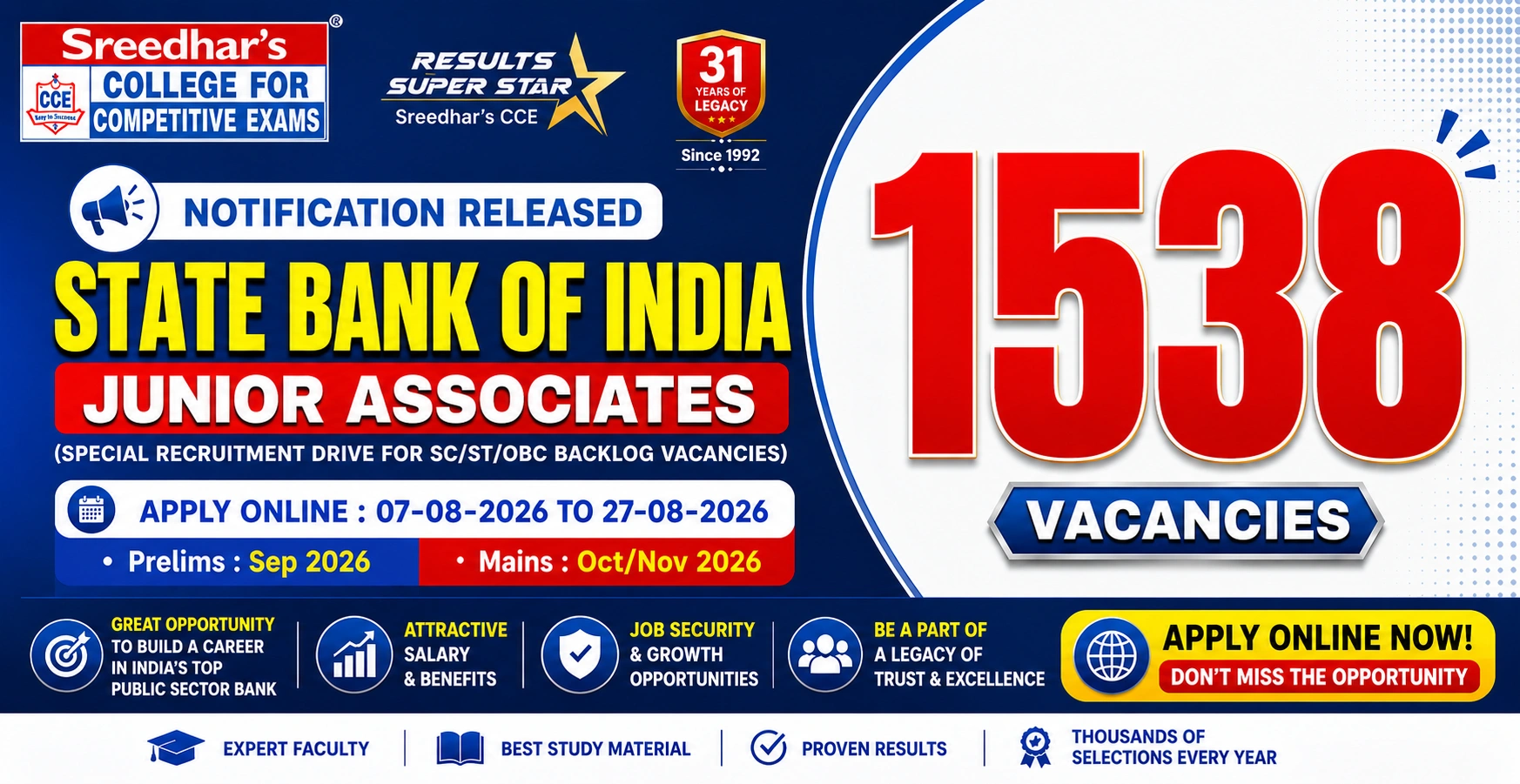
A separate special recruitment drive also exists for certain backlog vacancies. Candidates should not automatically combine every vacancy number appearing online because SBI has issued separate advertisements for the regular recruitment and the special drive.
What Is IBPS Clerk 2026?
IBPS Clerk is the commonly used name for the Customer Service Associate recruitment conducted through the Institute of Banking Personnel Selection.
For the 2026 cycle, the official recruitment is called:
CRP CSA-XVI.
CSA stands for Customer Service Associate.
The recruitment is conducted for participating public sector banks rather than for IBPS itself as an employer.
The 2026 cycle has 11,403 indicative vacancies based on the published vacancy structure.
That distinction is important.
IBPS is the recruitment body.
The eventual employer is one of the participating banks, subject to the provisional allotment process.
The role itself is a clerical or customer-service banking position involving activities such as:
-
Customer service
-
Account-related work
-
Banking transactions
-
Documentation
-
Deposits
-
Withdrawals
-
Cheque services
-
Digital banking support
-
Customer requests
-
Branch operations
The exact work environment will depend on the bank and branch to which the candidate is allotted.
SBI Clerk vs IBPS Clerk: What Is the Biggest Difference?
The biggest difference is not the syllabus.
It is the employment structure.
SBI Clerk
You apply for a Junior Associate position directly with SBI.
If selected, your employer is SBI.
IBPS Clerk
You participate in a common recruitment process conducted by IBPS.
If selected, you are provisionally allotted to one of the participating public sector banks according to the applicable process.
This means that an SBI Clerk selection gives you a more predictable employer identity from the beginning.
With IBPS, the bank you ultimately join depends on the allotment process.
For some candidates, that distinction matters more than the difference in exam difficulty.
Vacancies: Which Gives Better Odds?
Vacancies are one of the first things candidates compare.
For 2026, the broad numbers are:
| Cycle | SBI Clerk | IBPS Clerk |
|---|---|---|
| 2026 | 7,680 regular vacancies | 11,403 indicative vacancies |
| 2025 | 5,180 regular SBI vacancies | Varies by IBPS cycle and participating-bank requirements |
On the face of it, IBPS has more vacancies in 2026.
However, comparing national totals alone can be misleading.
Both recruitment processes involve state or State/UT-level vacancy structures.
Your actual competition depends on:
-
Your State/UT
-
Category
-
Number of vacancies in that State/UT
-
Number of applicants
-
Cut-offs
-
Reservation structure
-
Local language requirements
-
Bank-wise or circle-wise vacancy distribution
Therefore, you should not conclude that IBPS is automatically easier simply because the national vacancy number is higher.
Why State-Wise Vacancies Matter
Suppose one state has a large number of vacancies and another has very few.
Candidates do not compete uniformly across the entire country in the same way.
Your state preference can significantly affect your recruitment prospects.
This is particularly important for SBI because candidates apply for a particular State/UT and are generally posted according to that selection.
SBI's 2026 Vacancy Increase
SBI's 2026 regular vacancy count of 7,680 is substantially higher than the 5,180 regular vacancies announced in the previous cycle.
That represents an increase of roughly 48%.
This makes the 2026 SBI cycle notably larger than the previous regular recruitment.
However, vacancy count should not be interpreted as a guaranteed probability of selection.
A larger vacancy count can increase the number of available positions, but the actual difficulty still depends on applicant volume, state-wise distribution and cut-offs.
IBPS's 2026 Vacancy Pool
The IBPS CSA-XVI cycle has 11,403 indicative vacancies.
The word indicative matters.
IBPS recruitment vacancies can depend on the actual requirements reported by participating banks.
Therefore, candidates should treat the notified figure as the recruitment-cycle vacancy indication rather than assuming that every number translates directly into an immediate joining position.
SBI Clerk vs IBPS Clerk: Which Has Better Competition?
There is no reliable way to determine overall competition simply by looking at the number of vacancies.
You need at least two numbers:
Applicants ÷ vacancies
But even that is incomplete because competition differs by:
-
State
-
Category
-
Exam performance
-
Candidate quality
-
Eligibility
-
Local language
-
Cut-offs
For example, a state with fewer vacancies may have intense competition.
Another state with more vacancies may still have a high cut-off because a large number of candidates apply.
Do Not Choose an Exam Solely Because It Has More Vacancies
This is one of the biggest mistakes banking aspirants make.
The difference between 7,680 and 11,403 vacancies may look huge.
But if your preparation is poor, neither number helps.
A better approach is:
-
Check your state-wise vacancy.
-
Check eligibility.
-
Confirm language requirements.
-
Compare posting rules.
-
Prepare for both exams.
-
Write both.
-
Decide between actual opportunities later.
SBI Clerk vs IBPS Clerk Eligibility
The basic eligibility for both exams is similar.
Educational Qualification
Candidates generally need a graduation degree in any discipline from a recognised university or an equivalent qualification recognised by the relevant authority.
This means candidates from different academic backgrounds can apply.
You do not need a degree in:
-
Banking
-
Finance
-
Economics
-
Commerce
A graduate from engineering, science, arts, management or another discipline can be eligible if the notification requirements are satisfied.
Age Limit
For the 2026 cycles, the standard age range is:
20 to 28 years
Applicable age relaxations are available for eligible reserved and other categories according to government and recruitment rules.
Candidates should always calculate their age using the exact cut-off date specified in the respective notification.
Local Language Requirement
This is one area where candidates need to be particularly careful.
Banking clerical recruitment is heavily connected to customer service in local branches.
Therefore, proficiency in the relevant State/UT language is important.
For SBI, candidates may be required to take a Local Language Proficiency Test unless they satisfy the prescribed exemption, such as having studied the specified language at the required school level.
IBPS also specifies official language requirements connected with the State/UT selected by the candidate.
Why Language Can Become a Deciding Factor
Suppose you are academically eligible for a state but cannot comfortably read, write or speak its specified language.
That can create a problem later even if you clear the written examinations.
Therefore, do not select a state simply because it has more vacancies.
Check the language requirement first.
SBI Clerk vs IBPS Clerk Exam Pattern
The biggest advantage of preparing for both exams is the similarity in the basic syllabus.
Both Prelims examinations have three sections:
-
English Language
-
Numerical Ability
-
Reasoning Ability
The structure is highly similar.
Prelims Pattern
| Section | Questions | Marks | Time |
|---|---|---|---|
| English Language | 30 | 30 | 20 minutes |
| Numerical Ability | 35 | 35 | 20 minutes |
| Reasoning Ability | 35 | 35 | 20 minutes |
| Total | 100 | 100 | 60 minutes |
The sections are separately timed.
That means you cannot simply spend 35 minutes on reasoning because you are comfortable with it and then use the remaining 25 minutes across English and Quant.
Each section has its own time limit.
This changes preparation strategy.
How to Approach SBI and IBPS Prelims
Because the Prelims structures are so similar, your preparation can be combined.
You need to build three abilities:
Speed
You must solve familiar questions quickly.
Accuracy
Wrong answers can cost marks because of negative marking.
Selection
You need to identify which questions to attempt and which to leave.
This third skill is often overlooked.
Bank exams are not necessarily about solving every question.
They are about maximising your score within a fixed time.
English Language Preparation
English is common to both Prelims and remains important in Mains.
Important topics include:
-
Reading comprehension
-
Cloze tests
-
Error detection
-
Sentence correction
-
Fill in the blanks
-
Para jumbles
-
Vocabulary
-
Phrase replacement
-
Grammar
-
Sentence rearrangement
Common English Mistake
Many candidates spend too much time on difficult vocabulary.
For clerical-level banking exams, reading comprehension, grammar and question selection can matter more than memorising thousands of isolated words.
Better Strategy
Spend time reading:
-
Editorial-style articles
-
Banking-related news
-
General current affairs
-
Business articles
While reading, note unfamiliar words.
Do not try to memorise every word.
Instead, understand how words are used in context.
Quantitative Aptitude Preparation
Quant is another common area in both exams.
Important topics include:
-
Simplification
-
Approximation
-
Number series
-
Quadratic equations
-
Data interpretation
-
Percentage
-
Profit and loss
-
Simple and compound interest
-
Ratio and proportion
-
Average
-
Time and work
-
Time, speed and distance
-
Partnership
-
Mixture and allegation
-
Probability
-
Permutation and combination
The Most Important Quant Skill
Calculation speed.
A candidate may know the formula but lose time performing basic calculations.
Practise:
-
Squares
-
Cubes
-
Fraction conversions
-
Percentage conversions
-
Multiplication
-
Division
-
Approximation
Data Interpretation
DI becomes more important in Mains.
Practise:
-
Tables
-
Bar graphs
-
Line graphs
-
Pie charts
-
Caselet DI
-
Missing DI
-
Comparison-based sets
The goal is not only to calculate.
You must identify whether a set is worth attempting.
Reasoning Preparation
Reasoning is one of the biggest scoring opportunities in bank exams, but it can also consume significant time.
Important topics include:
-
Puzzles
-
Seating arrangements
-
Inequality
-
Syllogism
-
Coding-decoding
-
Blood relations
-
Direction sense
-
Alphanumeric series
-
Order and ranking
-
Input-output
-
Data sufficiency
-
Logical reasoning
Puzzle Strategy
Do not try to solve every puzzle.
Learn to identify:
-
Easy puzzles
-
Moderate puzzles
-
Time-consuming puzzles
During mocks, track how long you spend on each set.
If a puzzle takes 12 minutes and produces only four answers, it may not be the best use of your time.
Mains Pattern: SBI Clerk 2026
SBI's Mains examination is broader and more demanding than Prelims.
The structure is:
| Section | Questions | Marks | Time |
|---|---|---|---|
| General/Financial Awareness | 50 | 50 | 35 minutes |
| General English | 40 | 40 | 35 minutes |
| Quantitative Aptitude | 50 | 50 | 45 minutes |
| Reasoning Ability & Computer Aptitude | 50 | 60 | 45 minutes |
| Total | 190 | 200 | 160 minutes |
The Mains paper requires candidates to shift from speed-based Prelims preparation to broader subject preparation.
General and Financial Awareness
This section can become one of the biggest differentiators.
Prepare:
-
Current affairs
-
Banking awareness
-
RBI-related developments
-
Government schemes
-
Financial terminology
-
Banking products
-
Important appointments
-
Reports and indexes
-
National events
-
International events
-
Digital banking
-
Important economic developments
For SBI specifically, candidates should also be comfortable with SBI-related banking products, initiatives and terminology when relevant.
IBPS Clerk Mains 2026 Pattern
The IBPS CSA-XVI Mains structure has been changed from the previous cycle.
For 2026, the pattern is:
| Section | Questions | Marks | Time |
|---|---|---|---|
| General/Financial Awareness | 40 | 50 | 20 minutes |
| General English | 40 | 40 | 35 minutes |
| Reasoning Ability | 40 | 60 | 35 minutes |
| Quantitative Aptitude | 40 | 50 | 35 minutes |
| Total | 160 | 200 | 125 minutes |
This is an important change for candidates who have prepared using older IBPS Clerk material.
The earlier pattern had fewer Quant questions and a shorter overall test.
For CSA-XVI, Quant has been increased to 40 questions, and the total examination duration is 125 minutes.
Why This Change Matters
Candidates who rely on previous-year mock formats may initially feel that their timing is incorrect.
Your practice tests should match the current cycle.
Do not blindly use an old test structure.
If you are preparing for both SBI and IBPS, this means you should practise both Mains formats rather than assuming they are identical.
SBI Clerk vs IBPS Clerk Mains: Key Difference
The biggest difference is not the subject list.
It is the exact distribution of:
-
Questions
-
Marks
-
Time
SBI gives 45 minutes to Quant and 45 minutes to Reasoning plus Computer Aptitude.
IBPS CSA-XVI gives 35 minutes to Quant and 35 minutes to Reasoning.
IBPS also has a separate Reasoning Ability section rather than SBI's combined Reasoning Ability and Computer Aptitude structure.
Therefore, candidates should practise the two Mains formats separately after building common fundamentals.
Negative Marking
Both examinations use negative marking for incorrect answers.
A common rule is:
1/4 mark deducted for each wrong answer.
This makes accuracy important.
Suppose a question carries one mark.
A wrong answer can reduce your score by 0.25 marks.
Four incorrect answers can therefore cost one full mark.
What This Means in Practice
Do not guess blindly.
At the same time, do not become so cautious that you attempt too few questions.
Your target should be:
High accuracy + strong question selection + controlled speed.
Is SBI Clerk Harder Than IBPS Clerk?
This is one of the most common questions.
The answer requires some nuance.
The syllabus is highly similar.
The difficulty level can overlap significantly.
However, SBI Clerk is often perceived as more competitive because state-wise cut-offs can be high and the number of vacancies varies considerably by state.
SBI Prelims
Candidates often encounter:
-
Fast reasoning
-
Time pressure
-
Moderate puzzle selection
-
Speed-heavy Quant
-
English comprehension
IBPS Prelims
The broad skill requirement is similar.
Candidates should still prepare for:
-
Speed
-
Accuracy
-
Sectional timing
-
Question selection
Mains Differences
SBI Mains can feel demanding because of:
-
Longer reasoning sets
-
Computer aptitude integration
-
Financial awareness
-
Time pressure
IBPS Mains can be demanding because of:
-
Quantitative aptitude
-
Data interpretation
-
Reasoning
-
General and financial awareness
The actual difficulty varies from year to year.
Therefore, do not build your preparation around the assumption that one exam is always harder.
SBI Clerk vs IBPS Clerk Cut-Offs
Cut-offs are not fixed.
They depend on:
-
Number of vacancies
-
Number of candidates
-
Difficulty level
-
State
-
Category
-
Normalisation
-
Candidate performance
Why SBI Cut-Offs Can Feel High
SBI has state-wise competition.
If a state has relatively fewer seats and many candidates, the cut-off can rise.
Why You Should Not Chase a Fixed Cut-Off
A common mistake is preparing only to cross the previous year's cut-off.
That is risky.
Suppose the previous year's cut-off was 72.
You prepare to score 74.
If the paper becomes easier, the cut-off could rise.
Instead, aim for a buffer.
Your mock score should be comfortably above the previous trend whenever possible.
SBI Clerk Selection Process
The broad selection process includes:
-
Preliminary Examination
-
Main Examination
-
Local Language Proficiency Test where applicable
-
Document verification and other joining formalities
There is no traditional interview stage for SBI Clerk.
Is Prelims Score Added to Final Merit?
For SBI Clerk, Prelims is primarily a qualifying or screening stage.
The Mains examination carries the main weight for final selection.
This means that once you clear Prelims, your preparation must shift immediately toward Mains.
Do not stop studying after Prelims.
IBPS Clerk Selection Process
The broad process is:
-
Preliminary Examination
-
Main Examination
-
Provisional allotment
-
Language and document-related requirements as applicable
There is no conventional personal interview stage for the clerical recruitment process.
Why This Matters
Candidates who dislike interviews sometimes prefer clerical examinations because the selection is largely examination-driven.
However, this does not make the process easy.
The absence of an interview means your written examination performance becomes even more important.
Language Test: SBI vs IBPS
Language proficiency is an important part of clerical banking recruitment.
SBI Language Test
SBI can conduct a Local Language Proficiency Test for the specified language of the state or union territory selected by the candidate.
Candidates who satisfy the specified educational-language exemption may not need to take the separate test.
IBPS Language Requirement
IBPS also links State/UT preferences with the specified official language requirements.
Candidates should carefully check the language listed for the state they choose.
Why This Is Important for Aspirants From Different States
Do not choose a state purely based on vacancy numbers.
Suppose you are fluent in Telugu but cannot read or write Marathi.
Selecting Maharashtra solely because it has more vacancies may create problems.
Your application strategy should consider:
Vacancies + eligibility + language + posting preference.
SBI Clerk Posting and Transfer Rules
Posting is an important career consideration.
SBI Junior Associates are recruited against State/UT or circle-specific requirements.
The recruitment rules include restrictions on inter-circle and inter-state transfers for newly recruited Junior Associates.
This means you should not approach SBI Clerk assuming that you can freely move to another state immediately after joining.
Why This Matters
If you want to remain in your home state, SBI can be attractive if you apply for the appropriate State/UT and satisfy the language requirement.
But if you know that you may want to relocate to another state soon, read the transfer provisions carefully before making a career decision.
IBPS Clerk Posting and Transfer
IBPS has a different employment structure because the candidate is allotted to a participating bank.
Your eventual workplace depends on:
-
State/UT preference
-
Bank preference
-
Merit
-
Vacancy
-
Allotment rules
-
Bank requirements
Transfer policies then depend on the bank in which you are appointed.
Therefore, IBPS offers a different kind of uncertainty.
You know that you are entering a participating public sector bank, but the specific bank may depend on the allotment process.
Salary: SBI Clerk vs IBPS Clerk
Salary is another major reason candidates compare these exams.
SBI Clerk Salary
SBI Junior Associates have a starting basic pay of approximately:
₹26,730
The starting figure is higher than the base figure generally quoted for IBPS CSA because of the applicable pay structure and advance increments for graduates.
Actual monthly gross earnings can be around:
₹46,000 to ₹48,000
depending on location and allowances.
IBPS Clerk Salary
The starting basic pay is generally around:
₹24,050
The actual gross monthly salary can vary by participating bank and posting location.
A broad starting range often quoted is:
₹36,000 to ₹42,000
The exact amount should not be treated as universal.
Why Gross Salary Varies
Your salary can include components such as:
-
Basic pay
-
Dearness allowance
-
House rent allowance
-
Special allowance
-
Transport-related components
-
Other applicable allowances
Deductions can include:
-
Pension-related contributions
-
Tax where applicable
-
Other deductions
Therefore:
Basic pay ≠ in-hand salary.
Always distinguish between the basic figure, gross earnings and take-home salary.
Why SBI Pays More Initially
One reason SBI's starting basic pay is higher is the structure of its Junior Associate compensation, including advance increments applicable to graduates.
SBI also has its own allowance structure.
This creates a noticeable difference at the beginning of the career.
However, salary should not be the only factor you consider.
A job involves:
-
Posting
-
Workload
-
Transfer policy
-
Promotion
-
Bank culture
-
Career progression
-
Location
-
Work-life balance
-
Future opportunities
Career Growth: SBI Clerk
SBI provides multiple avenues for career progression.
A Junior Associate can progress through internal promotional opportunities subject to eligibility, performance, examinations and applicable bank rules.
Over time, employees can move into higher clerical or officer-level roles through the bank's internal career structure.
Officer Promotion
SBI has internal pathways through which eligible clerical employees can move toward officer positions.
Professional banking qualifications and internal examinations can play a role in career progression.
JAIIB and CAIIB
Bank employees may pursue professional banking qualifications such as:
-
JAIIB
-
CAIIB
These can support professional development and may have relevance in internal career progression and compensation under applicable rules.
Career Growth: IBPS Clerk
IBPS CSA employees also have opportunities for promotion within their respective banks.
However, once you are allotted to a bank, your career progression is governed by that bank's rules and policies.
This means that the exact promotion experience can vary.
A candidate should therefore distinguish between:
IBPS as the recruitment process
and
the bank as the actual employer.
SBI Clerk vs IBPS Clerk: Work Profile
At the clerical level, both roles are customer-facing.
You may handle:
-
Account opening support
-
Customer requests
-
Deposits
-
Withdrawals
-
Cheque services
-
Passbook-related work
-
Documentation
-
Digital banking support
-
Banking product information
-
Branch administration
-
Customer queries
The exact workload depends on:
-
Branch size
-
Location
-
Customer volume
-
Staff strength
-
Business targets
-
Banking operations
Customer Interaction
If you prefer a role with limited customer interaction, neither SBI Clerk nor IBPS Clerk should automatically be assumed to be a back-office position.
Both can involve significant customer-facing work.
You may need to:
-
Explain banking products
-
Resolve basic customer issues
-
Guide customers through digital services
-
Handle documentation
-
Process transactions
Communication skills therefore matter.
SBI Clerk vs IBPS Clerk: Which Has Better Job Security?
Both offer public sector banking employment and are generally viewed as stable career options.
However, job security should be considered alongside actual employment conditions.
The important factors include:
-
Permanent employment structure after successful appointment and probation requirements
-
Salary revisions
-
Promotion opportunities
-
Retirement benefits
-
Transfer policies
-
Work responsibilities
Instead of treating one as automatically "more secure," candidates should compare the specific employment conditions and their own priorities.
SBI Clerk vs IBPS Clerk: Which Has Better Brand Value?
SBI is one of India's most recognised banking institutions.
This gives SBI Junior Associate a strong employer identity.
IBPS Clerk, however, is not one employer.
It is a recruitment process leading to participating public sector banks.
The brand value therefore depends partly on the bank to which you are allotted.
If employer identity matters strongly to you, the distinction is straightforward:
SBI Clerk = direct SBI employment
IBPS Clerk = allotment to a participating public sector bank
Which Exam Has a Better Syllabus?
The syllabus overlap is substantial.
For Prelims, the preparation is almost entirely common:
-
English
-
Quant
-
Reasoning
For Mains, both include:
-
General/Financial Awareness
-
English
-
Quant
-
Reasoning
The differences are mainly in:
-
Section structure
-
Question distribution
-
Time allocation
-
Computer Aptitude integration in SBI
-
Current pattern changes
This is why preparing for one exam can significantly help with the other.
Which Exam Requires More Current Affairs Preparation?
Both require General and Financial Awareness in Mains.
You should prepare:
-
Current affairs
-
Banking news
-
RBI developments
-
Government schemes
-
Financial institutions
-
Economic developments
-
Appointments
-
Awards
-
Reports
-
Important national events
-
International developments
SBI-Specific Preparation
For SBI, add awareness of:
-
SBI products
-
SBI initiatives
-
SBI digital banking services
-
SBI campaigns
-
Important SBI-related developments
IBPS Preparation
For IBPS, focus more broadly on:
-
Banking sector developments
-
Participating public sector banks
-
RBI
-
Financial awareness
-
Government schemes
-
National and international banking news
How Many Months of Current Affairs Should You Study?
For Mains preparation, many banking aspirants focus heavily on the most recent several months.
A practical approach is to cover approximately the last six months thoroughly and then revise important banking and financial developments from the preceding period if time permits.
Do not simply read current affairs once.
Use three stages:
Read → Revise → Test
Reading gives exposure.
Revision builds retention.
Mocks reveal whether you actually remember the information.
SBI Clerk vs IBPS Clerk: Which Is Better for Beginners?
A beginner may assume they should choose one exam to avoid confusion.
That is not necessary.
Because the syllabus overlaps significantly, beginners can prepare for both simultaneously.
Start with:
-
English
-
Quant
-
Reasoning
Then add:
-
Banking awareness
-
Financial awareness
-
Current affairs
-
Mains-level reasoning
-
Mains-level Quant
Once your Prelims foundation is strong, preparing for the two exams becomes manageable.
SBI Clerk vs IBPS Clerk: Which Should Repeat Aspirants Choose?
Repeat candidates should avoid simply repeating last year's preparation.
If you attempted SBI or IBPS previously, analyse:
-
Prelims score
-
Sectional score
-
Accuracy
-
Attempts
-
Time management
-
Mains score
-
GA performance
-
Puzzle performance
-
DI performance
Use Your Previous Score as Data
Suppose you scored:
English: 24/30
Reasoning: 22/35
Quant: 14/35
Your problem is probably not English.
Your Quant preparation needs more attention.
Likewise, if your Prelims score was strong but Mains performance was weak, your focus should shift to Mains rather than repeating basic Prelims preparation.
Which Exam Should You Prioritise After SBI Prelims?
Since SBI Prelims has already taken place on 26 and 27 September 2026, candidates who appeared for it should now use the experience as feedback for IBPS Prelims.
Do not spend too much time analysing every SBI question.
Instead, ask:
-
Was my timing sufficient?
-
Which section consumed the most time?
-
Did I make avoidable mistakes?
-
Did I attempt too many difficult questions?
-
Which topic slowed me down?
-
Was my English reading speed adequate?
-
Did I panic when a puzzle looked difficult?
Then apply those lessons to IBPS.
Use SBI Prelims as an IBPS Simulation
The gap between the two Prelims examinations is useful.
You have an opportunity to convert your SBI experience into immediate improvement.
If Your SBI Quant Was Slow
Practise:
-
Simplification
-
Approximation
-
Number series
-
Arithmetic
-
DI
under a strict 20-minute limit.
If Reasoning Was Slow
Practise:
-
Seating
-
Puzzles
-
Inequality
-
Syllogism
-
Coding-decoding
Focus on question selection.
If English Was Weak
Practise:
-
Reading comprehension
-
Cloze tests
-
Error detection
-
Fillers
Focus on accuracy.
SBI Clerk vs IBPS Clerk Preparation Strategy
The most efficient approach is not to create two completely separate study plans.
Instead:
80% common preparation + 20% exam-specific preparation.
Common Preparation
Spend most of your time on:
-
English
-
Quant
-
Reasoning
-
Current affairs
-
Banking awareness
-
Mock tests
SBI-Specific Preparation
Add:
-
SBI-related awareness
-
SBI Mains structure
-
Computer aptitude
-
SBI-specific timing strategy
IBPS-Specific Preparation
Add:
-
CSA-XVI Mains pattern
-
Updated Quant distribution
-
Participating bank awareness
-
IBPS-specific mock practice
2026 Preparation Timeline
The remaining 2026 schedule gives candidates a useful sequence.
| Window | Priority |
|---|---|
| Now to 10 October | IBPS Prelims |
| 11 October to early November | Mains transition and current affairs |
| Early November to 23 November | SBI Mains preparation |
| 24 November to 27 December | IBPS Mains preparation |
| After IBPS Mains | Revision for other banking opportunities and next cycles |
Now to 10 October: IBPS Prelims
Your preparation should be highly focused.
Prioritise:
-
Sectional mocks
-
Full mocks
-
Previous-year questions
-
Speed
-
Accuracy
-
Question selection
Do not start learning large new topics.
After IBPS Prelims
Immediately move toward Mains.
Increase your focus on:
-
Current affairs
-
Banking awareness
-
DI
-
High-level puzzles
-
Reasoning
-
English
-
Mains mocks
Before SBI Mains
If you clear SBI Prelims, your focus should become SBI Mains-specific.
Do not wait for the result before preparing.
The time between Prelims result and Mains can be limited.
A Practical Daily Study Plan
If you can study five hours per day:
| Activity | Time |
|---|---|
| Quant | 60 minutes |
| Reasoning | 60 minutes |
| English | 45 minutes |
| Current Affairs/Banking Awareness | 60 minutes |
| Mock/Sectional Test | 45 minutes |
| Mock Analysis | 30 minutes |
The exact duration can change according to your strengths.
If You Are Weak in Quant
Increase Quant time.
If You Are Weak in Reasoning
Spend more time on puzzles and timed sets.
If You Are Weak in GA
Use more time for current affairs and revision.
The goal is not equal time.
The goal is effective time.
Mock Tests: SBI vs IBPS
Mock tests are essential for both exams.
But simply taking mocks is not enough.
The real improvement comes from analysis.
After every mock, record:
-
Score
-
Attempts
-
Accuracy
-
Time
-
Wrong answers
-
Unattempted questions
-
Questions that consumed too much time
Build a Mock Analysis Sheet
| Metric | Your Result | Target |
|---|---|---|
| Total score | 68 | 80+ |
| Accuracy | 84% | 90%+ |
| Quant attempts | 22 | Improve |
| Reasoning attempts | 28 | Maintain |
| English attempts | 25 | Maintain |
| Time lost on puzzles | 8 min | Reduce |
| Silly mistakes | 5 | Reduce |
The target should be based on your exam, state, category and mock difficulty rather than a universal number.
Why Mock Analysis Is More Important Than Mock Count
Suppose one candidate takes 50 mocks but never reviews mistakes.
Another takes 20 mocks and analyses every wrong answer.
The second candidate may improve more.
For every wrong question, ask:
Why did I get it wrong?
Possible reasons include:
-
Did not know the concept
-
Calculation mistake
-
Misread the question
-
Ran out of time
-
Chose the wrong approach
-
Guessed
-
Panicked
-
Did not understand the language
Each reason requires a different fix.
SBI Clerk vs IBPS Clerk: Which Has Better Career Growth?
Both offer structured banking careers.
SBI has a clearly defined internal promotion system.
IBPS candidates are employed by individual participating banks, so career progression depends on the bank.
This means there is no single universal IBPS career path.
What Matters More Than the Initial Designation
Look at:
-
Promotion speed
-
Internal exams
-
Transfer rules
-
Salary progression
-
Officer promotion opportunities
-
Location
-
Workload
-
Bank-specific policies
Your first designation is only the beginning of your banking career.
Can SBI Clerk Become an Officer?
Yes, eligible SBI clerical employees can pursue internal career progression toward officer roles under applicable bank policies and promotion processes.
This makes SBI Clerk more than just a long-term clerical position.
Candidates who join with the intention of progressing should understand:
-
Internal promotion examinations
-
Banking qualifications
-
Performance requirements
-
Eligibility conditions
Career progression requires preparation after joining as well.
Can IBPS Clerk Become an Officer?
Yes, clerical employees in participating public sector banks can have internal promotion opportunities.
However, the exact pathway depends on the bank.
This is another reason why the participating bank matters in an IBPS selection.
SBI Clerk vs IBPS Clerk: Work Pressure
Work pressure varies significantly by branch.
A busy urban branch can have:
-
Large customer volume
-
High transaction volume
-
Sales-related targets
-
Documentation
-
Digital service support
-
Long queues
A smaller branch may have a different work environment.
Therefore, avoid assuming that SBI is always more stressful or IBPS is always easier.
Your branch, manager, staffing and customer base can make a major difference.
SBI Clerk vs IBPS Clerk: Work-Life Balance
Neither exam guarantees a particular work-life balance.
It depends on:
-
Branch location
-
Staff strength
-
Customer load
-
Business targets
-
Managerial environment
-
Banking workload
-
Transfer
Candidates should therefore treat work-life balance as a factor to investigate rather than something guaranteed by the exam.
SBI Clerk vs IBPS Clerk for Candidates Who Want to Stay in Their Home State
This is an important consideration.
SBI recruitment is closely linked to the State/UT selected by the candidate, with specific transfer restrictions.
IBPS also involves State/UT preferences, but the eventual employer is determined through the allotment process.
If staying close to home is a major priority, carefully compare:
-
State vacancy
-
Language
-
Posting rules
-
Transfer provisions
-
Participating-bank presence
Do not assume that clearing an exam automatically guarantees a posting in your hometown.
SBI Clerk vs IBPS Clerk for Candidates From Telangana
For candidates applying from Telangana, local language requirements deserve particular attention.
Telugu is the principal regional language relevant to banking recruitment in the state, and candidates should carefully check the exact language requirements stated in the current notification.
The same principle applies across India.
Before selecting a State/UT, verify:
-
Vacancy
-
Official language
-
Eligibility
-
Posting rules
-
Transfer provisions
SBI Clerk vs IBPS Clerk: What Should You Study First?
If you are preparing for both, start with the common subjects.
First Priority
Reasoning + Quant + English
These determine Prelims performance.
Second Priority
Current Affairs + Banking Awareness
These become important for Mains.
Third Priority
Advanced Reasoning + DI
These require longer practice.
Fourth Priority
Computer Aptitude where applicable
For SBI Mains, include computer-related concepts as part of your preparation.
Common Mistakes Candidates Make While Preparing for Both
Treating the Exams as Completely Different
This doubles your workload unnecessarily.
Treating Them as Completely Identical
This creates problems because the Mains patterns differ.
Ignoring Current Affairs Until After Prelims
This can make Mains preparation extremely stressful.
Preparing Only From Old Mocks
The 2026 IBPS Mains pattern has changed.
Choosing a State Without Checking Language
This can create eligibility or language-test issues.
Assuming More Vacancies Means Easier Selection
Vacancies do not determine difficulty by themselves.
Which Exam Should You Choose If You Can Only Write One?
If circumstances genuinely force you to choose only one, compare the factors that matter most to you.
Choose SBI as the Higher Priority If:
-
Starting salary is a major factor.
-
You prefer being directly recruited by SBI.
-
You are comfortable with SBI's posting and transfer rules.
-
You satisfy the required local language conditions.
-
You prefer SBI's employer identity.
-
You are comfortable with the SBI Mains structure.
Choose IBPS as the Higher Priority If:
-
You want access to a larger vacancy pool.
-
You are comfortable with participating-bank allotment.
-
You prefer the IBPS recruitment structure.
-
You satisfy the relevant State/UT language requirements.
-
You are comfortable with the CSA-XVI Mains pattern.
However, for a candidate who is eligible for both, there is generally little practical reason to voluntarily eliminate one opportunity before taking the examinations.
Which One Should Most Candidates Prioritise?
Instead of choosing one exam, treat them as two opportunities built on almost the same preparation base.
The logical strategy is:
Prepare together → Write both → Compare actual outcomes.
This is especially useful in banking recruitment because selection depends on several variables that cannot be known in advance.
You may perform better in SBI.
You may perform better in IBPS.
Your state may have different vacancy levels.
One exam may have a more favourable paper.
Your rank may differ.
Therefore, preserving both opportunities is generally more practical than predicting the outcome beforehand.
What Happens After SBI Prelims?
If you appeared for SBI Prelims on 26–27 September, your immediate priority should be IBPS Prelims preparation.
Do not wait for the SBI result.
Continue with:
-
Daily sectional tests
-
Full mocks
-
Quant practice
-
Reasoning sets
-
English practice
At the same time, start limited Mains preparation.
You do not need to spend three hours a day on GA yet, but you should not completely ignore it.
What Happens After IBPS Prelims?
Once IBPS Prelims is over, move toward Mains preparation immediately.
Your priorities should become:
-
Current affairs
-
Banking awareness
-
Financial awareness
-
Mains-level reasoning
-
DI
-
English
-
Full-length Mains mocks
The transition should be fast.
Prelims preparation builds speed.
Mains preparation builds depth.
SBI Clerk vs IBPS Clerk: Final Comparison by Candidate Type
| Candidate profile | Relevant focus |
|---|---|
| Wants higher starting pay | SBI Clerk |
| Wants more vacancies | IBPS Clerk |
| Wants direct SBI employment | SBI Clerk |
| Wants access to multiple participating banks | IBPS Clerk |
| Wants to maximise opportunities | Both |
| Strong in Prelims, weak in GA | Strengthen Mains GA for both |
| Strong in Quant | Both, with IBPS Mains pattern practice |
| Strong in Reasoning | Both |
| Wants home-state posting | Check state-wise rules for both |
| Unsure about career path | Prepare for both and decide after selection |
How Sreedhar's CCE Can Help With SBI and IBPS Clerk Preparation
Candidates preparing for both SBI Clerk and IBPS Clerk often face one practical problem: managing two exam calendars without duplicating preparation.
A combined preparation approach can solve this.
Sreedhar's CCE can support aspirants with structured banking preparation covering common areas such as:
-
Quantitative Aptitude
-
Reasoning Ability
-
English Language
-
Banking Awareness
-
Current Affairs
-
Financial Awareness
-
Mock Tests
-
Previous-year questions
-
Exam-specific revision
The biggest advantage of a combined approach is that you can build common fundamentals once and then adapt them to the individual exam pattern.
For example, the same reasoning preparation can support SBI Prelims and IBPS Prelims.
The same Quant fundamentals can support both examinations.
Then, once Prelims are over, your preparation can be customised for the relevant Mains structure.
A good banking preparation programme should also emphasise mock analysis rather than simply providing more tests.
Candidates should know:
-
Where they are losing marks
-
Which sections consume too much time
-
Which topics are weak
-
Whether their accuracy is improving
-
Whether they are ready for Mains
For aspirants appearing for both exams in 2026, a combined mock and revision strategy can be particularly useful because the examination dates are close.
Leave a Comment
Required fields are marked *