



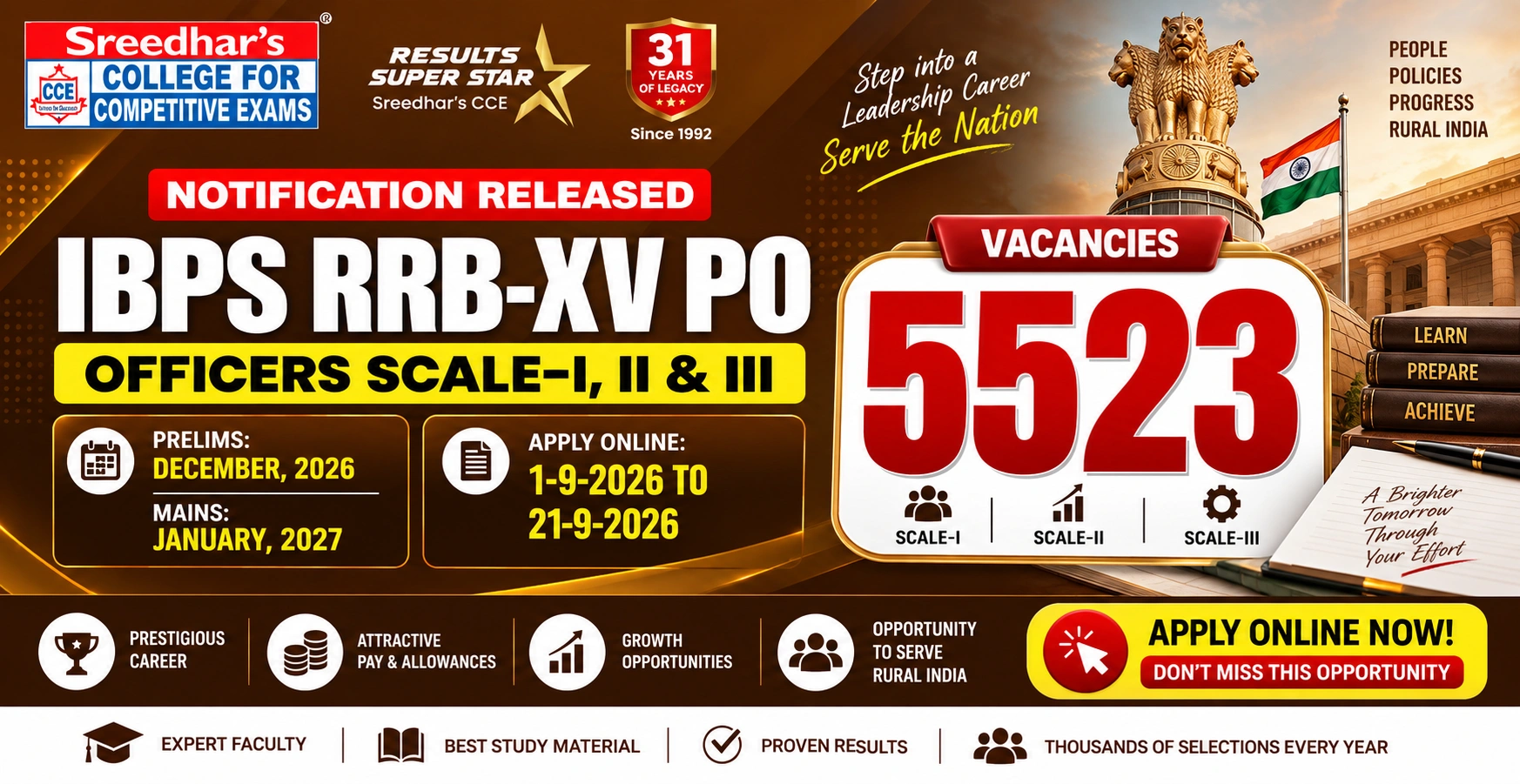
IBPS RRB XV PO Notification 2026
5,523 Officer Scale I, II and III Vacancies Explained
The Institute of Banking Personnel Selection has released the CRP RRB XV notification, and for officer cadre aspirants this is the biggest opportunity of the year. A total of 5,523 vacancies have been announced across Officer Scale I, Officer Scale II and Officer Scale III posts in Regional Rural Banks across India. If you have been preparing for a banking officer role that offers managerial responsibility, officer grade pay and a posting that usually stays within your home state, this notification deserves your undivided attention.
At Sreedhar's College for Competitive Exams, we have guided thousands of banking aspirants through exactly this process, from understanding the fine print of the notification to walking into the interview room with confidence. This article covers everything you need about the IBPS RRB XV Officer Scale I, II and III recruitment: dates, vacancies, eligibility, exam pattern, syllabus, salary, interview preparation and a realistic study plan built around the actual exam calendar.
Understanding the IBPS RRB XV Officer Recruitment
Regional Rural Banks occupy a unique position in India's banking landscape. They were established to serve rural and semi urban populations, extend agricultural credit, and drive financial inclusion in areas where commercial banking presence has historically been thin. Working as an officer in an RRB means being directly involved in that mission, whether through processing farm loans, expanding self help group linkages or managing a branch that serves as the primary financial touchpoint for an entire cluster of villages.
The officer cadre in RRBs is structured across three scales. Officer Scale I is the entry level officer position, functionally equivalent to an Assistant Manager. Officer Scale II covers Manager level roles and is split into General Banking Officer and Specialist Officer streams such as IT, Law, Chartered Accountant, Treasury, Marketing and Agriculture. Officer Scale III is the Senior Manager grade, reserved for candidates with substantial prior banking experience.
Together with the Office Assistant posts, this recruitment cycle covers a large total vacancy pool across participating Regional Rural Banks nationwide. The 5,523 officer vacancies represent the single biggest officer grade banking recruitment opportunity available to aspirants this year, and one that comes with a clear, well documented and transparent selection process.
One point worth noting immediately: the official notification states that candidates can apply for Office Assistant as well as an Officer post, but they can apply for only one post among Officer Scale I, Scale II and Scale III. This means you need to make a considered decision about which officer scale suits your profile before you fill the form, since you cannot hedge across multiple officer scales.
Key Dates for the Officer Posts
Getting the timeline right matters more for officer aspirants than most people realise, because the officer exam schedule runs ahead of the Office Assistant schedule. Candidates who assume the two share the same dates can lose weeks of preparation time.
| Event | Date |
|---|---|
| Window notification released | 31 August 2026 |
| Detailed notification and online registration opens | 1 September 2026 |
| Last date to apply online | 21 September 2026 |
| Application fee payment window | 1 September to 21 September 2026 |
| Officer Scale I Prelims examination | 21 and 22 November 2026 |
| Officer Scale I Mains examination | 20 December 2026 |
| Officer Scale II and III Single examination | 20 December 2026 |
| Common interview | To be announced |
| Provisional allotment | To be announced |
According to the official IBPS 2026 to 2027 examination calendar, the Officer Scale I Preliminary Examination is scheduled for 21 and 22 November 2026, while the Main or Single Examination for Officers Scale I, II and III is scheduled for 20 December 2026.
That gives officer aspirants roughly two months from now to the Prelims, and less than a month between Prelims and Mains. This compressed window is why we always advise our students at Sreedhar's CCE to begin Mains level preparation alongside Prelims preparation rather than sequentially. Waiting for the Prelims result before opening a General Awareness book is a strategy that has cost countless candidates their selection.
Application fee payment is available throughout the registration window, though we strongly recommend completing your form in the first week. Server congestion in the final days of an IBPS application window is a recurring problem, and a failed payment on 21 September means waiting an entire year for the next cycle.
Vacancy Breakdown Across the Officer Scales
The 5,523 officer vacancies are distributed across Officer Scale I, Officer Scale II in both General Banking and Specialist streams, and Officer Scale III. The bulk of these positions fall under Officer Scale I, which is the entry level officer post open to any graduate without prior work experience. Officer Scale II vacancies are split between the General Banking Officer role and specialist cadres including IT Officer, Chartered Accountant, Law Officer, Treasury Manager, Marketing Officer and Agricultural Officer. Officer Scale III vacancies are comparatively fewer, as expected for a senior management grade requiring five years of banking experience.
These vacancies span 28 participating Regional Rural Banks operating across states including Andhra Pradesh, Telangana, Karnataka, Tamil Nadu, Kerala, Maharashtra, Gujarat, Rajasthan, Uttar Pradesh, Bihar, West Bengal, Odisha, Madhya Pradesh, Punjab, Haryana and the north eastern region. IBPS has updated the names of several Regional Rural Banks in this cycle, including Assam Gramin Bank, Chhattisgarh Gramin Bank, Haryana Gramin Bank, Jharkhand Gramin Bank, Kerala Grameena Bank and Puducherry Grama Bank. Candidates should use the updated names when selecting their preferred bank in the application form.
Vacancy numbers in IBPS recruitment cycles are indicative rather than final. In this cycle alone, the total vacancy count was revised upward from an initial figure to a higher number as per a vacancy update issued in September 2026. IBPS revises these figures based on actual requirements reported by participating banks, so always treat the official notification PDF and any subsequent corrigendum as the authoritative source.
For candidates based in Andhra Pradesh and Telangana, including our students across Vijayawada and other centres, paying attention to the state wise vacancy annexure is particularly important. Cut offs for Officer Scale I are calculated separately for each state and category combination, which means the number of seats available in your chosen state directly influences how competitive your attempt will be.
Eligibility Criteria by Officer Scale
Eligibility differs meaningfully across the three officer scales, and misreading these requirements is one of the most common reasons candidates are disqualified after clearing the written stages. Here is the breakdown.
Officer Scale I, Assistant Manager
For Officer Scale I, candidates must be above 18 and below 30 years of age with a bachelor's degree in any discipline. No prior work experience is required, which is what makes this post accessible to fresh graduates. Having relevant banking or financial sector experience is not mandatory, though it can be beneficial.
Preference is typically given to candidates with a degree in Agriculture, Horticulture, Forestry, Animal Husbandry, Veterinary Science, Agricultural Engineering, Pisciculture, Agricultural Marketing and Cooperation, Information Technology, Management, Law, Economics or Accountancy, given the nature of RRB operations. Proficiency in the local language of the state where you are applying is a mandatory requirement.
Officer Scale II, General Banking Officer
Officer Scale II requires candidates to be above 21 and below 32 years of age. Scale II General Banking Officer requires graduation with a minimum of 50 percent marks. In addition, the post requires experience of two years as an Officer in a Bank or Financial Institution.
Officer Scale II, Specialist Officers
Specialist Officer posts under Scale II carry the same age range as the General Banking Officer role but require a domain specific qualification along with relevant experience. The experience requirements are: IT Officers one year, Chartered Accountant one year as a Chartered Accountant, Law Officer two years of work as an advocate or two years or more as a Law Officer in banks or financial institutions, Treasury Manager one year, Marketing Officer one year, and Agricultural Officer two years.
Qualification requirements for these specialist streams include a relevant specialised degree, such as B.Tech or B.E. for IT, CA for Accounts and LLB for Law.
Officer Scale III, Senior Manager
Officer Scale III requires candidates to be above 21 and below 40 years of age, along with prescribed qualifications and relevant work experience. The qualification requirement is a bachelor's degree with a minimum of 50 percent marks along with five years of banking experience. Specifically, a minimum of five years of experience as an Officer in a Bank or Financial Institution is required.
Candidates in their final year of graduation cannot apply for Officer Scale III, since applicants must have completed their graduation and be at least 21 years old to be eligible.
Nationality Requirements
Indian citizens, citizens of Nepal and Bhutan, Tibetan refugees settled in India before 1 January 1962, and persons of Indian origin from select countries with a certificate of eligibility can apply.
Age Relaxation
Standard age relaxation applies for SC, ST, OBC, PwBD and ex servicemen candidates as per Government of India norms. The exact relaxation table is provided in the detailed notification PDF and should be verified against your specific category before applying.
Local Language Requirement
This requirement catches out more candidates than any other single clause in the notification, and it is worth understanding properly.
Because RRB officers work directly with rural and semi urban customers who may not be comfortable in English or Hindi, proficiency in the official language of the state where the RRB operates is a genuine eligibility condition rather than a formality. Candidates who have studied the concerned State language in Standard VIII or at any level above Standard VIII from a Government recognised Board are generally treated as meeting this requirement. Candidates who cannot demonstrate this through their academic record are typically required to clear a Language Proficiency Test before final joining.
The practical implication is straightforward. Apply to an RRB in a state whose language you genuinely speak and read. There is no advantage in chasing a state with marginally lower cut offs if you cannot clear the language test afterwards, and the disappointment of losing a selection at that final stage is entirely avoidable.
There is an upside to this requirement as well. Because recruitment is tied to a specific state, RRB officers are generally posted within their own region rather than being transferred across the country, which matters considerably to candidates with family commitments. For many aspirants, this is precisely why an RRB officer role appeals more than a commercial bank PO position with a nationwide transfer liability.
Exam Pattern for Officer Scale I
Officer Scale I follows a three stage selection process: Preliminary examination, Main examination and a common interview.
Preliminary Examination
The Prelims consists of two sections, Reasoning and Quantitative Aptitude, with a total of 80 questions to be completed within 45 minutes. The Prelims has 40 questions in Reasoning allotted 25 minutes and 40 questions in Numerical Ability allotted 20 minutes, totalling 45 minutes.
| Section | Questions | Marks | Duration |
|---|---|---|---|
| Reasoning | 40 | 40 | 25 minutes |
| Quantitative Aptitude | 40 | 40 | 20 minutes |
| Total | 80 | 80 | 45 minutes |
Candidates must meet sectional and overall cut offs to qualify for Mains. Marks scored in Prelims are not carried forward to the final merit list. This stage exists purely to shortlist candidates for the next round.
Main Examination
The Mains has 200 questions in 120 minutes covering Reasoning, Quantitative Aptitude, Language in English or Hindi, General Awareness and Computer Knowledge, with candidates free to choose either English or Hindi for the language section.
| Section | Questions | Marks |
|---|---|---|
| Reasoning | 40 | 50 |
| Quantitative Aptitude and Data Interpretation | 40 | 50 |
| General Awareness | 40 | 40 |
| English or Hindi Language | 40 | 40 |
| Computer Knowledge | 40 | 20 |
| Total | 200 | 200 |
A negative marking of 0.25 marks applies for every incorrect answer, while unanswered questions attract no penalty.
Interview
Officer Scale I candidates who clear the Mains are called for a common interview conducted by the participating RRBs coordinated by IBPS or NABARD. The interview typically carries 100 marks, and the final merit is generally calculated on a weightage of 80 percent for the Mains score and 20 percent for the interview score. Final selection is based on Mains or Single Level Exam scores combined with interview marks.
Exam Pattern for Officer Scale II and Officer Scale III
The structure for the senior officer scales is different and notably more compressed.
Officer Scale II and Scale III candidates appear for a single level online exam followed by an interview, with no preliminary stage. Both are scheduled to be conducted through a Single Online Examination on 20 December 2026.
Officer Scale II, General Banking Officer
The single examination covers Reasoning, Quantitative Aptitude and Data Interpretation, English or Hindi, Computer Knowledge, General Awareness and Banking Knowledge, typically across 200 questions carrying 200 marks with a duration of 2 hours.
Officer Scale II, Specialist Officers
Specialist candidates face a paper covering Professional Knowledge relevant to the post, Reasoning, Quantitative Aptitude and Data Interpretation, English or Hindi, Computer Knowledge and General Awareness. The Professional Knowledge section typically carries the heaviest weightage, since it tests domain expertise that the role directly requires.
Officer Scale III
The Scale III single examination covers Reasoning, Quantitative Aptitude and Data Interpretation, English or Hindi, Computer Knowledge, General Awareness and Banking Knowledge, again typically across 200 questions worth 200 marks.
Duration varies by post, typically 2 hours for Scale I and 2.5 hours for Scale II and Scale III. The exact structure and timing is specified in the official notification, and candidates should treat the PDF as the final authority rather than any secondary source.
Because there is no Prelims filter for Scale II and III, every single mark in the single examination counts toward your final outcome alongside the interview. This raises the stakes considerably and is why experienced candidates targeting these scales should not treat the exam casually just because they have banking experience. Domain experience helps in Professional Knowledge and the interview, but the aptitude sections still demand structured practice.
Detailed Syllabus for Officer Posts
Understanding what to study, and at what depth, separates candidates who clear cut offs from those who miss by a handful of marks. Here is a section by section breakdown relevant to officer aspirants.
Reasoning Ability
Officer level Reasoning is noticeably harder than the clerical equivalent. Expect complex seating arrangements with multiple variables, floor and box based puzzles, scheduling puzzles, syllogism including reverse syllogism, coding decoding at a higher difficulty, blood relations, direction sense, input output, data sufficiency and critical reasoning including statement and assumption, cause and effect, and course of action questions.
Puzzles and seating arrangement typically dominate this section, often accounting for half the questions or more. Building the ability to identify which puzzle type you are looking at within the first thirty seconds, and knowing which ones to skip, is the single biggest determinant of your Reasoning score under time pressure.
Quantitative Aptitude and Data Interpretation
This section covers simplification and approximation, number series including missing and wrong number series, quadratic equations, data interpretation across tables, bar graphs, line graphs, pie charts, caselets and mixed sets, data sufficiency, and the full arithmetic range including percentage, ratio and proportion, profit and loss, simple and compound interest, time and work, time speed and distance, boats and streams, pipes and cisterns, mixtures and alligation, averages, ages, partnership, mensuration, permutation and combination, and probability.
Data interpretation carries the heaviest weightage at the officer level, particularly in Mains. Officer level DI sets are more calculation intensive and often combine multiple concepts within a single set, which makes practising approximation techniques and mental calculation shortcuts essential rather than optional.
English or Hindi Language
For English, the syllabus covers reading comprehension, cloze test, error spotting, sentence improvement, para jumbles, sentence rearrangement, fillers including double fillers, word usage and vocabulary, phrase replacement, connectors and paragraph completion. Reading comprehension passages at officer level are typically drawn from business, economics and current affairs contexts, so regular reading of financial newspapers builds both comprehension speed and General Awareness simultaneously.
For Hindi, the equivalent topics include comprehension passages, vyakaran, vaakya shuddhi, shabd gyaan and rearrangement based questions. Choose the language you are genuinely faster and more accurate in rather than choosing English by default.
General Awareness and Banking Knowledge
This is where officer aspirants can build a decisive advantage. The section leans heavily toward banking and financial awareness rather than static general knowledge. Focus areas include RBI functions and monetary policy tools, banking regulations and the Banking Regulation Act, NABARD and its role in rural credit, priority sector lending norms, financial inclusion schemes, the structure and functioning of Regional Rural Banks themselves, capital markets and SEBI, insurance and IRDAI, recent Union Budget provisions, government schemes particularly those related to agriculture and rural development, important national and international appointments, awards, sports and summits.
General Awareness in the RRB exam leans heavily on rural and cooperative banking, and aspirants who master this area quietly overtake hundreds on the merit list. Current affairs from the preceding four to six months are the most commonly tested, so building a daily reading habit now pays off directly in December.
Computer Knowledge
Computer fundamentals and generations, hardware and software basics, operating systems, MS Office including Word, Excel and PowerPoint, internet and networking concepts, database basics, computer security including viruses and firewalls, shortcut keys, abbreviations, and banking technology terms such as CBS, NEFT, RTGS, IMPS, UPI and NPCI.
In Mains, Computer Knowledge is a separate full section worth 20 marks. Since the syllabus is limited and factual, it offers one of the highest returns per hour of study in the entire exam.
Professional Knowledge for Specialist Officers
Scale II specialist candidates must prepare their domain syllabus thoroughly. IT Officers should cover database management, networking, operating systems, software engineering, data structures and information security. Law Officers should focus on banking related legislation, contract law, negotiable instruments, SARFAESI, RBI guidelines and consumer protection. Chartered Accountants should prepare accounting standards, auditing, taxation and financial management. Agricultural Officers should study crop production, soil science, agricultural economics, animal husbandry and rural credit systems. Marketing and Treasury Officers should prepare their respective functional domains along with relevant banking applications.
Application Process and Documents
The online application window runs from 1 September 2026 to 21 September 2026 on the official IBPS website. Before you begin, assemble the following.
A recent passport size photograph and scanned signature matching the exact dimensions and file size specified in the notification. The signature must be signed in black ink on white paper, sized between 10 KB and 20 KB with dimensions of 140 by 60 pixels, and signatures in capital letters are invalid. A handwritten declaration in the prescribed format. Your 10th standard certificate as date of birth proof. Graduation degree and marksheets. Category certificate if applicable. Experience certificates for Scale II and Scale III applicants, which is a document many candidates forget to arrange in advance. Professional qualification certificates for specialist posts. A valid email ID and mobile number you will retain access to throughout the cycle.
The application itself follows a standard sequence: online registration generating a provisional registration number and password, filling personal and educational details, uploading documents, selecting preferred RRBs and exam centres, paying the fee online, previewing the completed form, and final submission. Download and save a copy of the submitted application along with the fee receipt.
A correction window opens for a limited period after registration closes, but the editable fields are restricted. Treat the first submission as final and review it thoroughly before clicking submit.
Salary and Career Progression
Officer Scale I in a Regional Rural Bank carries a basic pay structure comparable to a commercial bank Probationary Officer. Once dearness allowance, house rent allowance or official accommodation, city compensatory allowance, special allowance and other permissible benefits are included, the gross monthly compensation for a fresh Officer Scale I typically falls in a range broadly comparable to entry level officer pay in public sector banks, though the exact figure varies by posting location and the applicable pay revision in effect.
Officer Scale II as a Manager and Officer Scale III as a Senior Manager carry progressively higher pay scales reflecting their seniority and responsibility. Beyond the salary, the role carries provident fund, pension benefits under the applicable scheme, medical coverage, leave fare concession, and in many cases subsidised loan facilities for housing and vehicles.
Career progression within RRBs follows a defined path from Scale I through Scale II, Scale III and upward into senior management positions, based on a combination of service years, internal promotion examinations and performance. Officer Scale I involves Assistant Manager duties including customer service, transactional responsibilities, loan processing, account opening, cash management and branch administration under a senior officer, while Officer Scale II General Banking is a managerial role responsible for overall branch management, operational efficiency, staff supervision and business targets, and Officer Scale III is a senior manager role involving strategic planning and policy implementation.
For candidates weighing an RRB officer role against a commercial bank PO position, the trade off is usually this: commercial banks may offer marginally faster progression into larger scale operations and metro postings, while RRBs offer comparable officer grade pay with the significant advantage of staying within your home state. Which matters more depends entirely on your personal circumstances.
Preparing with Sreedhar's CCE
Officer cadre preparation is a different exercise from clerical preparation. The difficulty level is higher, the Mains syllabus is broader, the competition includes experienced candidates, and there is an interview stage where communication skills and banking awareness are assessed directly. Preparing for this in isolation, without structured feedback, is possible but considerably harder than it needs to be.
At Sreedhar's College for Competitive Exams, our banking programme is built around this reality. Classes cover the full officer level syllabus at officer level difficulty, not a clerical syllabus with a few harder questions added on. Our test series mirrors the actual IBPS RRB pattern including sectional timing for Prelims and the full 200 question Mains structure, so that exam day feels familiar rather than intimidating. Every test is followed by a structured analysis session where our faculty identifies the specific topics and error patterns holding each student back, rather than simply announcing scores.
Our new banking batches are open for enrollment now. Bank Clerk, PO and LIC batches begin on 9 September 2026 with morning timings of 6.30 am to 9.30 am at our Vijayawada centre, giving working candidates and college students a practical window to attend before the day begins. We also run afternoon and evening batches, including a batch starting 30 September 2026 running from 1.30 pm to 8.00 pm, for candidates whose schedules suit later hours.
Because a substantial part of the IBPS RRB officer syllabus overlaps with IBPS PO, SBI PO, IBPS Clerk and other banking exams, our integrated approach lets students prepare for multiple opportunities within the same cycle rather than committing everything to a single exam. Our faculty can help you build that multi exam calendar during your counselling session.
Interview preparation is where many otherwise strong candidates lose ground, and it is an area we treat seriously. Mock interview sessions conducted by experienced panellists, guidance on presenting your academic and professional background effectively, and structured revision of banking awareness topics commonly raised in RRB interviews form part of our officer cadre programme.
Our institute has consistently produced results across banking and government exam cycles over three decades, and that track record comes from a simple approach: structured teaching, honest feedback and consistent follow up with every student until they clear.
A Realistic Study Plan to November and December
With the Officer Scale I Prelims on 21 and 22 November 2026 and the Mains and Single Examination on 20 December 2026, here is how the available time should be allocated.
September and Early October: Foundation and Prelims Focus
Build conceptual strength in Reasoning and Quantitative Aptitude, since these two sections constitute the entire Prelims paper and half the Mains marks. Work through each topic systematically rather than jumping between them. Simultaneously begin a non negotiable daily habit of thirty minutes on banking and current affairs, because General Awareness cannot be compressed into the final weeks.
Scale II and Scale III aspirants should use this period to start Professional Knowledge or Banking Knowledge preparation in parallel, since there is no Prelims buffer before their single examination in December.
Mid October to Mid November: Speed, Accuracy and Mocks
Shift from learning to timed practice. Take sectional tests daily and full length Prelims mocks at least three times a week, always under exact exam conditions including sectional timing. Analyse every mock thoroughly, categorising errors as conceptual gaps, calculation mistakes, misreading or time mismanagement, because the remedy for each is different.
Do not abandon Mains topics during this phase. Allocate at least a few hours each week to General Awareness, Computer Knowledge and the Language section, so that the post Prelims window is used for revision rather than starting from zero.
Final Week Before Prelims
Stop learning new topics. Focus on revision of formulae, shortcuts and frequently made errors. Take one or two mocks to stay sharp but prioritise rest and confidence over cramming. Confirm your exam centre location and travel plan in advance.
23 November to 20 December: Mains Sprint
This is the decisive phase. With roughly four weeks between Prelims and Mains, every day matters. Front load General Awareness and Computer Knowledge revision since these are the fastest sections to consolidate. Move Reasoning and Quantitative Aptitude practice to Mains difficulty level, which is a genuine step up from Prelims. Take full length Mains mocks at least twice a week, and treat the 200 question, 120 minute format as a stamina exercise as much as a knowledge test.
Officer Scale II and Scale III candidates should use this entire period for intensive Professional Knowledge and Banking Knowledge revision alongside aptitude practice, since their single examination falls on the same date.
After the Written Exam
Do not wait for results to begin interview preparation. Start reading up on your chosen RRB, the structure and role of Regional Rural Banks, NABARD, priority sector lending, recent banking sector developments, and be prepared to speak about your own academic background and work experience clearly. Mock interviews at Sreedhar's CCE are available to help you refine this before the actual panel.
Mistakes That Cost Officer Aspirants Their Selection
Applying to a state whose language you do not know. The Language Proficiency Test is real, and failing it after clearing Mains and the interview is a devastating and entirely preventable outcome.
Treating Prelims as the main event. Prelims marks do not count toward the final merit. Candidates who exhaust themselves perfecting Prelims level questions while neglecting General Awareness, Computer Knowledge and Language often clear Prelims comfortably and then miss the Mains cut off.
Choosing the wrong officer scale. Since you can apply for only one post among Scale I, II and III, this decision needs genuine thought about your experience, qualifications and realistic competitiveness rather than defaulting to the highest scale you technically qualify for.
Ignoring negative marking in practice. A 0.25 penalty per wrong answer compounds quickly across 200 questions. Practise disciplined elimination based attempting during mocks so it becomes automatic on exam day.
Leaving experience certificates to the last minute. Scale II and Scale III applicants routinely discover during document verification that their experience certificate does not contain the specific details IBPS requires. Arrange these early and check the format against the notification.
Preparing General Awareness only from a monthly capsule. Capsules are useful for revision but weak as a primary source. Daily reading over three months builds retention that a last minute capsule cannot replicate.
Common Questions Students Ask
Can I apply for both Office Assistant and an Officer post?
Yes. Candidates can apply for Office Assistant as well as an Officer post, but only one post among Officer Scale I, Scale II and Scale III. Separate applications and fees apply for each post.
Is there an interview for Officer Scale I?
Yes. Unlike the Office Assistant post, all officer scales include a common interview after the written stage, and interview marks contribute to the final merit.
Do Officer Scale II and III have a Prelims exam?
No. Officer Scale II and Officer Scale III do not have a Preliminary examination and are assessed through a Single Online Examination.
Can final year students apply for Officer Scale I?
Final year students can apply provided their graduation results are declared before the closing date of the application as specified in the eligibility criteria. Always verify the exact cut off date in the official notification.
Is work experience mandatory for Officer Scale I?
No. Officer Scale I is open to fresh graduates with no prior work experience requirement.
Are there sectional cut offs in the officer exams?
Yes, the Officer Scale I exam has sectional cut offs along with the overall cut off. The Officer Scale II exam similarly has both sectional and overall cut offs.
How is the final merit calculated?
For officer posts, final merit is based on the Mains or Single Examination score combined with interview marks, typically in an 80 to 20 weightage ratio. Prelims marks are not included.
Can I change my selected RRB after submitting the application?
Generally no, beyond whatever is permitted in the limited correction window. This is why the choice of RRB and state should be made carefully at the time of application.
Does Sreedhar's CCE offer separate coaching for officer cadre posts?
Yes. Our banking programme covers officer level preparation at officer level difficulty, with dedicated Mains modules, a pattern accurate test series and mock interview sessions. Speak with our counsellors about the batch that fits your schedule.
Closing Thoughts
The IBPS RRB XV notification with 5,523 officer vacancies is the clearest path into an officer grade banking career available this year, particularly for candidates who want the stability of a public sector banking role without the nationwide transfer liability that comes with most commercial bank positions. The selection process is transparent, the syllabus is well defined, and the outcome depends on preparation rather than anything outside your control.
What separates candidates who convert this opportunity from those who do not is rarely raw ability. It is usually structure: a plan that accounts for the actual exam calendar, honest assessment of weak areas, consistent practice at the right difficulty level, and not leaving Mains preparation until after Prelims results.
If you want that structure, our banking batches at Sreedhar's College for Competitive Exams are enrolling now, including the morning batch starting 9 September 2026 and the afternoon batch starting 30 September 2026 in Vijayawada. Speak with our admissions team, pick the batch that fits your routine, and start today. The Prelims is in November, and the candidates who begin this week will be the ones sitting comfortably in that exam hall.
Leave a Comment
Required fields are marked *