




IBPS RRB XV Office Assistant (Multipurpose) 2026 Notification: 8,183 Vacancies, Eligibility & Exam Guide
Your Complete Guide to 8,183 IBPS RRB Office Assistant Vacancies in 2026
The Institute of Banking Personnel Selection has released the much awaited IBPS RRB Clerk notification for 2026, and the numbers are big. A total of 8,183 vacancies have been announced for the post of Office Assistant (Multipurpose) under the Common Recruitment Process for Regional Rural Banks, commonly known as CRP RRB XV. If you have been waiting for a stable government banking job with a clear syllabus, a predictable exam pattern and no interview round, this notification deserves your full attention.
At Sreedhar's College for Competitive Exams, we track every banking and government notification closely so our students never miss a deadline or a preparation window. This article breaks down everything you need to know about the IBPS RRB XV Office Assistant notification, from important dates and eligibility to exam pattern, salary and a practical study plan. Read it once, bookmark it, and come back to it as your preparation progresses.
Overview of IBPS RRB XV Office Assistant 2026
The Office Assistant, or Multipurpose, post is the clerical cadre role within Regional Rural Banks. It is one of the most sought after government banking jobs in India because the eligibility is open to any graduate, the exam has no interview stage, and the final selection depends purely on merit in the Mains examination. This makes the process transparent and gives every serious candidate a fair shot regardless of their background.
The window notification for CRP RRB XV appeared on the official IBPS website on 31 August 2026, and the detailed notification along with the online application link followed on 1 September 2026. Together with vacancies for Officer Scale I, II and III, this recruitment cycle covers thousands of posts across 28 participating Regional Rural Banks spread across the country. The Office Assistant segment alone accounts for 8,183 of those openings, making it the single largest post category in this cycle.
If your goal is a secure job in the banking sector with reasonable working hours, steady increments and a path that does not require you to clear a personal interview, this notification is worth your complete focus for the next few months.
Important Dates You Cannot Miss
Every successful exam attempt begins with disciplined date tracking. Missing even one deadline in this cycle could mean waiting another year for the next opportunity, so mark these dates carefully.
| Event | Date |
|---|---|
| Window notification released | 31 August 2026 |
| Detailed notification and online application start | 1 September 2026 |
| Last date to apply online | 21 September 2026 |
| Application fee payment window | 1 September to 21 September 2026 |
| Application correction window | Opens 2 days after registration closes |
| Office Assistant Prelims exam | 6, 12 and 13 December 2026 |
| Office Assistant Mains exam | 30 January 2027 |
Notice that the application window is relatively short, just about three weeks. Candidates often lose valuable preparation time scrambling to complete their registration in the final days because of server load or last minute document issues. Our advice is simple: complete your application in the first week itself so that the remaining time before Prelims in December can be spent entirely on studying rather than paperwork.
Between now and the Prelims date in December, you have a little over three months. That is enough time to build a strong foundation and revise multiple times if you follow a structured plan, which we outline later in this article.
Vacancy Details, State Wise and Category Wise
The 8,183 Office Assistant vacancies are distributed across the 28 participating Regional Rural Banks, and further broken down by state and by reservation category as per Government of India norms. This distribution matters more than most candidates realise, because cut off marks for the Mains exam are calculated separately for each state and category combination.
A candidate applying against a state with a larger number of vacancies generally faces a slightly more accessible cut off compared to a state with very few seats, simply because of statistical spread. This is why we always tell students at Sreedhar's CCE to check the exact state wise breakup in the official notification PDF before choosing which RRB zone to apply for, rather than making an assumption based on last year's figures alone.
Reservation categories including SC, ST, OBC, EWS and PwBD candidates have earmarked vacancies as per the applicable government guidelines, and age or fee relaxations apply to eligible categories. Since local language knowledge is a requirement for this post, candidates are generally encouraged to apply for RRBs operating in a state where they are comfortable with the regional language, because a Language Proficiency Test is conducted after provisional selection and before joining.
Because vacancy numbers can be revised at any stage of the recruitment cycle, always cross check the final figures with the official IBPS notification PDF rather than relying on any secondary source, including this article.
It is also worth understanding why the state wise breakup matters so much for your strategy. IBPS conducts this recruitment centrally, but the actual appointment and posting happens through the participating RRB in the state you choose. A candidate from Andhra Pradesh or Telangana, for instance, is far better placed applying to an RRB operating within these states, both because of familiarity with the local language requirement and because staying close to home during the initial years of a banking career tends to make the transition smoother. Candidates preparing at Sreedhar's CCE, particularly those based in and around Vijayawada, should pay close attention to the vacancy numbers published for RRBs operating in Andhra Pradesh and Telangana when the detailed state wise annexure becomes available.
Participating Regional Rural Banks
CRP RRB XV covers 28 participating Regional Rural Banks spread across the country, each sponsored by a specific public sector bank and operating within a defined set of states. While the exact list and vacancy split for each RRB is published in the official notification annexure, broadly these banks operate across regions including Andhra Pradesh, Telangana, Karnataka, Tamil Nadu, Kerala, Maharashtra, Gujarat, Rajasthan, Uttar Pradesh, Bihar, West Bengal, Odisha, Madhya Pradesh, Punjab, Haryana and several north eastern states.
Each participating RRB may have a slightly different vacancy count, and consequently a different expected cut-off, based on the applicant pool in that region and the total seats available. Candidates who have flexibility about location can sometimes improve their selection odds by applying to an RRB with a comparatively higher vacancy to applicant ratio, though this should never come at the cost of ignoring the local language requirement discussed earlier. Always read the RRB wise annexure in the official notification carefully rather than assuming all RRBs function identically.
5Eligibility Criteria: Age Limit and Qualification
Eligibility for the Office Assistant post is intentionally kept broad so that any graduate, irrespective of their specialisation, can apply. Here is what the notification specifies.
Age Limit
Candidates must be a minimum of 18 years and a maximum of 28 years of age as on 1 September 2026. In practical terms, this means you should not have been born before 2 September 1998 and not after 1 September 2008. Age relaxation is available for reserved category candidates, ex servicemen and other groups as per standard government of India rules, and the exact relaxation table is published in the detailed notification.
Educational Qualification
A candidate needs a Bachelor's degree in any discipline from a recognised university, or an equivalent qualification recognised by the central government. There is no minimum percentage requirement specified for most categories, though candidates should verify this in the official document since specific RRBs occasionally add clarifications.
Local Language Requirement
This is a detail many first time applicants overlook. Since the Office Assistant role involves daily interaction with customers in rural and semi urban branches, proficiency in the official language of the state where the applying RRB operates is compulsory. Candidates who have studied the local language up to the 10th standard, or can otherwise demonstrate proficiency, are generally considered eligible. This requirement is verified through the Language Proficiency Test conducted after the Mains result, before final allotment.
We recommend every aspirant read the eligibility section of the official notification twice before filling the application form, since an error here can lead to disqualification even after clearing both stages of the exam.
Nationality
Candidates must be a citizen of India, or fall under specific categories defined for subjects of Nepal, Bhutan, Tibetan refugees who arrived in India before a specified date, or persons of Indian origin who migrated from certain listed countries with the intention of permanently settling in India, subject to possession of the necessary eligibility certificate.
Application Fee and How to Apply Online
The online application process is active from 1 September 2026 to 21 September 2026 on the official IBPS website. The general application fee structure for this cycle follows the pattern used in previous cycles, with a reduced fee for SC, ST and PwBD candidates and a higher fee inclusive of intimation charges for General, OBC and EWS candidates. Exact figures should always be verified on the official notification since fee structures are occasionally revised.
Steps to Apply Online
- Visit the official IBPS website and locate the CRP RRB XV section.
- Complete the one time registration with a valid email ID and mobile number.
- Fill in personal, educational and category details carefully.
- Upload scanned copies of your photograph, signature and a handwritten declaration as per the specified format and size.
- Select your preferred participating RRBs and exam centres.
- Pay the application fee through the available online payment modes.
- Review the complete form before final submission and download a copy for your records.
A correction window opens for a short period after the registration closes, allowing candidates to fix minor errors. However, this window has limitations on what can be edited, so it is far better to get the form right the first time than to depend on the correction facility.
Documents and Checklist Before You Begin
Before you sit down to fill the application, keep the following ready so the process is quick and error-free.
- A recent passport-size photograph scanned as per the specified dimensions and file size, typically between 20 KB and 50 KB in JPEG format.
- A scanned signature, again matching the size and format specified in the notification.
- A scanned copy of a handwritten declaration in the format prescribed by IBPS, usually to be written in your own handwriting in either English or Hindi.
- Category certificate, if applicable, such as SC, ST, OBC non creamy layer, EWS or PwBD certificate issued by a competent authority.
- Proof of date of birth, typically your 10th standard marksheet or certificate.
- Graduation degree certificate or provisional certificate along with marksheets.
- A valid email ID and mobile number that you will have continuous access to throughout the recruitment cycle, since all future communication including admit cards and result notifications are sent through these channels.
- Debit card, credit card or net banking details for fee payment, or alternately the details required for offline fee payment modes if available.
Keeping these ready in advance, rather than searching for them on the last day of the application window, saves considerable stress and avoids the risk of missing the deadline entirely.
Exam Pattern for Prelims and Mains
The Office Assistant selection process has two written stages: Preliminary examination and Main examination, followed by a Language Proficiency Test for provisionally selected candidates. There is no interview for this post, which is one of the reasons it attracts such a large number of applicants every cycle.
Preliminary Examination Pattern
The Prelims exam is an online objective test consisting of 80 questions worth 80 marks, to be completed in 45 minutes.
| Section | Questions | Marks | Duration |
|---|---|---|---|
| Reasoning | 40 | 40 | 25 minutes |
| Numerical Ability | 40 | 40 | 20 minutes |
| Total | 80 | 80 | 45 minutes |
Marks scored in Prelims are not added to the final merit. This stage is purely qualifying in nature, used only to shortlist candidates for Mains based on state wise and category wise cut offs.
Main Examination Pattern
The Mains exam is more comprehensive, testing five different areas across 200 questions worth 200 marks, with a total duration of 2 hours.
| Section | Questions | Marks | Duration |
|---|---|---|---|
| Reasoning | 40 | 50 | 30 minutes |
| Numerical Ability | 40 | 50 | 30 minutes |
| General Awareness | 40 | 40 | 15 minutes |
| Computer Knowledge | 40 | 20 | 15 minutes |
| English or Hindi Language | 40 | 40 | 30 minutes |
| Total | 200 | 200 | 120 minutes |
Candidates choose either English or Hindi as their language section at the time of registration, and this choice cannot usually be changed later. A negative marking of 0.25 marks applies for every wrong answer in both Prelims and Mains, so guessing without any elimination strategy can actively hurt your score. Since some sections carry more than one mark per question, such as Reasoning with 50 marks across 40 questions, a careless wrong answer in that section costs more than a wrong answer in a one mark section like Computer Knowledge.
The final selection and merit list for Office Assistant is prepared purely on Mains marks, so this is the stage that truly decides your result. Prelims should be treated as a filter to clear comfortably, while your real preparation intensity should be reserved for Mains level topics.
There are no sectional time limits within Prelims or Mains for the Office Assistant post, meaning candidates can move between sections and manage their overall time as they see fit, unlike the Officer Scale I Mains paper which does enforce sectional timing. This flexibility is an advantage worth using strategically. If you are naturally strong in Numerical Ability but slower in Reasoning, you can choose to attempt your stronger section first to secure marks early and build confidence before tackling the more time consuming puzzles and seating arrangement sets.
Detailed Syllabus Breakdown
Understanding the syllabus in depth, rather than just skimming section names, is what separates candidates who clear the cut off from those who fall short by a few marks. Here is a breakdown by section.
Reasoning
This section tests logical and analytical thinking through topics such as puzzles, seating arrangement, syllogism, coding decoding, blood relations, direction sense, inequality, alphanumeric series and input output. Puzzles and seating arrangement typically carry the highest weightage, so daily practice with varied puzzle formats pays off significantly.
Numerical Ability
Also called Quantitative Aptitude in some sources, this section covers simplification, approximation, number series, quadratic equations, data interpretation, ratio and proportion, percentage, profit and loss, time and work, time speed and distance, simple and compound interest, mixtures and averages. Data interpretation sets, usually presented as tables, bar graphs or pie charts, often carry the most marks in Mains, so building speed and accuracy here is essential.
English or Hindi Language
For candidates opting for English, expect reading comprehension, cloze test, error detection, sentence rearrangement, fillers and vocabulary based questions. For Hindi, similar concepts are tested through comprehension passages, grammar and vocabulary in the Hindi language. Choose whichever language you are genuinely more comfortable and fast in, rather than defaulting to English out of habit.
General Awareness
This section focuses heavily on banking and financial awareness, along with current affairs from the past four to six months. Topics include monetary policy, RBI functions, banking terminology, government schemes related to financial inclusion, budget highlights, important committees and recent appointments. Since this section rewards daily reading rather than last minute cramming, building a habit of reading financial news from day one of your preparation gives you a real edge.
Computer Knowledge
Basic computer fundamentals, MS Office applications, internet and networking basics, shortcut keys, computer abbreviations, and banking related computer terms such as CBS, NEFT and RTGS are commonly tested. This is considered one of the easiest scoring sections if prepared systematically, since the syllabus is limited and factual.
Weightage Based Preparation Approach
Rather than preparing every topic with equal intensity, smart candidates allocate their time based on weightage and personal comfort. Reasoning and Numerical Ability together account for 100 of the 200 Mains marks, making them the backbone of your score. General Awareness and Computer Knowledge together contribute 60 marks in just 30 minutes of exam time, making them the fastest sections to attempt if you have prepared well, since these are largely factual and do not require lengthy calculation or analysis. The Language section, worth 40 marks, rewards candidates who read consistently and practice grammar rules through daily exercises rather than one time revision.
A well rounded student at Sreedhar's CCE typically spends roughly 40 percent of their weekly study hours on Reasoning and Numerical Ability combined, 25 percent on General Awareness and current affairs, 20 percent on English or Hindi Language, and the remaining 15 percent on Computer Knowledge, adjusting this split based on individual strengths identified through periodic diagnostic tests.
Selection Process and Local Language Proficiency Test
The complete selection process for Office Assistant follows this sequence.
- Preliminary Examination, which is qualifying in nature.
- Main Examination, whose marks form the basis of the final merit list.
- Provisional allotment based on state wise and category wise merit and vacancy availability.
- Local Language Proficiency Test, conducted for candidates who cannot furnish proof of having studied the local language up to the 10th standard.
- Document verification before final joining.
Because there is no interview, your entire result hinges on how well you perform in the Mains exam. This is different from the Officer Scale I process, which includes an additional interview stage weighted at 20 percent of the final score. For Office Assistant, focus your energy entirely on written test performance.
Provisional allotment happens after Mains results are declared, based on your rank within your chosen state and category combination, matched against the number of vacancies notified for that combination. It is important to understand that even a strong overall score does not guarantee allotment to your first preference RRB if the seats in that state or category are limited. This is another reason candidates should think carefully about which RRB or state to apply for at the time of registration, rather than treating it as a minor administrative detail.
Salary, Pay Scale and Job Profile
The Office Assistant post follows a defined pay scale applicable across participating Regional Rural Banks, with basic pay starting around Rs. 15,000 per month and increasing through a structured series of annual increments. Once dearness allowance, house rent allowance or subsidised housing, and other permissible allowances are added, the approximate in hand salary for a fresh Office Assistant generally falls in the range of Rs. 30,000 to Rs. 37,000 per month, though this varies depending on the specific RRB, posting location and applicable allowances.
Beyond the salary, the role offers standard government banking benefits including provident fund, pension under the applicable scheme, medical benefits, leave fare concession and promotional avenues into officer cadre roles over time through internal promotion exams. The job itself involves day to day banking operations such as handling cash transactions, account opening, processing deposits and withdrawals, and assisting customers, largely within rural and semi urban branch networks. For many candidates, especially those from smaller towns, this combination of job security, reasonable pay and proximity to home makes the Office Assistant post an attractive long term career choice.
Beyond the starting compensation, Office Assistants also have a defined path for career growth. Many RRBs conduct internal promotion processes that allow experienced clerical staff to move into Officer Scale I roles after a certain number of years of service, combined with qualifying an internal exam. This means the Office Assistant post is not just an entry level job but can function as the first step of a much longer banking career, provided you continue to build your skills and stay updated on internal promotion opportunities once you join.
How This Cycle Compares with Previous Years
Looking at recent cycles helps put the current 8,183 vacancy figure in perspective. The previous cycle, CRP RRB XIII conducted in 2024, concluded with roughly 5,585 vacancies for the Office Assistant post across 43 RRBs, with provisional allotment completed in early 2025. The current CRP RRB XV cycle represents a meaningful increase in vacancy count compared to that cycle, which is good news for aspirants since a larger vacancy pool generally translates into a more accessible cut off, all else being equal.
This increase also reflects the continued expansion of banking services in rural India and periodic staffing reviews conducted by Regional Rural Banks as branch networks grow and existing staff retire or get promoted into officer roles. For candidates who may have missed the previous cycle or are attempting this exam for the first time, the larger vacancy count in this cycle is a genuine opportunity that should not be allowed to pass by without a serious attempt.
Common Mistakes Candidates Make and How to Avoid Them
Every year, a noticeable number of otherwise well-prepared candidates lose out not because of weak subject knowledge but due to avoidable errors. Here are the most frequent ones we see at Sreedhar's CCE, along with how to avoid each.
Delaying the application until the final few days. Server traffic increases sharply in the last 48 hours of any IBPS application window, occasionally causing payment failures or upload errors. Complete your form in the first week to avoid this entirely.
Ignoring the local language requirement. Some candidates apply to an RRB in a state whose language they are not proficient in, assuming the requirement is a formality. It is not, and failing the Language Proficiency Test after Mains can cost you the entire selection despite strong exam performance.
Treating Prelims and Mains preparation identically. Since Prelims marks do not count toward the final merit, spending excessive time perfecting Prelims level questions while neglecting the additional Mains sections, General Awareness, Computer Knowledge and Language, is a common and costly mistake.
Guessing blindly under time pressure. With a 0.25 negative marking penalty, random guessing across multiple questions can erode a solid score. Practice elimination based guessing during mock tests so that on exam day, you only attempt questions where you can eliminate at least two incorrect options confidently.
Neglecting current affairs until the final month. General Awareness rewards months of consistent reading far more than a few weeks of concentrated cramming. Candidates who start this habit only in November often find themselves unable to recall events from earlier in the year that still appear in the exam.
Not analysing mock test performance. Simply taking mock tests without reviewing every wrong answer and understanding why the mistake happened wastes much of the value these tests provide. A structured review process, which our faculty at Sreedhar's CCE builds into every test series, is what actually drives score improvement.
How Sreedhar's CCE Can Help You Crack This Exam
Preparing for a national level exam with over 8,000 vacancies and lakhs of applicants requires more than good intentions. It requires structured guidance, regular assessment and a mentor who has seen candidates succeed year after year. This is exactly where Sreedhar's College for Competitive Exams comes in.
Our new batches for the IBPS RRB Clerk 2026 cycle are being announced now, with a special batch beginning on 30 September 2026 timed at 1.30 pm to 8.00 pm at our Vijayawada centre, giving you focused evening hours to prepare without disturbing your daytime routine. We also run dedicated Bank Clerk and PO or LIC batches, so if you are simultaneously eyeing other banking exams, our faculty can guide you on how to prepare for multiple exams together without duplicating effort, since a large part of the Reasoning, Numerical Ability and General Awareness syllabus overlaps across these exams.
At Sreedhar's CCE we combine daily topic wise classes with weekly mock tests modeled closely on the actual IBPS pattern, sectional practice sessions to strengthen weak areas, and personalised doubt clearing so no student is left behind. Our results speak for themselves, our institute has consistently produced results super stars across multiple banking and government exam cycles, a track record we take pride in maintaining every year.
If you are serious about converting this notification into a confirmed offer letter, we encourage you to explore our banking exam course offerings and speak with our academic counsellors about which batch timing and format suits your current schedule best.
Beyond the classroom, our approach places heavy emphasis on continuous evaluation. Every student receives a performance report after each sectional test and mock exam, highlighting specific topics that need more attention rather than a generic score. This data driven approach allows our faculty to adjust the pace and focus of classes as the batch progresses, ensuring that by the time exam day arrives, every student has addressed their individual weak points rather than simply covering the syllabus once and hoping for the best.
We also understand that many aspirants are balancing preparation with a job, another exam, or family responsibilities. That is why our batch timings, including the upcoming 1.30 pm to 8.00 pm batch starting 30 September 2026, are designed to give working candidates and students alike a realistic window to attend classes without disrupting their existing commitments.
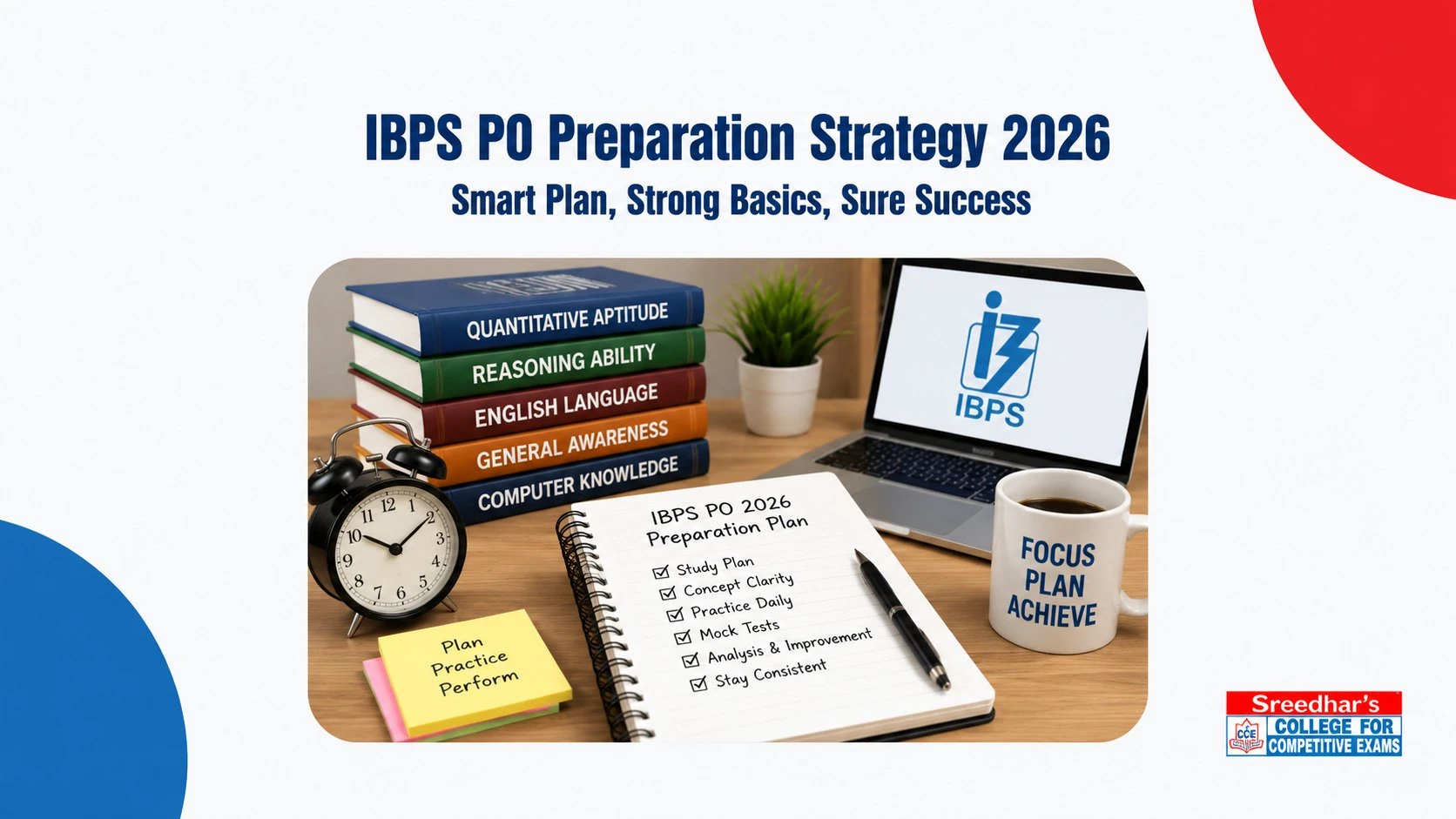
Preparation Strategy and Month-Wise Plan
With roughly three months between now and the Prelims exam in December, a phased approach works best. Here is a suggested framework you can adapt to your own strengths and weaknesses.
September: Foundation Building
Spend this month building conceptual clarity across Reasoning and Numerical Ability, since these two sections form the entire Prelims paper and carry substantial weightage in Mains too. Simultaneously, start a daily fifteen to twenty minute habit of reading banking and current affairs news, since General Awareness rewards consistency far more than intensity.
October: Sectional Practice and Speed Building
Move from concept learning to timed sectional tests. Focus on identifying which puzzle types, data interpretation formats or grammar rules consistently trip you up, and drill those specifically rather than practicing randomly. This is also the right time to begin structured Computer Knowledge revision, since it is a compact syllabus that yields quick returns.
November: Full Length Mock Tests
Begin taking full length Prelims mock tests under strict timed conditions at least three times a week. Analyse every mock test thoroughly, not just for the score but for the specific error patterns, whether they stem from silly mistakes, time mismanagement or genuine conceptual gaps. Simultaneously start Mains level practice for Reasoning and Numerical Ability, since these sections get noticeably harder at the Mains stage.
December, Pre Exam Week
In the final week before your Prelims exam date, shift entirely to revision and light practice. Avoid learning new topics at this stage. Focus on maintaining accuracy, managing exam day nerves, and getting adequate rest. Once Prelims concludes, immediately pivot your full attention to Mains level preparation for the remaining sections, since the gap until the January Mains date, though it may feel long, disappears quickly once combined with festival breaks and other commitments.
Throughout every phase, joining a structured coaching environment like Sreedhar's CCE ensures you are not preparing in isolation. Peer competition through regular tests, faculty feedback on your specific weak areas, and a fixed schedule that keeps procrastination at bay make a measurable difference in outcomes, especially for an exam this competitive.
January: Mains Focused Sprint
Once Prelims results are announced, typically within a few weeks of the exam, candidates who qualify move directly into an intensive Mains preparation sprint before the 30 January 2027 exam date. This period should be dedicated almost entirely to Mains level General Awareness revision, Computer Knowledge consolidation, and advanced practice in Reasoning and Numerical Ability at the higher difficulty level Mains typically demands. Since the gap between the Prelims result and the Mains exam is comparatively short, candidates who have already built a strong foundation during September, October and November will find this final sprint far more manageable than those starting Mains specific preparation from scratch.
Exam Day Tips
- Strong preparation can still be undone by poor exam day management. Keep these practical points in mind.
- Reach your exam centre well ahead of the reporting time, since biometric verification and document checks can take longer than expected, especially at centres handling a large number of candidates. Carry your admit card along with a valid original photo identity proof, since entry is typically denied without both.
- During the exam itself, do a quick scan of all sections before diving in, so you have a mental map of which sections to prioritise based on your strengths. Avoid getting stuck on a single difficult question, particularly in Reasoning puzzles, since time lost there often cannot be recovered elsewhere. Mark such questions for review if the interface allows it, and return only if time permits after attempting everything else.
- Stay calm if a section feels tougher than expected. Exam difficulty is normalised across different shifts using an equating process, so a harder shift does not automatically put you at a disadvantage compared to candidates in an easier shift. Focus purely on maximising your own accurate attempts rather than worrying about how other shifts might be performing.
Common Questions People Ask
Is there an interview for the IBPS RRB Office Assistant post?
No. Selection is based entirely on the Prelims and Mains written examinations. Prelims is qualifying in nature and Mains marks decide the final merit list.
Can final year graduation students apply?
This depends on the specific cut off date mentioned in the detailed notification for proof of graduation. Candidates should check the official notification PDF for exact eligibility conditions regarding provisional degree certificates.
Is knowledge of the local language mandatory before applying?
Proficiency in the local language of the state where you are applying is required for the role. If you cannot prove this through your academic record, you will need to clear a Language Proficiency Test after provisional selection and before joining.
How many attempts are allowed for this exam?
There is generally no cap on the number of attempts for IBPS RRB Office Assistant, subject to the candidate meeting the age and eligibility criteria for that particular cycle.
What is a good target score for Prelims?
Since Prelims marks are not added to the final merit and only used for qualifying, your target should simply be to clear the sectional and overall cut offs comfortably, which typically requires accurate attempts in the range of 55 to 65 out of 80, though this varies by state, category and difficulty level each year.
Where can I get authentic study material and mock tests for this exam?
Structured courses at Sreedhar's CCE include updated study material, sectional tests and full length mocks designed specifically around the latest IBPS RRB pattern, along with regular doubt clearing sessions from experienced faculty.
Can I apply for both Office Assistant and Officer Scale I in the same cycle?
IBPS generally allows candidates meeting the eligibility criteria for multiple posts to apply separately for each post under CRP RRB XV, subject to separate application fees and forms for each post. Always confirm this provision in the official notification since exam schedules for different posts may also overlap.
What happens if I do not clear the Language Proficiency Test after being provisionally selected?
Candidates who cannot prove proficiency in the local language and subsequently fail the Language Proficiency Test risk losing their provisional allotment, since local language proficiency is a mandatory requirement for this role. This is precisely why we recommend applying to RRBs in a state whose language you are genuinely comfortable with.
Does Sreedhar's CCE offer test series separately for students who only want practice tests?
Yes, alongside our complete classroom batches, we offer dedicated test series options for candidates who prefer self study but still want access to high quality, pattern based mock tests and performance analytics. Speak with our counsellors to find the option that matches your preparation style.
Final Word
The IBPS RRB XV Office Assistant 2026 notification represents one of the largest banking recruitment opportunities of the year, with 8,183 vacancies open to any graduate willing to put in focused, structured preparation over the coming months. The absence of an interview stage means your fate is entirely in your own hands, decided purely by how well you perform on exam day.
Whether you choose to prepare independently or with structured guidance, the most important factor is starting today rather than waiting for the exam date to draw closer. If you would like expert mentorship, a proven test series and a peer group that keeps you accountable, our banking batches at Sreedhar's College for Competitive Exams are open for enrollment now, including the new batch starting 30 September 2026 in Vijayawada. Reach out to our admissions team to secure your seat and begin your journey toward a confirmed banking career.
Leave a Comment
Required fields are marked *