



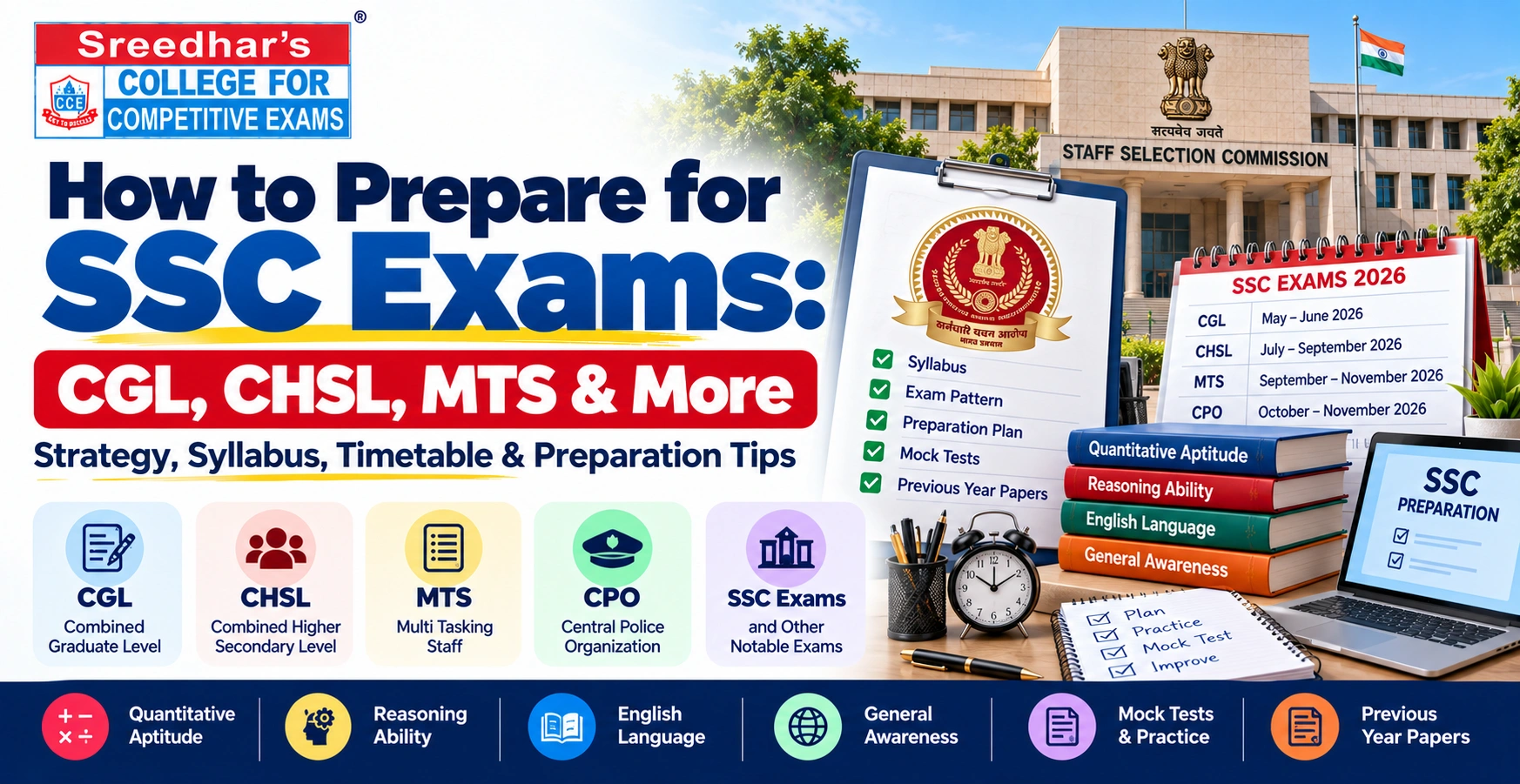
How to Prepare for SSC Exams: CGL, CHSL, MTS & More
SSC Exam Preparation Guide: Choose Your Exam, Build Your Strategy & Crack It With Confidence
Every year, millions of Indians sit for examinations run by the Staff Selection Commission. The reason is simple: SSC offers some of the most stable and respected jobs in central government. A graduate can aim for an Assistant Section Officer or Inspector post through CGL. A candidate with a Class 12 certificate can target Lower Division Clerk or Data Entry Operator posts through CHSL. A matriculate can enter through Multi-Tasking Staff. Those who prefer a uniformed career can aim for GD Constable in the central armed police forces, Sub-Inspector through CPO, or Delhi Police. Engineers have the Junior Engineer exam, skilled shorthand writers have the Stenographer exam, and the Selection Post series fills departmental vacancies at matric, higher secondary and graduate levels.
These exams look different on paper, but they share a common backbone. Almost all of them test four things: reasoning, quantitative ability, English and general awareness. Almost all are computer-based. Almost all carry negative marking. And almost all reward the same habits: a clear understanding of the pattern, a disciplined routine, repeated practice on previous year questions, and a ruthless approach to analysing your own mistakes.
This article is a practical roadmap. It first explains where the SSC calendar stands right now, then summarises the pattern of each exam in your list, then builds a common preparation foundation, goes subject by subject, and finally gives exam-specific strategies, mock-test methods, sample study plans and advice on staying healthy and consistent. If you are preparing for more than one exam, which most smart aspirants do, you will see how a single well-planned preparation can serve several targets.
Where the SSC Calendar Stands Today
The Commission published its tentative calendar for 2026-27 on 8 January 2026, and it has since been revised, so many dates quoted in older blog posts are out of date. Based on the most recent coverage, here is the picture as of early October 2026.
SSC CGL 2026. The notification came out on 21 May 2026 with roughly 12,256 tentative vacancies, and applications closed in late June. According to the revised calendar, the Tier 1 computer-based test is scheduled from 30 September to 30 October 2026. If you are appearing in this window, your job now is revision, mocks and calm. If you are not, treat this cycle as a live rehearsal and begin your CGL 2027 preparation immediately.
SSC CHSL 2026. Applications opened on 7 September 2026 and, per current listings, close on 7 October 2026, which is tomorrow. If you have not applied, do it today. The Tier 1 date has not been announced; some listings suggest a window from December 2026 into early 2027, which gives you roughly two to three months.
SSC CPO (Sub-Inspector in Delhi Police and CAPFs, plus Sub-Inspector Fire in CISF). The notification was released on 10 September 2026 for about 1,871 tentative vacancies. The last date to apply was 30 September, with a correction window from 8 to 10 October. The exam date is yet to be announced, so applicants have a valuable preparation runway.
SSC Stenographer Grade C and D. The CBT was scheduled for 9 to 12 September 2026. If you appeared, your focus should now be the skill test; if not, the next cycle is your target.
SSC Selection Post (Phase XIV). Registration ran from 13 April to 4 May 2026, and the computer-based test was scheduled for 16 to 26 September 2026. Phase XIII, which appears on the SSC exam list, belongs to the previous cycle.
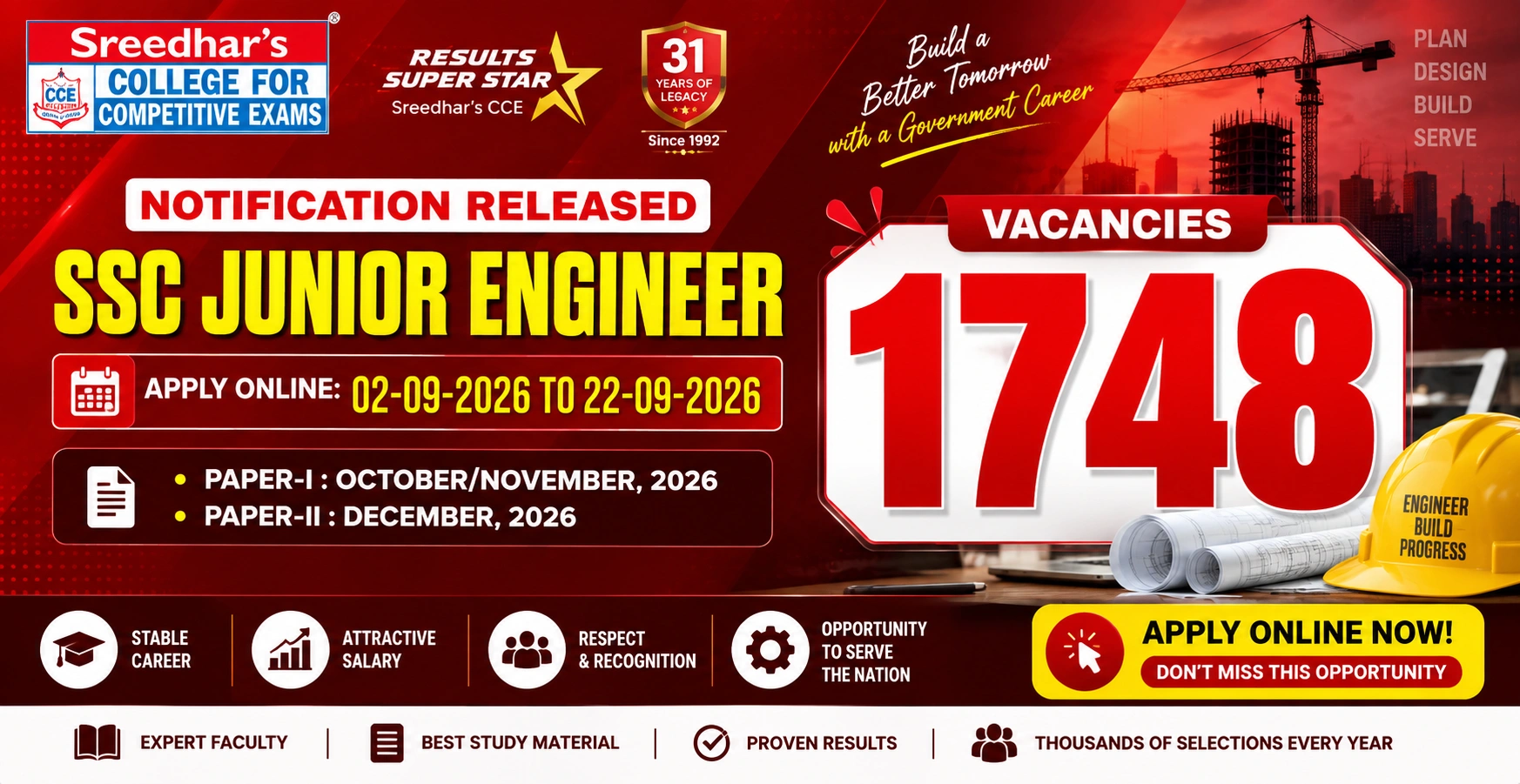
SSC JE. Coverage points to an October or November 2026 exam window for Paper I.
SSC MTS and Havaldar. The calendar placed the notification in the August to September 2026 window and the exam in the later months of 2026, but different sources disagree, so check the SSC website for the live status.
SSC GD Constable. The previous cycle began with a notification on 1 December 2025 for about 25,487 posts. The tentative calendar places the next GD notification around November 2026, with the exam in early 2027.
The lesson from this calendar is that SSC runs on a nearly continuous loop. Something is always open, something is always about to open, and something is always being evaluated. The smartest approach is to build a base that supports two or three exams at once and then sharpen it for whichever notification arrives first.
The Exams at a Glance
Before you plan anything, you must know exactly what you are preparing for. Here is a plain-language summary of each exam based on the latest patterns. Treat the numbers as a guide and verify them against the notification of the cycle you are applying for.
SSC CGL (Combined Graduate Level)
CGL has two computer-based tiers, and there is no interview. Tier 1 is a screening test of 100 questions for 200 marks in 60 minutes, split equally across General Intelligence and Reasoning, General Awareness, Quantitative Aptitude and English Comprehension. Each wrong answer costs 0.50 marks. The big change in the 2026 cycle is the sectional timer: every subject gets exactly 15 minutes, and once a section ends you cannot go back to it.
Tier 2 decides your rank. Paper I has Section I (Mathematical Abilities with 30 questions and Reasoning with 30 questions, one hour with a 30-minute timer for each), Section II (English with 45 questions and General Awareness with 25, one hour with 40 and 20 minutes respectively), Section III (a 20-question Computer Knowledge Test in 15 minutes) and a Data Entry Speed Test of 15 minutes for the posts that need it. Questions in Sections I to III carry three marks each, and each wrong answer costs one mark. Paper II (Statistics) applies to Junior Statistical Officer and Statistical Investigator Grade II aspirants, and a new Paper III (General Studies in Finance and Economics) has been introduced for Assistant Audit Officer and Assistant Accounts Officer, each with 100 questions, 200 marks, two hours and 0.50 negative marking.
SSC CHSL (Combined Higher Secondary Level)
CHSL also has two tiers. Tier 1 mirrors the CGL Tier 1 format: 100 questions, 200 marks, 60 minutes, four equal sections and 0.50 negative marking, with sectional timing expected. Tier 2 is now fully objective rather than descriptive. Session I covers Mathematical Abilities, Reasoning, English, General Awareness and a Computer Knowledge module, and Session II is the skill or typing test. The Data Entry Operator skill test requires a speed of about 8,000 key depressions per hour over roughly 15 minutes, while Lower Division Clerk and Junior Secretariat Assistant posts need a typing test, with 35 words per minute in English commonly cited. These skill tests are qualifying, so they add nothing to your rank but can end your candidacy if you fail them.
SSC MTS (Multi-Tasking Staff) and Havaldar
MTS is a single computer-based exam in two sessions. Session I has 40 questions (numerical ability and reasoning) for 120 marks in 45 minutes with no negative marking. Session II covers general awareness and English and carries negative marking. The full paper is 90 questions for 270 marks. Havaldar posts in CBIC and CBN additionally require a physical efficiency and standard test.
SSC GD Constable
The GD exam is one computer-based test of 80 questions for 160 marks in 60 minutes, with four sections: reasoning, general knowledge and awareness, elementary mathematics, and English or Hindi. Each wrong answer costs 0.25 marks. Clear the written test and you face the Physical Efficiency Test, Physical Standard Test, detailed medical examination and document verification. Roughly speaking, the written exam sets your merit and the physical stages are qualifying.
SSC CPO (Sub-Inspector)
The 2026 notification revised the pattern. Paper I now has 100 questions (25 in each of the four subjects) for 100 marks in one hour, with a 15-minute sectional timer and 0.25 negative marking. After Paper I come the PST and PET, then Paper II, which was previously an English-only paper. It is now a 160-question, 320-mark test: 20 questions each in reasoning, general awareness and quantitative aptitude, plus 100 English questions, over two hours, with 0.50 negative marking. A detailed medical examination and document verification follow. Candidates must be graduates, and the usual age range is 20 to 25 years with relaxations.
SSC Delhi Police Constable
The Delhi Police constable recruitment is run through SSC and has historically involved a computer-based test on reasoning, general knowledge, numerical ability and computer fundamentals, followed by physical endurance and measurement tests and a medical examination. I could not find a current 2026-27 notice during my research, so treat this as a general description and read the specific notice when it appears.
SSC Junior Engineer
JE is a technical exam for Civil, Mechanical and Electrical branches. Paper I (200 marks) tests general intelligence and reasoning, general awareness and the core engineering discipline. Paper II (300 marks) is now a computer-based, discipline-specific objective test rather than a descriptive paper. Negative marking applies in both papers, and sources differ on the exact penalty for Paper II, so confirm it in the notice. Document verification closes the process.
SSC Stenographer Grade C and D
The CBT has 200 questions for 200 marks in two hours covering reasoning, general awareness and English, with 0.25 negative marking. Qualifiers take a stenography skill test consisting of a ten-minute dictation at 100 words per minute for Grade C and 80 words per minute for Grade D, followed by transcription. The skill test is qualifying.
SSC Selection Post
Selection Post exams fill posts in various departments at matriculation, higher secondary and graduate levels through a computer-based test on reasoning, general awareness, quantitative aptitude and English, usually followed by document verification or a skill component for particular posts.
The Common Foundation: Principles That Work for Every SSC Exam
Before going deeper into subjects, it helps to settle a few principles. They sound simple, but they separate those who clear the cut-off from those who keep "almost making it."
1. Treat the notification as your textbook
The official notification is the only authoritative source for syllabus, pattern, marking, eligibility and dates. Read it end to end. Print the pattern table and keep it on your study desk. Many aspirants lose marks because they prepared for last year's rules, for example by relying on free movement between sections when the 2026 CGL and CPO papers lock each section behind a timer.
2. Prepare in layers, not in silos
Think of preparation as three concentric layers. The inner layer is the shared core of arithmetic, reasoning, English grammar and basic general awareness. The middle layer is the exam-specific content, such as CGL Tier 2 advanced maths or JE engineering subjects. The outer layer is test-day skill: speed, accuracy, section strategy and nerve control. Spend your first weeks on the inner layer because it feeds CGL, CHSL, MTS, GD, CPO, Stenographer and Selection Post together.
3. Prioritise Tier 2 or the merit-deciding stage from day one
In CGL and CHSL, Tier 1 only screens you, and your final rank comes from Tier 2. Coaching experts repeatedly stress that Tier 1 should not be your final goal. If you build only enough skill to clear Tier 1, you will face a steep climb afterwards. Prepare at Tier 2 depth and Tier 1 becomes comfortable.
4. Build accuracy before speed
With negative marking in nearly every SSC paper, a wrong answer hurts twice: you lose the marks you could have earned and you lose the penalty. A candidate who attempts 80 questions with 90 percent accuracy usually beats one who attempts 95 with 70 percent. Learn each topic slowly, solve correctly, and only then push the clock.
5. Use previous year questions as your map
SSC repeats concepts, question types and difficulty bands with remarkable consistency. Solving PYQs tells you which topics matter, how questions are framed and what a realistic speed looks like. Do them topic-wise early, then year-wise and shift-wise later.
6. Maintain an error log
Keep a notebook or document with four columns: the question type, why you got it wrong (concept gap, calculation slip, misread, time pressure), the correct approach and a revision date. Review it weekly. This single habit usually produces more improvement than doing hundreds of extra questions.
7. Consistency over intensity
A steady four to six focused hours daily over many months beat a burst of fourteen hour days followed by burnout. Pick a routine you can actually repeat, protect it, and measure progress weekly rather than daily.
Subject-Wise Preparation
Quantitative Aptitude and Elementary Mathematics
Quant is where most aspirants either gain a decisive edge or lose their rank. The syllabus draws from school mathematics up to Class 10 level for most exams, with CGL Tier 2 going deeper into algebra, geometry, trigonometry and data interpretation.
Core topics to master. Number system and simplification, percentage, ratio and proportion, average, profit and loss, discount, simple and compound interest, partnership, mixture and alligation, time and work, time, speed and distance, mensuration (2D and 3D), basic algebraic identities, geometry (triangles, circles, quadrilaterals, polygons), trigonometry (ratios, identities, heights and distances) and data interpretation covering bar graphs, pie charts, histograms and tables.
How to study it.
- Start with fundamentals. If your tables, squares up to 30, cubes up to 15, fractions and percentage equivalents are not instant, fix that first. Speed in quant begins with calculation fluency.
- Learn each topic from one reliable source, make a one-page formula sheet, and then solve 50 to 100 graded questions on it.
- Shift gradually from textbook methods to shortcuts. Shortcuts such as successive percentage, ratio-based approaches, option elimination and unitary methods save 20 to 40 seconds a question, which matters when a section gives you only 15 minutes.
- For geometry, understand the proof or logic rather than memorising results. Questions are often twisted just enough to defeat pure memory.
- For CGL Tier 2, add a daily block for advanced algebra, trigonometric identities and complex geometry. Each Tier 2 maths question is worth three marks and costs one on a wrong attempt, so precision is everything.
- For GD, MTS and Selection Post at lower levels, concentrate on arithmetic: percentage, ratio, average, profit and loss, time and work, speed and distance, and basic mensuration will cover most of what appears.
General Intelligence and Reasoning
Reasoning is the most improvable section because it rewards pattern recognition, which grows with practice.
Verbal and logical topics. Analogy, classification, series (number, letter and mixed), coding-decoding, blood relations, direction sense, ranking and order, syllogism, statement and conclusion, Venn diagrams, calendar and clock problems, mathematical operations and word-based problems.
Non-verbal topics. Figural analogy, classification and series, paper folding and cutting, embedded figures, mirror and water images, counting figures, and pattern completion.
Approach.
- Work topic by topic and write down the rule behind each solved question, not just the answer.
- Time yourself: most reasoning questions should take 25 to 30 seconds. If one takes more than a minute, flag it and move on.
- For non-verbal reasoning, practise daily for 15 minutes. Figures are quick to scan once your eye is trained.
- Because the 2026 sectional pattern gives you 15 minutes for 25 questions, aim to finish reasoning in about 11 to 12 minutes and keep the remainder as buffer for hard items.
- Remember that the reasoning in SSC exams is generally moderate in difficulty, so full marks are realistic.
English Language and Comprehension
English is a scoring section for those who prepare systematically, and for CGL Tier 2 and CPO Paper II it carries enormous weight. In the new CPO Paper II, English alone accounts for 200 of 320 marks.
Topics. Error spotting, sentence improvement, fill in the blanks, cloze test, para jumbles, one-word substitution, idioms and phrases, synonyms and antonyms, spelling errors, active and passive voice, direct and indirect speech, reading comprehension and sentence rearrangement.
Approach.
- Build grammar first. Subject-verb agreement, tenses, articles, prepositions, conjunctions, modifiers and parallelism produce a large share of the questions.
- Make vocabulary a daily 20-minute habit: learn ten new words from previous papers or a reliable word list, with a sentence for each, and revise old ones. Idioms and one-word substitutions have a high repeat rate.
- Read an English newspaper editorial every day. It improves comprehension speed, vocabulary and grammatical instinct together.
- For comprehension passages, read the questions first, skim the passage for the answer location and avoid over-reading.
- Maintain an error log specifically for grammar rules you get wrong. The same five or six rules usually cause most mistakes.
General Awareness and General Knowledge
This section is high-return because it has no calculation and each question is quick. It is also where a lack of structure hurts most.
Static GK. History (ancient, medieval, modern and the freedom struggle), geography (India and the world), Indian polity and the Constitution, and economy basics.
General science. Class 6 to 10 level physics, chemistry and biology, with emphasis on everyday science, human body, diseases, nutrition and basic scientific principles. NCERT is the most reliable base.
Current affairs. Last 6 to 12 months of national and international news, government schemes, appointments, awards, sports, books and authors, summits, defence exercises, important days and science and technology updates.
Approach.
- Use NCERT for the base and one compact static GK book for revision.
- Convert current affairs into short monthly notes and revise them weekly. A one-page summary per week is better than a heap of saved links.
- Use flashcards or spaced-repetition for facts such as capitals, currencies, national parks, firsts and dates.
- Practise topic-wise PYQs. SSC frequently repeats facts in changed form.
- For GD and MTS, give awareness extra priority because it is a big share of the paper and rarely needs more than steady revision.
Exam-Specific Strategies
With the foundation and subjects covered, here is how to tune your preparation for each exam on your list.
SSC CGL: Think Tier 2 First
CGL offers the widest range of posts, from Assistant Section Officer and Inspector to Assistant Audit Officer, Assistant Accounts Officer and Statistical Investigator, and its pay levels run from Level 4 to Level 8. It is also the exam most affected by the 2026 pattern changes.
- Treat sectional timing as a skill. Each Tier 1 subject has a fixed 15-minute window, and you cannot return after submitting it. You can no longer skip a hard question to revisit later in a different subject. Practise by running 15-minute sectional tests until you can finish 25 questions with a small buffer.
- Set a Tier 1 target and a Tier 2 target. For Tier 1, a safe score is one comfortably above the previous year's cut-off for your category and post, with a margin because difficulty fluctuates across shifts and normalisation is applied. Remember that Tier 1 marks do not count towards the final merit.
- Give Tier 2 maths and English real depth. Together with reasoning and general awareness these make up Paper I, where each question is worth three marks and a wrong answer costs one. Aim for accuracy above 85 percent.
- Do not ignore the Computer Knowledge Test and DEST. The computer module is a short 20-question paper in 15 minutes on basics such as hardware, operating systems, MS Office, internet, networking and security. The data entry speed test is a qualifying stage, so practise typing for 20 minutes a day if your chosen post requires it.
- Decide early whether you want the statistics or accounts track. Candidates aiming for Junior Statistical Officer or Statistical Investigator Grade II need to prepare Statistics for Paper II. Those aiming for Assistant Audit Officer or Assistant Accounts Officer must prepare Finance and Economics for the new Paper III. These papers have 100 questions each and are worth the extra effort if the post suits you.
- Study post preferences. Pay scales, location, job profile and promotion prospects differ widely. Investigate them before filling your preference list so your target score is realistic.
SSC CHSL: A Race Against Time and Typing
CHSL leads to posts such as Lower Division Clerk, Junior Secretariat Assistant, Postal Assistant, Sorting Assistant and Data Entry Operator. It has a short preparation cycle when the notification arrives late in the year, so start with focus.
- Begin with the basics. Spend the first month on arithmetic, grammar and a first pass of static GK. Then switch to sectional tests and weekly full mocks.
- Prepare for Tier 2 from the start. Because Tier 2 is objective and deeper than Tier 1, your maths needs to extend beyond simple arithmetic, and English needs steady grammar and vocabulary work.
- Make typing a daily habit. Start with 20 to 30 minutes of typing practice every day. For LDC and JSA, build speed and accuracy on English or Hindi passages. For DEO, practise sustained keystroke speed because the test lasts about 15 minutes and requires roughly 8,000 key depressions an hour.
- Learn the Computer Knowledge module. It is easy to score and easy to ignore. Cover basic computer concepts, Windows and MS Office, internet and email, and common abbreviations.
- Check your posts. DEO, LDC and JSA each have different skill-test requirements, and your choice determines which test you appear for.
SSC MTS and Havaldar: Smart Strategy for a Two-Session Paper
MTS attracts huge numbers because it needs only a matriculation pass, so competition is intense and cut-offs depend on how well you manage accuracy.
- Use the no-negative-marking Session I. Because Session I carries no penalty, attempt every question in numerical ability and reasoning. Spend time to maximise accuracy, but never leave a blank.
- Treat Session II with care. General awareness and English come with a penalty. Attempt only the questions you can answer with reasonable confidence, and use elimination to improve odds on doubtful ones.
- Strengthen the basics. Percentage, ratio, average, simple interest, time and work, number series, coding-decoding, analogy and simple English grammar form the heart of the paper.
- If you target Havaldar, start physical training early. The PET and PST are qualifying and failure here wastes all your written-test effort.
SSC GD Constable: Written Test Plus Physical Fitness
GD is the largest recruitment into the central armed police forces, including BSF, CISF, CRPF, ITBP, SSB, Assam Rifles, NIA and SSF. With tens of thousands of vacancies in each cycle, it is also one of the most competitive.
- Plan two parallel tracks. Study for the written test and train physically every day. Many candidates neglect the physical side until the written result, which leaves too little time to prepare for the race and other events.
- Master the four sections. Reasoning, GK and awareness, elementary maths and language each carry 20 questions. Because there is no Tier 2, the single test decides your merit. Aim for 70 or more correct answers with 90 percent accuracy as a competitive target, adjusting after you see cut-off trends for your category and state.
- Do not waste negative marking. At 0.25 per wrong answer the penalty is light but real, so avoid pure guessing on 80 questions.
- Prepare for the physical test. Typical stages include a timed race (for example 5 km for men and 1.6 km for women in the usual GD pattern), along with physical standard measurements and the medical examination. Check the notice for the current numbers, and build endurance with progressive running, strength work and good recovery.
- Check medical standards early. Eyesight, flat feet, knock knees, tattoos and similar criteria can disqualify candidates, so read the medical rules in the notification.
SSC CPO (Sub-Inspector): A Pattern Revised in 2026
CPO is a graduate-level exam with prestige, good pay and real responsibility, and the 2026 pattern changes are significant.
- Understand the new structure. Paper I is now shorter, with 100 questions and a 15-minute sectional timer. Paper II is longer, with reasoning, awareness and maths at 20 questions each and 100 English questions. Marks are doubled in Paper II, and the negative marking is 0.50.
- Give English a leading role. With 200 of 320 Paper II marks coming from English, your language ability can make or break your rank. Dedicate daily time to grammar, vocabulary, comprehension and cloze practice.
- Prepare for two written tests. Because Paper II follows the physical stage, you must stay in study mode while training. Do not relax after Paper I.
- Train for the PET. For male candidates, the events listed in the notice include a 100-metre race in 16 seconds, a 1.6-kilometre race in 6.5 minutes, a long jump of 3.65 metres, a high jump of 1.2 metres and a shot put of 4.5 metres. For female candidates, the events include a 100-metre race in 18 seconds, an 800-metre race in 4 minutes, a long jump of 2.7 metres and a high jump of 0.9 metres. Ex-servicemen are exempt from the PET but must meet the standards.
- Know the PST. The minimum height for general-category male candidates is 170 cm with a chest of 80 to 85 cm, and for general-category female candidates it is 157 cm. Relaxations apply to hill-area and ST candidates. Check your eligibility before you invest months.
- Upgrade GK and quant. Because Paper II includes awareness and quant in addition to English, you cannot afford to be one-dimensional.
SSC Delhi Police Constable
The usual route is a computer-based test, physical endurance and measurement tests, and a medical examination. Preparation overlaps with GD and MTS: reasoning, general awareness, numerical ability and basic computer knowledge. Because the pattern has varied across notices and I could not verify a current one, use the notification as your final guide. Meanwhile, build the core skills and begin physical conditioning, which will help in either case.
SSC JE: Two Papers, Two Mindsets
JE is both a general and a technical exam, so planning must reflect both.
- Know your branch weighting. In Paper I, the engineering discipline carries a large share alongside reasoning and general awareness. In Paper II, it is purely technical, for Civil, Mechanical or Electrical.
- Begin with your core subjects. For Civil, that means building materials, structures, soil mechanics, estimation and costing, surveying and transportation. For Mechanical, thermodynamics, fluid mechanics, strength of materials, theory of machines and production. For Electrical, circuits, machines, power systems, measurements and basic electronics.
- Learn through numericals and concepts. Objective engineering questions test both formulas and conceptual understanding. Solve previous year questions subject-wise and note the repeated areas.
- Do not neglect reasoning and awareness in Paper I. Because they are scoring and relatively easy, losing marks there is costly.
- Mind the negative marking. Penalties exist in both papers and, in some coverage, are heavier in Paper II, so avoid blind attempts.
SSC Stenographer Grade C and D
The CBT looks simple, with reasoning, awareness and English, but the skill test is what separates serious candidates.
- Start shorthand early. Dictation speed is built slowly through daily practice. Grade D requires 80 words per minute and Grade C requires 100, delivered over ten minutes and followed by transcription on a computer. Start with theory and outlines, then work with graded dictations.
- Practise transcription separately. Typing the dictated matter accurately and within the allowed time is a different skill. Work on typing speed, spelling, punctuation and formatting.
- Keep your CBT sharp. The paper has 200 questions in two hours and 0.25 negative marking, so you need speed across all three sections, especially English and general awareness.
- Treat the skill test seriously. Because it is qualifying, failure removes you from the race regardless of your written score.
SSC Selection Post
Selection Post is useful for candidates who want to leverage a similar syllabus across levels. If you prepare for CGL, CHSL and MTS, you already cover most of its content. Keep an eye on the notification for the post level you target, since matriculation, higher secondary and graduate levels have different difficulty and eligibility. The Phase XIV computer-based test was scheduled for 16 to 26 September 2026, so your next opportunity will be the following phase, whose notice you should watch closely.
Mock Tests, Sectional Timing and Test-Day Skill
Knowledge alone does not clear an SSC exam. Test-day performance is a trained skill, and the 2026 shift to sectional timers makes it even more important.
Start mocks early, and in the right order. In the first two months, take sectional tests only, to check topic understanding. From month three, add one full-length mock a week. In the last two months, take two to three a week, ideally in the same time slot as the actual exam.
Replicate the real pattern. If your exam uses a 15-minute timer for each subject, your mock must too. Do not practise with a flexible one-hour pool if the real test will not allow it.
Analyse every mock thoroughly. For each test, record your score, attempts, accuracy, time spent per section and the types of errors. Then answer three questions: which topics cost me the most marks, where did I waste time, and what will I change in the next mock? Spend at least as long on analysis as on taking the test.
Develop a section order and a skip rule. In exams without locked sections, begin with your strongest section to build confidence, and use a rule such as skipping any question that needs more than a minute and a half. In exams with locked sections, the skip rule is even more crucial, because you will not get a second pass.
Use elimination and calculated guessing. With a penalty of a quarter or half a mark, an answer where you can eliminate two of four options offers a positive expected value. A pure guess does not.
Train your attention and your body. Practise on a computer screen rather than paper, because staring at a screen for 60 to 120 minutes is itself a stamina issue. Learn the exam interface features, such as marking questions for review where allowed, and be at ease with them.
Learn from previous cut-offs. Look at last year's cut-offs by category and post, and set a target score a few marks above the line. Remember that cut-offs vary with difficulty and vacancy numbers.
Sample Study Plans
These plans are templates. Adjust them to your job, college schedule and starting level.
A Six-Month Plan (for CGL, CPO or JE-level preparation)
- Months 1 and 2: Foundation. Study the syllabus, collect a few reliable books, and learn basics in each subject. Quant fundamentals, grammar basics, reasoning topics and NCERT-based GK. Take a diagnostic mock in week one and weekly sectional tests thereafter.
- Months 3 and 4: Depth and PYQs. Move to advanced topics (for CGL Tier 2, advanced maths and higher-level English). Solve topic-wise PYQs, build the error log, start current affairs revision and take one full mock every week.
- Month 5: Speed and simulation. Take two or three full mocks a week with the exact sectional timing. Spend half of each day on analysis and revision of weak areas.
- Month 6: Revision and polish. Revise formula sheets, error logs, vocabulary lists and monthly current affairs notes. Take mocks alternate days, rest well and avoid new topics in the last week.
A Three-Month Plan (for CHSL, MTS, GD or Selection Post)
- Month 1: Basics and pattern. Cover arithmetic, grammar, reasoning topics and basic GK. Begin typing or physical training daily if your exam needs it.
- Month 2: Practice. Solve topic-wise PYQs, take sectional tests and begin weekly mocks. Add current affairs notes.
- Month 3: Mocks and revision. Take mocks every second or third day, analyse thoroughly and revise weak areas.
A Thirty-Day Sprint (for a notification that arrives soon)
For a short window, do not try to finish the entire syllabus. Instead, concentrate on high-yield areas: percentage, ratio, average, profit and loss, time and work, speed and distance, simple geometry, core reasoning topics, grammar rules, vocabulary lists and the last six months of current affairs. Take a mock every second day, revise errors daily and keep a typing or fitness routine if needed.
A Sample Daily Routine
- Morning (2 hours): Quant or the toughest subject, when your mind is fresh.
- Late morning (1 hour): Reasoning practice.
- Afternoon (1 to 2 hours): English: grammar, vocabulary and a reading passage.
- Evening (1 hour): General awareness and current affairs.
- Night (45 minutes): Revision of the error log and the day's notes. Typing or physical training should be placed in whichever slot suits you.
Working candidates and students can scale this to three or four hours with the same sequence, giving extra time to weekends for mocks.
Resources: What to Use and What to Skip
You do not need a mountain of books. Choose one good resource per subject and use it deeply: NCERT books (Class 6 to 10) for science, history, geography and polity basics; one well-structured arithmetic book with topic-wise exercises; one grammar and vocabulary book for English; one reasoning workbook; and a compiled set of previous year papers. Add a daily newspaper and a monthly current affairs compilation. Official sources, such as ssc.gov.in for notices and syllabi and the previous year question papers released after exams, are free and reliable. Online test series and coaching can add structure and mock discipline, but they work only if you follow the plan and analyse your results. Institutes such as Sreedhar's CCE and others provide classroom and online options, so compare syllabus coverage, faculty and mock quality before choosing.
Common Mistakes to Avoid
- Studying from outdated patterns. Many blogs and videos still describe the old single-pool timing. Check dates and pattern updates before relying on any material.
- Jumping between books and resources. Constant switching creates shallow knowledge. Choose and commit.
- Ignoring English and awareness for maths. These sections are scoring in all exams and decisive in CPO and CGL Tier 2.
- Doing mocks without analysis. A mock without review is a wasted opportunity.
- Neglecting the physical or skill component. Typing, shorthand and fitness tests are qualifying but unforgiving.
- Missing deadlines and details. Applications, category certificates, photo and signature specifications, and corrections have strict windows. Mistakes here can cost a whole year.
- Over-relying on guessing. With negative marking, undisciplined guessing erodes your score.
- Comparing yourself with others. Everyone's starting line differs. Compare yourself with last week's version of you.
Staying Healthy and Motivated
A long preparation cycle tests your mind as much as your knowledge. Sleep seven to eight hours, because memory consolidation depends on it. Exercise at least 30 minutes a day, which sharpens focus and reduces anxiety, and is essential for GD and CPO aspirants anyway. Eat regular meals and drink enough water. Take a full day off every week or two so that your brain recovers, and take short breaks during study blocks. Limit social media, especially in the final months.
It also helps to define your why. Write down what the job means for you and your family and keep it where you study. When motivation drops, which it will, your routine and your why will carry you through. If you fail to clear a cut-off, treat it as data: study your score report, find where the marks slipped, adjust and return. Many selected candidates succeeded on their second or third attempt precisely because they learned from the first.
Finally, do not hesitate to ask for help. Join a reliable study group, speak with a mentor, or seek counselling if stress feels unmanageable. Preparing for an exam is a marathon, and no one should run it alone.
Conclusion: Your Next Seven Days
Preparing for SSC exams is not about brilliance. It is about clarity, structure and repetition. Know your exam, read the notification, build the shared foundation in maths, reasoning, English and awareness, practise with PYQs, master sectional timing through mocks, and protect your health and routine.
Here is a simple plan for the next seven days. First, decide your primary target and one backup exam from this list. Second, download the latest notification and syllabus for each and mark the pattern and dates. Third, take a diagnostic mock to find your baseline. Fourth, build a weekly timetable with fixed study blocks, a typing or fitness slot if needed, and a weekly full mock. Fifth, start your error log and your formula and vocabulary notebooks. Sixth, begin a daily newspaper and current affairs habit. Seventh, review the week and adjust.
If the CHSL application window is still open for you, finish it today. If you are in the middle of CGL Tier 1, revise calmly and avoid last-minute new topics. If you are waiting for CPO, GD, MTS or JE dates, use that time well, because the aspirants who start preparing before the notification are usually the ones who clear the cut-off after it.

Leave a Comment
Required fields are marked *