



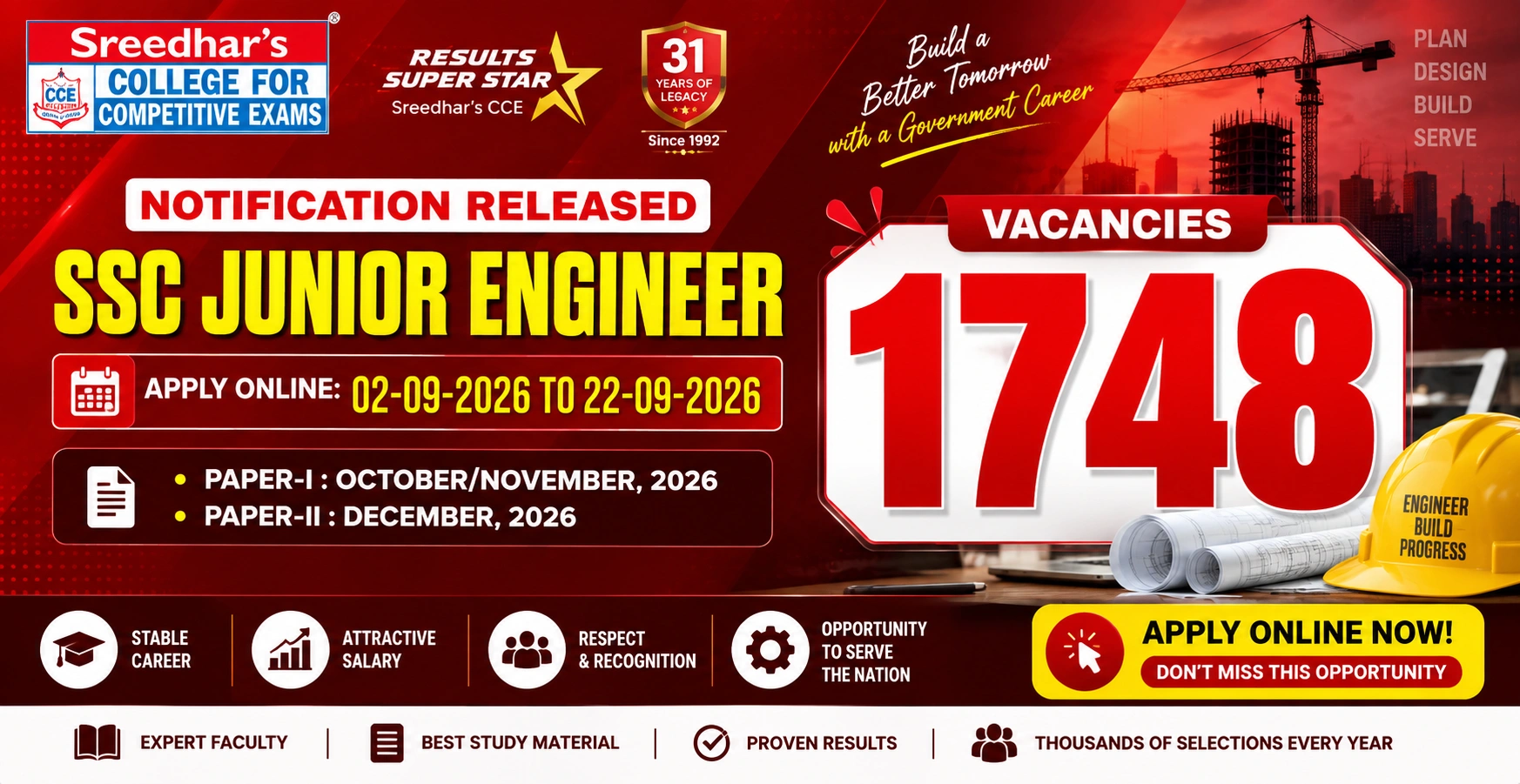
SSC JE 2026 Notification
Complete Guide to Vacancies, Eligibility, Exam Pattern and Preparation Strategy
The Staff Selection Commission has released the SSC Junior Engineer Examination 2026 notification, opening the doors to 1,748 vacancies across some of the most respected engineering departments in the Government of India. For diploma and degree holders in Civil, Electrical, Mechanical and allied engineering branches, this is one of the biggest technical recruitment opportunities of the year. If you have been waiting for a stable, well paying government job that puts your engineering knowledge to direct use, SSC JE 2026 deserves your full attention.
This guide walks you through everything you need to know about the notification: important dates, vacancy distribution, eligibility criteria, application process, exam pattern, syllabus, salary structure and a preparation roadmap that actually works. Whether you are appearing for SSC JE for the first time or attempting it again after a previous try, this article is designed to give you a clear, honest and complete picture so you can plan your preparation with confidence.
At Sreedhar's CCE, we have guided thousands of aspirants toward government job selections since 1995, and this article draws on that experience to help you understand not just what the notification says, but what it actually means for your preparation.
SSC JE 2026 Notification: Quick Overview
Before diving into the details, here is a snapshot of the SSC JE 2026 recruitment cycle.
| Particulars | Details |
|---|---|
| Conducting Body | Staff Selection Commission (SSC) |
| Exam Name | Junior Engineer Examination, 2026 |
| Posts | Junior Engineer (Civil, Electrical, Mechanical, Electrical and Mechanical, Telecom) and Scientific Assistant (IMD) |
| Total Vacancies | 1,748 (tentative) |
| Application Mode | Online only |
| Application Start Date | 2 September 2026 |
| Application End Date | 22 September 2026 (23:00 hours) |
| Fee Payment Last Date | 23 September 2026 (23:00 hours) |
| Correction Window | 28 to 30 September 2026 |
| Paper I (tentative) | October or November 2026 |
| Paper II (tentative) | December 2026 |
| Pay Scale | Level 6, Rs. 35,400 to Rs. 1,12,400 (7th CPC) |
| Official Website | ssc.gov.in |
This notification is significant not only because of the vacancy count, but also because it covers a wide range of technical roles across defence, water resources, meteorology, public works and telecommunications departments. Understanding the structure of the notification is the first step toward building an effective preparation plan.
Why SSC JE 2026 Matters for Engineering Aspirants
Every year, thousands of engineering diploma and degree holders across India look for a government job that matches their technical qualification without requiring them to clear a separate management or administrative exam. SSC JE fills exactly that gap. Unlike many other SSC exams that are open to graduates from any stream, SSC JE is a specialised recruitment exam meant specifically for engineers, which naturally narrows the competition to candidates with a relevant technical background.
The role of a Junior Engineer is also professionally rewarding. Selected candidates get to work on real infrastructure projects, from road construction under the Border Roads Organisation to water resource management under the Central Water Commission, and from public building maintenance under CPWD to meteorological instrumentation under IMD. For someone who has spent years studying engineering, this is a chance to apply that knowledge directly in a government setting with long term job security, pension benefits and clear promotion pathways.
If you are exploring more government exam options besides SSC JE, you can browse the complete list of exams we cover on our Exams page, which includes Banking, Railways, Insurance, Police and State Government examinations as well.
SSC JE 2026 Important Dates
Keeping track of dates is the single most avoidable mistake candidates make while preparing for competitive exams. Missing the correction window or the fee payment deadline can cost you an entire year of preparation. Here are the key dates for SSC JE 2026.
- Notification release date: 2 September 2026
- Online application start date: 2 September 2026
- Online application closing date: 22 September 2026 (23:00 hours)
- Last date for online fee payment: 23 September 2026 (23:00 hours)
- Application correction window: 28 September 2026 to 30 September 2026
- Paper I examination (tentative): October or November 2026
- Paper II examination (tentative): December 2026
- Admit card release: to be announced closer to the exam date
Because Paper I and Paper II dates are tentative and subject to change, candidates should keep checking the official SSC website regularly and avoid relying solely on third party sources for updates. We also recommend bookmarking our Blogs section, where we publish timely updates on exam schedules, admit cards and results for SSC, Banking and Railway exams.
SSC JE 2026 Vacancy Details
The SSC JE 2026 notification has announced 1,748 tentative vacancies. These posts are spread across multiple central government organisations, each with its own qualification and age requirements for the same designation of Junior Engineer. The vacancy distribution typically covers three major engineering streams: Civil, Electrical and Mechanical, along with combined Electrical and Mechanical posts and Telecom related posts in a few departments.
It is important to understand that "tentative" vacancies can change before the final result is declared. The Commission sometimes revises the number upward or downward depending on requisitions received from participating departments. Candidates should not restrict their preparation intensity based on the current vacancy figure. Treat every SSC JE cycle as highly competitive, regardless of how the numbers look on paper.
Organisations Recruiting Through SSC JE 2026
SSC JE is not a single department exam. It is a common recruitment exercise through which several central government bodies fill their Junior Engineer positions. Some of the key recruiting organisations include:
Border Roads Organisation (BRO): Recruits JE (Civil) and JE (Electrical and Mechanical) for road and infrastructure projects, often in border and strategic areas. BRO posts usually carry an age limit of up to 30 years and may involve postings in remote or high altitude locations.
Central Water Commission (CWC): Recruits JE (Civil) and JE (Mechanical) for water resource planning, irrigation and hydel project related work.
Central Public Works Department (CPWD): One of the largest recruiters through SSC JE, hiring JE (Civil) and JE (Electrical) for construction and maintenance of government buildings across India. CPWD often has a slightly higher age limit compared to other departments.
Military Engineer Services (MES): Recruits JE (Civil), JE (Electrical) and JE (Mechanical) for defence infrastructure projects under the Ministry of Defence.
Brahmaputra Board, Ministry of Jal Shakti: Recruits JE (Civil) primarily for flood control and river management projects in the northeastern region.
India Meteorological Department (IMD): Recruits Scientific Assistants, a technical post that is included within the same SSC JE examination cycle, requiring a science background rather than an engineering degree.
Farakka Barrage Project: Recruits JE (Civil) and JE (Electrical/Mechanical) for barrage operations and maintenance in West Bengal.
Each organisation has its own post-wise qualification, age limit and sometimes even a different pay matrix level, so candidates must carefully check the official notification PDF for the exact requirements of the posts they intend to apply for. Choosing the right combination of organisation and post during the application itself can meaningfully affect your chances, especially in departments with a higher age cutoff or fewer eligible applicants.
SSC JE 2026 Eligibility Criteria
Eligibility for SSC JE is assessed on two fronts: educational qualification and age limit. Both vary depending on the specific post and organisation, so read this section carefully alongside the official notification for your chosen department.
Educational Qualification
In general, candidates need one of the following, depending on the post and organisation:
- A degree in the relevant engineering discipline (Civil, Electrical or Mechanical) from a recognised university or institute, or
- A three year diploma in the relevant engineering discipline from a recognised institute, sometimes combined with a specified number of years of relevant work experience (commonly two years), particularly for organisations like BRO.
For the Scientific Assistant post under IMD, candidates typically need a Bachelor's degree in Science with Physics as one of the subjects, or a related qualification as specified in the notification.
Because qualification requirements differ by organisation and even by specific post within the same organisation, candidates should not assume that a diploma alone is sufficient for every post, or that a degree automatically qualifies them for every organisation. Always cross check against the detailed post-wise table in the official PDF before filling the application.
Age Limit
The age limit for SSC JE 2026 is calculated as on 1 August 2026, and it varies by post.
- For most posts, the upper age limit is 30 years, meaning candidates should be born not earlier than 2 August 1996 and not later than 1 August 2008.
- For certain posts, particularly some CPWD positions, the upper age limit extends to 32 years, meaning candidates should be born not earlier than 2 August 1994 and not later than 1 August 2008.
Age relaxation is available for reserved categories as per government norms:
| Category | Age Relaxation |
|---|---|
| SC/ST | 5 years |
| OBC | 3 years |
| PwBD (Unreserved/EWS) | 10 years |
| PwBD + OBC | 13 years |
| PwBD + SC/ST | 15 years |
| Ex-Servicemen | 3 years after deducting military service from actual age |
| Disabled Defence Personnel (UR/EWS/OBC) | 3 years |
| Disabled Defence Personnel (SC/ST) | 8 years |
If you are unsure whether you fall within the eligible age bracket for a particular post, use our free Age Calculator tool to instantly check your eligibility against the SSC JE 2026 cutoff date. This small step can save you from applying for a post you are not eligible for, which is a common and avoidable mistake among first time applicants.
SSC JE 2026 Application Fee
The application fee structure for SSC JE 2026 is straightforward:
- General, OBC and EWS male candidates: Rs. 100
- Women candidates, SC, ST, PwBD and Ex-Servicemen candidates: exempted from fee payment
Fees can be paid online through BHIM UPI, net banking, or Visa, MasterCard, Maestro and RuPay debit cards. Candidates must ensure the fee is paid before the deadline of 23 September 2026 (23:00 hours), since an unpaid application is typically treated as incomplete and will not be considered for further processing.
How to Apply for SSC JE 2026
The application process is entirely online and follows a fairly standard sequence used across most SSC examinations. Here is a step by step outline to help first time applicants navigate it smoothly.
- Visit the official SSC website at ssc.gov.in or use the mySSC mobile application.
- Complete the one time registration process if you have not registered before, providing basic personal details, a valid mobile number and email address.
- Log in using your registration ID and password, then locate the SSC JE 2026 notification link.
- Fill in your educational qualification, category, post preferences and organisation preferences carefully. Remember that different organisations may have different qualification and age criteria, so choose posts you are genuinely eligible for.
- Upload the required documents, which typically include a recent photograph and signature in the specified format and size.
- Pay the application fee, if applicable, through one of the accepted online payment modes.
- Review the entire application carefully before final submission. Once submitted, most fields cannot be changed except during the designated correction window.
- Download and save a copy of the submitted application form for your records.
During the correction window between 28 and 30 September 2026, candidates can make limited changes to their application, usually related to category, post preference or personal details, sometimes with an additional correction fee. Use this window wisely rather than treating it as an opportunity to make major changes at the last minute.
SSC JE 2026 Exam Pattern
SSC JE follows a two-tier examination structure, both conducted in Computer Based Test (CBT) mode.
Paper I (Qualifying in Nature)
Paper I is a screening test. Candidates who clear the qualifying cutoff in Paper I become eligible to appear for Paper II, but the actual score obtained in Paper I is generally not used for final merit ranking, which is instead based on Paper II performance combined with a qualifying Paper I.
- Total questions: 200
- Total marks: 200
- Duration: 2 hours
- Negative marking: 0.25 marks deducted for each incorrect answer
Paper I is divided into three sections:
- General Intelligence and Reasoning: 50 marks
- General Awareness: 50 marks
- General Engineering (Civil and Structural, or Electrical, or Mechanical, based on the candidate's chosen discipline): 100 marks
Paper II (Determines Final Merit)
Paper II is the decisive stage of the SSC JE exam. It focuses entirely on the candidate's chosen engineering discipline and carries significantly more weight in determining the final selection.
- Total questions: 100
- Total marks: 300
- Duration: 2 hours
- Negative marking: 1 mark deducted for each incorrect answer
Because each question in Paper II is worth three marks while an incorrect answer costs a full mark, the penalty for guessing is proportionally steeper than in Paper I. This makes accuracy far more important than speed in this stage. Candidates should avoid blind guessing in Paper II and instead attempt only those questions where they have reasonable confidence in the answer.
Both papers are conducted in online mode with objective type, multiple choice questions. There is no interview stage in the current SSC JE selection process for most posts, which means your performance in these two computer based papers largely determines your final outcome, along with document verification and, for certain posts, a medical or physical standards test.
SSC JE 2026 Syllabus Overview
The syllabus for SSC JE is divided by section and by engineering discipline. Here is a broad overview to help you plan your study schedule.
General Intelligence and Reasoning (Paper I)
This section tests analytical thinking through topics such as analogies, similarities and differences, spatial visualisation, problem solving, analysis, judgment, decision making, visual memory, discrimination, observation, relationship concepts, arithmetical reasoning, verbal and figure classification, and non-verbal series.
General Awareness (Paper I)
This section assesses the candidate's knowledge of current events and everyday observations in and around their environment, covering India and its neighbouring countries with an emphasis on general polity, geography, economics, history, culture and scientific developments relevant to a technical role.
General Engineering (Paper I and Paper II)
Depending on the discipline chosen, the technical syllabus generally includes:
Civil Engineering: Building materials, estimation and costing, surveying, soil mechanics, hydraulics, irrigation engineering, transportation engineering, environmental engineering, structural engineering including RCC and steel structures, and construction management.
Electrical Engineering: Basic concepts of electrical circuits, magnetic circuits, AC fundamentals, measurement and measuring instruments, electrical machines, synchronous machines, generation, transmission and distribution, estimation and costing, and basic electronics and utilisation of electrical energy.
Mechanical Engineering: Theory of machines and machine design, engineering mechanics and strength of materials, thermal engineering covering properties of pure substances, IC engines, refrigeration and air conditioning, fluid mechanics and hydraulic machines, and production engineering.
The technical syllabus is fairly detailed and requires consistent revision of fundamentals covered during your diploma or degree studies, combined with regular practice of previous year question papers to understand how these concepts are typically tested. If you want a structured, exam-focused breakdown of the full syllabus along with practice material, explore our SSC coaching batches, which are designed around the latest exam pattern and updated regularly by our faculty team.
SSC JE 2026 Selection Process
The overall selection process for SSC JE 2026 typically follows these stages:
- Paper I (Computer Based Examination): A qualifying stage that screens out candidates below the cutoff.
- Paper II (Computer Based Examination): The main stage that determines final merit ranking.
- Document Verification: Shortlisted candidates are called for verification of educational certificates, category certificates, age proof and other relevant documents.
- Medical Examination (where applicable): Certain posts, especially those involving fieldwork under organisations like BRO, may require candidates to clear a medical standards test.
Final selection and allotment of posts is based on merit in Paper II combined with the candidate's category, post preferences and vacancy availability in each organisation. Because normalisation is often applied when the exam is conducted across multiple shifts, candidates should focus on maximising accuracy rather than worrying too much about shift-wise difficulty variation.
SSC JE 2026 Salary and Pay Scale
Selected Junior Engineers are placed in Pay Level 6 of the 7th Central Pay Commission, with a pay scale ranging from Rs. 35,400 to Rs. 1,12,400. In addition to basic pay, employees are entitled to Dearness Allowance, House Rent Allowance and Transport Allowance as applicable based on their posting location, along with other standard government employee benefits such as medical facilities, pension under the National Pension System, and periodic increments.
The exact in-hand salary varies depending on the city classification of the posting, but SSC JE remains one of the more attractive entry points into central government service for engineering diploma and degree holders, particularly when compared to many private sector roles at a similar experience level.
How to Prepare for SSC JE 2026: A Practical Strategy
Preparing for SSC JE effectively requires a combination of conceptual clarity in your engineering subjects, sharp reasoning skills and consistent awareness of current affairs. Here is a preparation approach that has worked well for successful candidates over the years.
Start With a Realistic Study Plan
Given that the application window closes on 22 September 2026 and Paper I is expected around October or November 2026, most candidates will have a limited but workable preparation window. Break this period into phases: a foundation phase to revise core engineering concepts, a practice phase focused on solving previous year papers and mock tests, and a final revision phase concentrating on weak areas and quick recall notes.
Prioritise Your Engineering Subject
Since Paper II carries 300 marks entirely from your chosen engineering discipline and directly decides your final merit, this should receive the largest share of your preparation time. Go back to your diploma or degree textbooks, but supplement them with SSC JE specific study material that highlights exactly which topics are repeatedly tested and in what format.
Do Not Neglect Reasoning and General Awareness
Because Paper I is qualifying, some candidates make the mistake of under-preparing for Reasoning and General Awareness, assuming their technical strength alone will carry them through. This is risky. A candidate who fails to clear the Paper I cutoff never gets a chance to sit for Paper II, no matter how strong their engineering knowledge is. Dedicate focused, regular time to both sections rather than treating them as an afterthought.
Practice With Negative Marking in Mind
Given the negative marking structure of both papers, particularly the steeper penalty in Paper II, practice under realistic conditions that force you to decide when to attempt a question and when to skip it. Blind guessing across a large number of questions can significantly damage your overall score, so build the habit of selective attempting during your mock test practice itself.
Take Regular Mock Tests
Simulated testing under timed conditions is one of the most effective ways to build exam temperament, identify weak areas and improve time management. Regular sectional and full-length mock tests, followed by detailed error analysis, help convert theoretical knowledge into exam-ready performance.
Track Reliable Update Sources
Exam dates, admit card releases and any changes to the notification should be tracked through reliable sources rather than unofficial social media forwards. Our Blogs page regularly publishes verified updates on SSC, Banking and Railway examinations to help you stay accurately informed throughout your preparation journey.
Why Choose Sreedhar's CCE for SSC JE 2026 Preparation
Since 1995, Sreedhar's CCE has helped more than 30,000 students secure government jobs across Banking, SSC, Railways, Insurance, Police and State Government examinations. Our approach to SSC JE preparation is built around a few core principles that consistently produce results for our students.
Experienced and dedicated faculty: Our engineering faculty team has deep familiarity with the SSC JE exam pattern and question trends across Civil, Electrical and Mechanical streams, and they guide students with a structured, exam-oriented approach rather than generic textbook teaching.
Structured phase-wise training: We follow a planned training model covering concept building, practice, tests, detailed analysis and revision, so students progress step by step with growing confidence rather than being overwhelmed by the volume of syllabus at once.
Exam-oriented study material: Our material is regularly updated to reflect the latest SSC JE exam pattern and syllabus, with topic-wise handouts and practice sets that mirror the actual difficulty level of the exam.
Regular tests and detailed performance analysis: Sectional tests, grand tests and full-length mock exams come with performance analytics that help students understand exactly where they stand and what needs improvement before the real exam.
Doubt clarification and mentoring: Dedicated doubt-clearing sessions ensure that technical concepts, especially the ones that tend to confuse candidates from a diploma background transitioning into competitive exam level questions, are fully clarified before moving ahead.
You can explore our current SSC coaching batches to find a bilingual or English medium option that fits your schedule, whether you prefer live classes or a recorded plus live combination. Our track record is reflected directly in our Results page, where you can see the real outcomes achieved by our students across multiple exam categories.
With branches across Andhra Pradesh, Telangana, Karnataka and Odisha, including our Hyderabad centres at Ameerpet, Dilsukhnagar and KPHB, students across South India can access quality classroom coaching along with our online course options.
Common Mistakes to Avoid While Preparing for SSC JE 2026
Even well prepared candidates sometimes lose out on selection due to avoidable errors rather than a genuine lack of knowledge. Here are a few mistakes worth watching out for.
Applying for the wrong post or organisation: Since different organisations under SSC JE have different qualification and age criteria for the same designation, candidates sometimes apply for a post they are not actually eligible for, only to be rejected at the document verification stage. Always double check the post-wise eligibility table in the official notification before submitting your application.
Ignoring the correction window: Many candidates skip reviewing their application during the correction window, assuming everything was filled correctly the first time. Small errors in category, post preference or personal details can have significant consequences later, so use the correction window as a genuine review opportunity rather than skipping it.
Over-relying on rote memorisation for technical subjects: SSC JE technical questions often test applied understanding rather than pure definitions. Candidates who memorise formulas without understanding their practical application tend to struggle with application-based questions in the actual exam.
Underestimating General Awareness: Since this section is often seen as unpredictable, some candidates deprioritise it entirely. A consistent daily habit of reading current affairs, even for twenty to thirty minutes, compounds significantly over a two to three month preparation window.
Skipping mock test analysis: Simply taking mock tests without reviewing mistakes afterward wastes a significant portion of their potential benefit. The real learning happens during the analysis phase, where you identify patterns in your errors and correct them before the actual exam.
Post-Wise Breakdown: Choosing the Right Discipline and Organisation
One decision that many first time applicants overlook is how much the choice of discipline and organisation preference can affect their real chances of selection. SSC JE allows candidates to apply based on their engineering discipline, and within that discipline, to indicate preferences for the recruiting organisations they wish to be considered for. Making this choice thoughtfully, rather than filling it in as an afterthought, can meaningfully change your outcome.
Civil Engineering Aspirants
Civil engineering candidates typically have the widest range of organisations to choose from, including BRO, CWC, CPWD, MES and the Brahmaputra Board. Each of these has a slightly different work profile. BRO postings often involve fieldwork in border and hilly regions, which suits candidates comfortable with a more physically demanding, mobile role. CPWD, on the other hand, usually involves building construction and maintenance work closer to urban centres. Candidates should think about their personal preferences around location and work style, not just the vacancy numbers, before ranking their organisation choices.
Electrical and Mechanical Engineering Aspirants
Electrical and Mechanical engineers generally find opportunities across CPWD, MES, CWC and Farakka Barrage Project, among others. Since some departments recruit for combined Electrical and Mechanical posts while others recruit separately, candidates should read the qualification table carefully to understand exactly which stream is being sought for each specific vacancy code.
Scientific Assistant (IMD) Aspirants
Candidates with a Bachelor's degree in Physics or a closely related science background, rather than a formal engineering degree, should pay close attention to the Scientific Assistant post under IMD. This post is included within the same SSC JE examination but has a distinct qualification requirement and a technical syllabus oriented more toward physics and meteorology fundamentals rather than core engineering subjects.
Whichever discipline or organisation you choose, remember that your Paper II score is what ultimately competes against other candidates within your chosen category and post combination. This means the actual competition you face can vary quite a bit depending on how many aspirants choose the same organisation as you, which is worth keeping in mind while filling your preferences.
Building a Month-by-Month Preparation Timeline
Given the tentative exam schedule, here is a broad month-by-month approach that candidates can adapt based on their own starting point and available study hours.
First month: Focus on revising the fundamentals of your chosen engineering discipline from your diploma or degree coursework, while simultaneously starting a daily routine for General Awareness and basic Reasoning practice. This month should be about rebuilding your conceptual base rather than rushing into mock tests.
Second month: Shift toward topic-wise practice questions in your technical subject, combined with structured reasoning practice covering all major question types. Begin taking sectional tests to identify which topics need more attention. Continue your daily current affairs habit without interruption.
Third month: Move into full-length mock tests under timed, exam-like conditions for both Paper I and Paper II. Dedicate significant time to reviewing every mock test in detail, understanding not just which questions you got wrong, but why, and what pattern of error is repeating. Use the final two to three weeks before the exam purely for revision of formulas, previous year questions and quick recall notes rather than learning new topics.
This kind of structured timeline, when followed consistently, tends to produce far better outcomes than last-minute cramming, especially for a technical exam like SSC JE where conceptual clarity cannot be built overnight.
SSC JE 2026 Frequently Asked Questions
What is the last date to apply for SSC JE 2026? The online application window for SSC JE 2026 closes on 22 September 2026 at 23:00 hours. The last date for online fee payment is 23 September 2026.
How many vacancies are there in SSC JE 2026? The SSC JE 2026 notification has announced 1,748 tentative vacancies across Junior Engineer posts in Civil, Electrical, Mechanical and Telecom disciplines, along with Scientific Assistant posts under IMD.
What is the age limit for SSC JE 2026? The age limit varies by post, generally set at either 30 or 32 years as on 1 August 2026, with standard age relaxation applicable for reserved categories.
What is the application fee for SSC JE 2026? The application fee is Rs. 100 for General, OBC and EWS male candidates. Women candidates and those from SC, ST, PwBD and Ex-Servicemen categories are exempted from the fee.
Is there an interview in SSC JE selection? No, the current SSC JE selection process is based on two computer based examinations, Paper I and Paper II, followed by document verification and, for certain posts, a medical examination. There is no separate interview round for most posts.
Which subjects should I focus on the most for SSC JE 2026? Since Paper II is worth 300 marks and is based entirely on your chosen engineering discipline, it should receive your primary focus. However, Reasoning and General Awareness in Paper I must not be neglected since clearing the Paper I cutoff is a prerequisite to appearing for Paper II.
When will the SSC JE 2026 exam be conducted? Paper I is tentatively scheduled for October or November 2026, and Paper II is tentatively scheduled for December 2026. Candidates should regularly check the official SSC website for confirmed dates.
Final Thoughts
SSC JE 2026 presents a genuine and substantial opportunity for engineering diploma and degree holders to secure a stable, respected position in central government service. With 1,748 vacancies spread across departments like BRO, CWC, CPWD, MES and IMD, the notification opens multiple pathways depending on your engineering discipline and career preferences.
Success in this exam depends on a combination of strong technical fundamentals, sharp reasoning ability, consistent general awareness and disciplined exam practice under realistic timed conditions. The preparation window between now and the tentative Paper I exam in October or November 2026 is limited, which makes a structured and guided approach more valuable than ever.
If you are serious about converting this opportunity into a selection, consider joining a coaching programme that understands the exact demands of the SSC JE exam pattern. At Sreedhar's CCE, our experienced faculty, structured study material and regular testing framework are designed to take you from wherever you are today to exam-ready confidence by the time Paper I arrives. Visit our Exams page to explore all the competitive exams we cover, or reach out through our Contact Us page to speak with our counselling team about the right SSC JE preparation plan for you.
Your engineering degree or diploma has already given you the technical foundation. SSC JE 2026 is your chance to put it to work in a government career built for the long term. Prepare with focus, apply carefully within the given dates, and give this attempt everything it deserves.
Leave a Comment
Required fields are marked *