



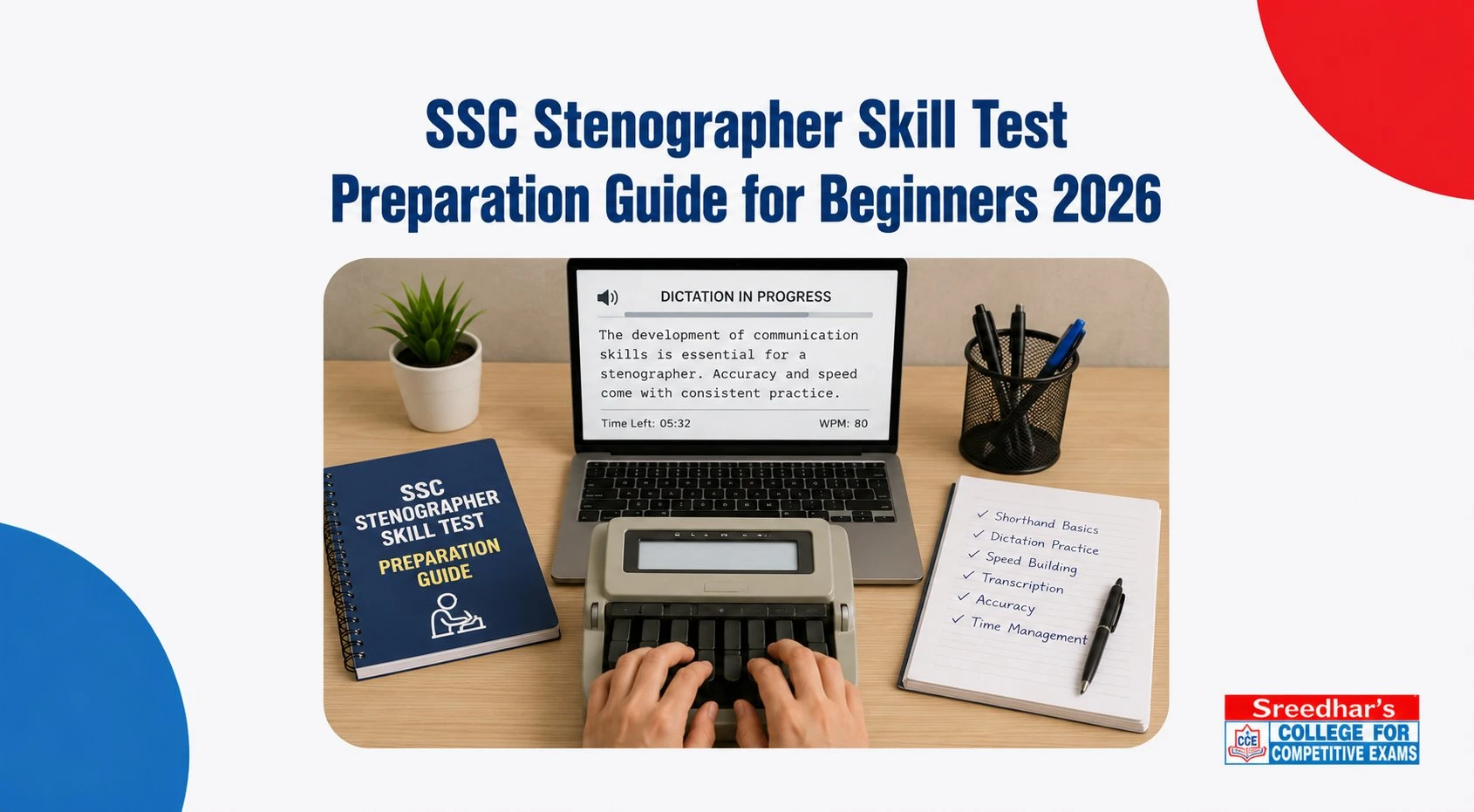
SSC Stenographer Skill Test Preparation Guide 2026
Expert Strategy from Sreedhar's CCE to Qualify with Confidence for Beginners
One misconception we often notice among SSC Stenographer aspirants is this: many students focus entirely on clearing the written examination while assuming the skill test can be managed later. Unfortunately, this assumption becomes a major reason for failure.
Unlike many SSC examinations, SSC Stenographer is not just a knowledge-based recruitment exam. It is a skill-oriented examination where qualifying the shorthand and transcription test becomes equally important. Every year, several aspirants successfully clear the CBT but fail to qualify in the skill test because they delay preparation or underestimate the practice required.
Our faculty at Sreedhar's CCE regularly interact with SSC aspirants across Telangana and Andhra Pradesh, and we have observed a clear pattern. Students who begin shorthand practice early and follow structured improvement routines usually perform far better than candidates who postpone skill preparation until after the written exam.
The SSC Stenographer skill test is not about natural talent or typing speed alone. It is about:
- Consistent practice
- Listening accuracy
- Dictation familiarity
- Time discipline
- Error reduction
- Mental concentration
This detailed SSC Stenographer Skill Test Preparation Guide for Beginners is designed using practical coaching insights and real exam observations from the mentors at Sreedhar's CCE.
In this guide, our experts explain:
- How the SSC Stenographer skill test works
- Dictation and transcription rules
- Required speed benchmarks
- Daily shorthand practice methods
- Accuracy-building techniques
- Beginner mistakes to avoid
- Free practice tools and resources
- Exam-day strategy
- How Sreedhar's CCE helps students qualify confidently
Why SSC Stenographer Remains a Popular Government Career Choice
SSC Stenographer continues to attract aspirants because it offers:
- Central government employment
- Stable career growth
- Office-based work
- Respectable salary
- Promotions
- Ministry-level exposure
- Work-life balance
The examination recruits candidates for:
Stenographer Grade C
Usually placed in:
- Ministries
- Government departments
- Higher offices
Stenographer Grade D
Usually placed in:
- Central government departments
- Regional offices
- Administrative units
At Sreedhar's CCE, we often explain that SSC Stenographer is ideal for students seeking government careers with skill-based recruitment opportunities.
Understanding the SSC Stenographer Selection Process
The recruitment process involves:
Stage 1: Computer Based Examination
This includes:
- General Intelligence & Reasoning
- General Awareness
- English Language
Stage 2: Skill Test
This is qualifying in nature but extremely important.
Many students underestimate this stage.
At Sreedhar's CCE, our mentors strongly advise aspirants to prepare for both stages together.
What Exactly is the SSC Stenographer Skill Test?
The skill test evaluates:
- Shorthand speed
- Listening ability
- Accuracy
- Transcription skill
- Time management
Candidates are given dictation and must transcribe it within specified time limits.
This tests real stenography skills.
The process usually includes:
- Listening to dictated passage
- Taking shorthand notes
- Transcribing into computer text
- Completing within prescribed time
SSC Stenographer Skill Test Speed Requirements
Understanding speed requirements is critical.
Grade C
| Language | Dictation Speed |
|---|---|
| English | 100 wpm |
| Hindi | 100 wpm |
Grade D
| Language | Dictation Speed |
|---|---|
| English | 80 wpm |
| Hindi | 80 wpm |
Many beginners become nervous seeing these numbers.
At Sreedhar's CCE, we reassure students that speed develops gradually through systematic practice.
English vs Hindi Stenography: Which Should You Choose?
This depends on:
- Educational background
- Comfort level
- Practice environment
- Career preference
English Stenography
Advantages:
- Wider departmental usage
- Greater resource availability
- More practice material
Hindi Stenography
Advantages:
- Strong comfort for Hindi-medium students
- Familiar language patterns
Students should choose based on genuine comfort rather than peer pressure.
How Dictation Actually Works in the Exam
Many beginners imagine dictation as extremely difficult.
In reality, difficulty depends heavily on preparation.
The examiner dictates passage at fixed speed.
Candidates must:
- listen carefully
- write shorthand notes
- maintain concentration
- avoid panic
After dictation:
- transcription begins
- timing starts
- candidates type final text
Biggest Beginner Mistake According to Sreedhar's CCE Mentors
The most common mistake is:
Starting shorthand too late.
Students often say:
"I’ll focus on shorthand after CBT."
This creates unnecessary pressure.
Shorthand requires:
- muscle memory
- repetition
- speed building
- listening familiarity
It cannot be mastered overnight.
Step-by-Step Beginner Strategy
At Sreedhar's CCE, we usually recommend a gradual learning model.
Phase 1: Symbol Familiarity
Focus on:
- strokes
- curves
- shorthand symbols
- sound patterns
Avoid speed obsession initially.
Phase 2: Controlled Dictation
Practice:
- slow dictation
- phrase recognition
- note organization
Goal:
clarity over speed
Phase 3: Timed Practice
Introduce:
- speed drills
- transcription timing
- error correction
This builds exam readiness.
Daily Practice Routine Recommended by Sreedhar's CCE
Consistency matters more than long sessions.
Recommended schedule:
Morning (30-45 mins)
- shorthand outlines
- symbol revision
Afternoon (30 mins)
- slow dictation
Evening (45 mins)
- transcription practice
- speed improvement
Daily repetition creates gradual mastery.
How to Improve Shorthand Speed
Many aspirants focus only on speed.
This is a mistake.
Speed improves naturally after accuracy develops.
Expert Tips from Sreedhar's CCE
Practice Common Phrases
Frequently used phrases improve flow.
Increase Dictation Gradually
Avoid jumping directly to exam speed.
Progress:
- 40 wpm
- 60 wpm
- 80 wpm
- target speed
Repeat Dictation
Repetition improves:
- memory
- rhythm
- confidence
Accuracy Matters More Than Many Students Realize
A fast but inaccurate candidate may still fail.
At Sreedhar's CCE, we advise:
Accuracy first, speed second.
Common accuracy problems:
- missed words
- spelling errors
- punctuation mistakes
- poor shorthand outlines
- typing mistakes
Reducing these errors is essential.
Typing and Transcription Strategy
Typing speed also matters.
Students should practice:
- keyboard familiarity
- paragraph typing
- formatting
- punctuation
Typing practice improves:
- confidence
- speed
- transcription completion
Free Practice Resources and Tools
Students can use:
- SSC previous dictations
- typing practice websites
- newspaper passages
- recorded dictations
- shorthand books
However, avoid using too many sources.
One structured routine works better.
Common Mistakes Beginners Make
At Sreedhar’s CCE, we repeatedly observe these errors.
Ignoring Daily Practice
Skill breaks without consistency.
Comparing With Advanced Students
Progress varies.
Avoid discouragement.
Chasing Speed Too Early
This damages accuracy.
Lack of Revision
Students must revise shorthand notes regularly.
Exam-Day Skill Test Strategy
Performance depends on calm execution.
Before exam:
- sleep properly
- avoid last-minute panic
- revise shorthand basics
During exam:
- focus on listening
- stay composed
- avoid overthinking mistakes
If one word is missed:
- continue immediately
- do not freeze
This is one of the most important survival strategies.
Managing Nervousness During Dictation
Nervousness affects:
- listening
- handwriting
- memory
- speed
Our mentors at Sreedhar's CCE advise:
- deep breathing
- calm posture
- positive focus
- controlled attention
Practice itself reduces anxiety.
How Sreedhar's CCE Helps SSC Stenographer Aspirants
At Sreedhar's CCE, stenographer preparation combines written exam support with skill-based guidance.
Students benefit from:
- Expert shorthand guidance
- Structured practice schedules
- Skill test mentoring
- Doubt clarification
- Mock dictation sessions
- Personalized correction
- Confidence-building support
Faculty members guide students not only in speed improvement but also in:
- consistency
- transcription discipline
- exam temperament
- error correction
This practical mentoring environment helps aspirants approach the skill test with confidence rather than fear.
Final Guidance from Sreedhar's CCE Experts
SSC Stenographer preparation rewards disciplined learners.
At Sreedhar's CCE, we remind students:
The skill test is not impossible.
It simply demands:
- patience
- practice
- consistency
- correct guidance
Students who begin early and practice intelligently usually improve steadily.
Shorthand is not about perfection on Day 1.
It is about becoming better every day.
Leave a Comment
Required fields are marked *