



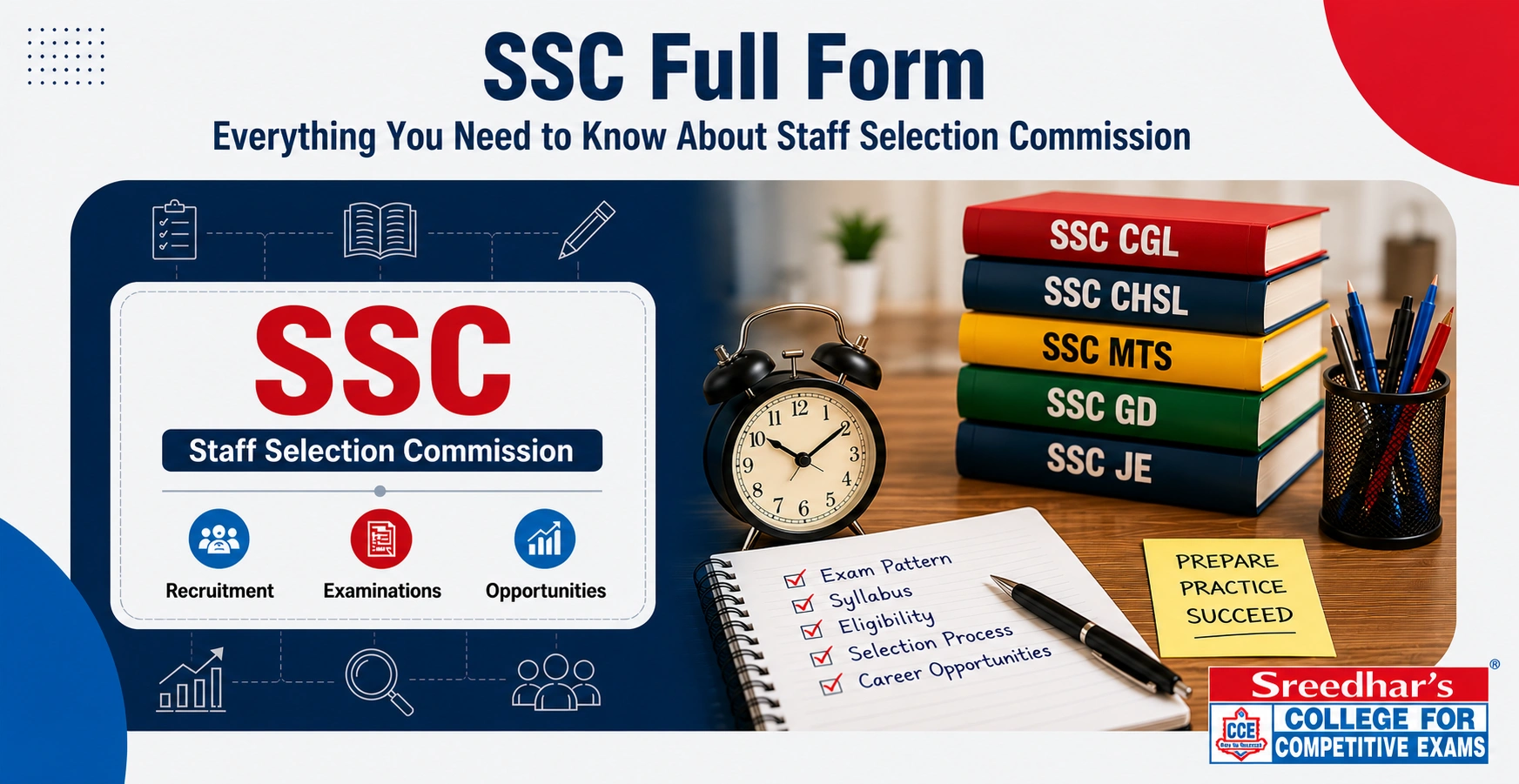
SSC Full Form: Everything You Need to Know About Staff Selection Commission
Your Complete Guide to SSC Full Form, Exams, and Career Opportunities
If you have ever browsed government job notifications in India, you have almost certainly come across the term "SSC." It appears on exam calendars, admit cards, coaching institute banners, and in conversations among lakhs of aspirants every year. But what does SSC actually stand for, and why does it matter so much to job seekers across the country? This guide breaks down the SSC full form, the organization behind it, the exams it conducts, and how you can prepare strategically to crack one of these highly sought-after government exams.
SSC Full Form
The full form of SSC is Staff Selection Commission. It is an organization under the Government of India responsible for recruiting staff for various posts in the different ministries, departments, and subordinate offices of the central government. In simple terms, SSC is the gateway through which millions of Indian citizens secure stable, respectable, and well-paying government jobs every year without needing to appear for exams like UPSC.
Each word in the name reflects its purpose:
- Staff – refers to the personnel or workforce required to fill various roles across government ministries and departments.
- Selection – represents the process of choosing the most suitable candidates through a structured, merit-based examination and evaluation system.
- Commission – denotes an autonomous statutory body set up under government authority to conduct recruitment in a fair and transparent manner.
Put together, the Staff Selection Commission is the body that decides who gets selected for a wide range of Group B and Group C government posts, from clerks and inspectors to sub-inspectors and junior engineers.
It's worth noting that "SSC" is used as an abbreviation in a few other contexts too, for instance, "Secondary School Certificate" (the 10th-grade board exam in several states) is also sometimes called SSC. However, when aspirants talk about "SSC exams," "SSC jobs," or "SSC coaching," they are almost always referring to the Staff Selection Commission and its recruitment exams, which is the focus of this article.
A Brief History of the Staff Selection Commission
Understanding where SSC came from helps explain why it holds so much weight in India's recruitment ecosystem today.
The idea of a centralized recruitment body took shape when the Estimates Committee of the Parliament, in its 47th report (1967–68), recommended setting up a Service Selection Commission to conduct examinations for recruiting candidates to lower categories of posts. Acting on this recommendation, the Government of India, through the Department of Personnel and Administrative Reforms, constituted a commission on 4 November 1975, initially named the Subordinate Services Commission.
On 26 September 1977, this body was renamed the Staff Selection Commission, the name it carries to this day. Over the next couple of decades, the Commission's functions were periodically reviewed and expanded to keep pace with the government's growing recruitment needs. A significant redefinition of SSC's role took place on 21 May 1999, through the Ministry of Personnel, Public Grievances and Pensions, and the revised constitution and functions came into effect from 1 June 1999.
Since then, SSC has grown into one of the largest recruiting bodies in the country, conducting multiple examinations every year and processing applications from crores of candidates.
Structure and Administration of SSC
The Staff Selection Commission functions as an attached office of the Department of Personnel and Training (DoPT). Its administrative structure includes:
- A Chairman, who heads the Commission
- Two Members
- A Secretary-cum-Controller of Examinations, whose post is equivalent to the rank of Additional Secretary to the Government of India
Below this leadership, SSC has a full-fledged network of officers and staff, including Directors, Deputy Secretaries, Joint Directors, Under Secretaries, Deputy Directors, and Section Officers, who manage everything from notification releases to answer key publication and result declaration.
The headquarters of SSC is located in New Delhi, but the Commission operates through a network of regional and sub-regional offices to manage the massive scale of applications and examinations across the country. It currently has regional offices in Prayagraj, Mumbai, Kolkata, Guwahati, Chennai, Bangalore, and New Delhi, along with sub-regional offices in Raipur and Chandigarh. This regional structure allows SSC to conduct exams smoothly across different states and, wherever possible, post successful candidates closer to their home state or region.
What Does SSC Do? Objectives and Functions
The core mandate of the Staff Selection Commission is recruitment for non-gazetted posts in the central government. Specifically, SSC is responsible for:
- Conducting recruitment examinations and interviews for Group B (Non-Gazetted) posts and Group C (non-technical) posts in various ministries, departments, attached offices, and subordinate offices of the Government of India.
- Holding open competitive examinations for posts such as Lower Division Clerks and similar roles across government departments.
- Ensuring exams are conducted at multiple centres across the country, and, wherever feasible, posting successful candidates to their home state or region.
- Performing any other recruitment-related functions assigned to it by the central government from time to time.
SSC's stated vision is to be a trusted, impartial, and result-oriented recruitment body that ensures the timely and fair selection of manpower for government organizations, with special emphasis on transparency and equal opportunity for all applicants, regardless of their background.
In practice, this means SSC handles the massive job of recruiting for roles ranging from tax assistants and auditors to sub-inspectors of police, junior engineers, and multi-tasking staff, jobs that keep the machinery of the Indian government running at every level.
Major Examinations Conducted by SSC
SSC conducts a wide variety of examinations throughout the year, each catering to different educational qualifications and job profiles. Here are the most prominent ones:
1. SSC CGL (Combined Graduate Level Examination)
SSC CGL is the flagship examination conducted by the Commission for recruiting graduates into Group B and Group C posts. It opens doors to prestigious roles such as Income Tax Inspector, Assistant Section Officer, Auditor, Excise Inspector, and Sub-Inspector in various government departments. The exam is conducted in multiple tiers, typically including a preliminary computer-based test, a mains examination, and further stages such as document verification or skill tests depending on the post applied for. Because of the range of respectable posts it offers, SSC CGL remains the most competitive and closely watched exam in the SSC calendar.
2. SSC CHSL (Combined Higher Secondary Level Examination)
SSC CHSL is meant for candidates who have passed Class 12 (10+2) and are looking for clerical and data-entry roles. Common posts filled through this exam include Lower Division Clerk (LDC), Junior Secretariat Assistant (JSA), Postal Assistant, and Data Entry Operator. It is considered slightly less intensive than CGL since it targets 12th-pass candidates, but it remains highly competitive given the sheer number of applicants each year.
3. SSC MTS (Multi-Tasking Non-Technical Staff)
SSC MTS is designed for candidates who have passed Class 10. It recruits for Group C posts such as peon, watchman, gardener, and general support staff across various central government offices. Being open to 10th-pass candidates, this exam attracts one of the largest applicant pools among all SSC exams.
4. SSC CPO (Central Police Organisation)
This exam recruits candidates for the posts of Sub-Inspector in Delhi Police and various Central Armed Police Forces (CAPFs), as well as Assistant Sub-Inspector roles. It requires physical fitness alongside academic qualification, since selected candidates go on to serve in frontline law enforcement roles.
5. SSC JE (Junior Engineer)
SSC JE is conducted to recruit Junior Engineers (Civil, Mechanical, Electrical, and Quantity Surveying & Contracts) for various government departments and organizations. This exam is aimed at candidates with a diploma or degree in the relevant engineering discipline.
6. SSC GD Constable
This examination is conducted to recruit constables for frontline positions in paramilitary and police forces such as the BSF, CRPF, CISF, and others. It is one of the largest recruitment drives conducted by SSC in terms of the number of vacancies.
7. SSC Stenographer
This exam is held to recruit Stenographers of Grade 'C' and Grade 'D' in various ministries and departments, testing candidates on their shorthand and typing skills alongside general aptitude.
8. SSC Selection Posts and Departmental Exams
Beyond the well-known exams above, SSC also conducts Selection Post examinations for various Group B and Group C positions, as well as departmental exams for existing government employees who are seeking promotions or transfers within their own departments.
Eligibility Criteria for SSC Exams
Since SSC conducts exams catering to different educational levels, eligibility criteria vary depending on the specific exam:
- SSC MTS – Minimum qualification of Class 10 (Matriculation) pass
- SSC CHSL – Minimum qualification of Class 12 (10+2) pass
- SSC CGL – Candidates must hold a Bachelor's degree from a recognized university (specific posts may require additional qualifications, such as a degree in a particular subject)
- SSC JE – A relevant diploma or degree in engineering, depending on the discipline and post
- SSC CPO / GD Constable – Educational qualification requirements vary by post, generally ranging from Class 10 pass to graduation, often combined with physical standards and endurance tests
Age limits also vary by exam and post, and typically range from 18 to 32 years, with age relaxations available for reserved categories as per government norms. Since eligibility details are revised with each notification, aspirants should always cross-check the latest official notification before applying.
SSC Exam Pattern: What to Expect
While the exact pattern differs across exams, most SSC examinations follow a broadly similar multi-stage structure:
- Tier/Phase I – Computer-Based Test (CBT): A preliminary objective-type exam covering General Intelligence & Reasoning, General Awareness, Quantitative Aptitude, and English Comprehension.
- Tier/Phase II – Mains Examination: A more advanced and specialized paper, often testing subject-specific knowledge in greater depth, along with sections on quantitative ability and English/comprehension.
- Tier/Phase III – Descriptive Paper (where applicable): Tests written communication skills through essay, letter, or précis writing, mainly for exams like SSC CGL.
- Tier/Phase IV – Skill Test / Document Verification: This may include a Data Entry Speed Test (DEST), typing test, physical efficiency test (for police and paramilitary posts), and verification of original documents.
Negative marking is a common feature across most SSC exams, so accuracy is just as important as speed and knowledge. Because the syllabus tends to be revised every few years, staying updated with the latest exam pattern and syllabus before beginning preparation is essential.
Why Are SSC Jobs So Popular?
SSC jobs are among the most sought-after government positions in India, and for good reason:
- Job security – Once selected, employees typically enjoy permanent, pensionable government jobs with long-term stability.
- Attractive pay scales – Depending on the post, salaries generally range from roughly ₹25,000 to ₹80,000 per month, along with allowances like House Rent Allowance (HRA), Dearness Allowance (DA), and Travel Allowance (TA).
- Career growth – Government roles come with structured promotion paths, departmental exams, and opportunities to move into higher grades over time.
- Wide accessibility – With exams open to candidates from Class 10 pass to graduate level, SSC offers opportunities to aspirants across a wide range of educational backgrounds.
- Nationwide reach – SSC exams are conducted at numerous centres across India, making them accessible to candidates from big cities as well as smaller towns and rural areas.
This combination of stability, respectable pay, and accessibility is why lakhs of aspirants, from fresh graduates to working professionals looking for a government job, apply for SSC exams every single year.
How to Apply for SSC Exams
Applying for any SSC examination follows a fairly standard process:
- Visit the official SSC website and check the latest notification for the exam you wish to apply for.
- Register using a valid email ID and mobile number to generate your login credentials.
- Fill in your personal, educational, and category details accurately.
- Upload the required documents, such as photograph, signature, and category certificates (if applicable).
- Pay the applicable examination fee (fee waivers are available for certain reserved categories).
- Download and save the confirmation page for future reference.
Since application windows are typically open for a limited period and made available strictly through the official portal, aspirants should keep a close eye on notification dates and avoid last-minute submissions.
How to Prepare Effectively for SSC Exams
Cracking an SSC exam requires more than just knowing the syllabus; it demands a structured strategy. Here are some proven preparation tips:
- Understand the syllabus and exam pattern thoroughly before you start studying, so your effort is focused on what's actually tested.
- Build strong fundamentals in Quantitative Aptitude, Reasoning, English Language, and General Awareness, since these form the core of almost every SSC exam.
- Practice previous year question papers regularly to understand question trends, difficulty levels, and recurring topics.
- Take timed mock tests to improve speed and accuracy while managing negative marking effectively.
- Revise General Awareness consistently, since this section rewards regular reading over last-minute cramming.
- Analyze your mistakes after every test to identify weak areas and work on them systematically.
- Stay updated with notification dates, exam calendars, and any changes in pattern or syllabus.
While self-study can work for some, most successful candidates benefit significantly from structured coaching, expert guidance, and a disciplined test-taking environment, which is where the right coaching institute makes a real difference.
Why Choose Sreedhar's CCE for Your SSC Preparation
If you're serious about cracking SSC CGL, CHSL, MTS, CPO, or any other SSC exam, choosing the right coaching partner can significantly shape your outcome. Here's why thousands of aspirants across Andhra Pradesh, Telangana, and beyond trust Sreedhar's CCE for their SSC preparation:
A legacy of nearly three decades. Founded in 1995, Sreedhar's College for Competitive Exams has been training government job aspirants for close to 30 years. What started as a modest coaching centre has grown into one of the most trusted names in competitive exam coaching, having helped more than 30,000 students secure government jobs across Banking, SSC, Railways, Insurance, and State PSC examinations.
Experienced, dedicated faculty. SSC exams demand strong conceptual clarity in Quantitative Aptitude, Reasoning, English, and General Awareness. Sreedhar's CCE brings together senior, exam-focused faculty who specialize in breaking down complex topics into simple, exam-oriented methods, helping students build both speed and accuracy.
Structured, updated study material. Rather than relying on generic content, Sreedhar's CCE provides well-structured and regularly updated study material aligned with the latest SSC exam trends, ensuring students focus their revision time on what actually matters for CGL, CHSL, MTS, and CPO exams.
Daily tests and real exam-like practice. Consistent daily tests based on the latest SSC exam pattern help students sharpen accuracy, speed, and time management. Students also get to practice in a real Computer-Based Test (CBT) environment through dedicated computer labs, which builds familiarity and reduces exam-day anxiety, a crucial edge for objective, time-bound SSC papers.
Both offline and online learning options. Whether you prefer the discipline of a classroom environment or the flexibility of studying from home, Sreedhar's CCE's online courses and offline classroom batches are designed to fit different learning styles, complete with live classes, recorded lectures, previous year question practice, and structured test series.
A proven, result-oriented track record. Sreedhar's CCE has a strong and consistent history of student selections across SSC, Banking, and RRB exams, built on a disciplined preparation approach, strategic exam methods, and constant performance analysis, not vague promises.
Special focus on rural and underprivileged aspirants. True to its founding mission, Sreedhar's CCE has consistently prioritized affordable, accessible education, empowering thousands of students from rural and economically weaker backgrounds to build stable government careers.
Wide branch network. With a strong presence across multiple cities in Andhra Pradesh, Telangana, and neighbouring states, Sreedhar's CCE makes quality SSC coaching accessible to aspirants without requiring them to relocate to a metro city.
For anyone preparing seriously for SSC CGL, CHSL, MTS, or CPO, this combination of experienced mentorship, updated content, rigorous testing, and a genuinely student-first approach is what sets Sreedhar's CCE apart as a coaching partner for the long haul. You can explore current batches and enrolment details on the Sreedhar's CCE online courses page, or check commonly asked questions on their FAQs page.
Conclusion
The SSC full form, Staff Selection Commission, represents far more than just three letters; it stands for one of India's most significant gateways to a secure and respected government career. From the multi-tier SSC CGL exam that opens doors to prestigious Group B posts, to SSC MTS and SSC CHSL that welcome candidates straight out of school or college, the Commission plays a central role in shaping the professional futures of lakhs of Indians every year.
Success in these exams, however, depends heavily on informed, structured, and consistent preparation. Whether you're just starting to explore SSC exams or are already deep into your preparation journey, having the right guidance can make all the difference between a good attempt and a successful selection. With decades of experience, a strong faculty team, and a genuine commitment to student success, Sreedhar's CCE remains a trusted partner for thousands of SSC aspirants working towards their government job dreams.
Leave a Comment
Required fields are marked *