



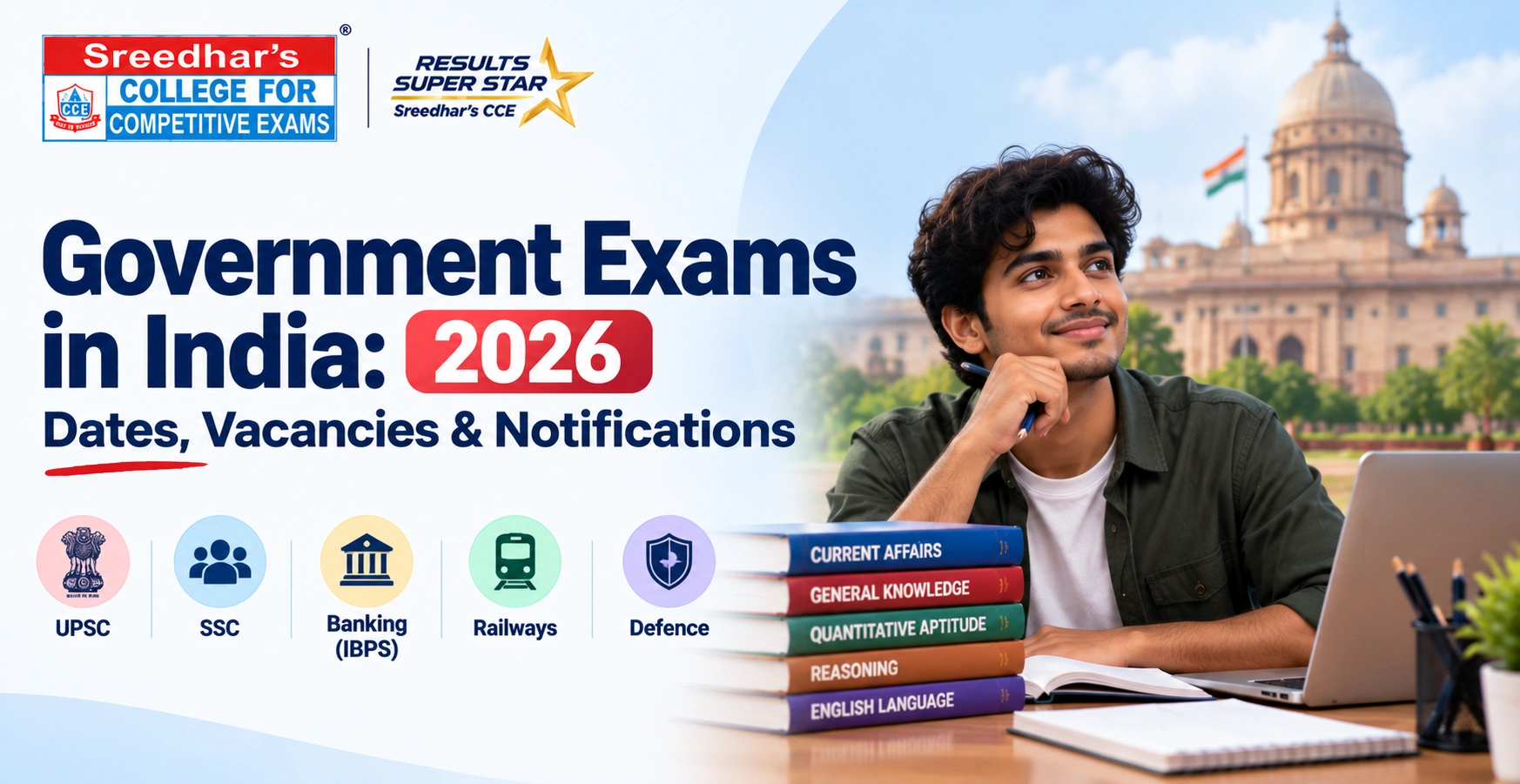
Government Exams in India 2026
Complete Guide to Eligibility, Exams, Preparation and Career Opportunities
Government jobs continue to attract millions of aspirants across India because they offer opportunities across banking, railways, SSC, insurance, police, public sector organisations, central government departments and state government services.
However, the government exam landscape can be confusing for a first-time aspirant. There are hundreds of recruitment notifications released by different organisations every year, each with its own eligibility criteria, age limit, syllabus, exam pattern, selection process and application timeline.
The right approach is not to prepare randomly for every notification. Aspirants need to understand which exams match their educational qualification, age, interests and career goals, and then build a focused preparation strategy.
Sreedhar's CCE provides exam information and preparation support across major competitive examination categories, including Banking, SSC, Railways, Insurance, Police, State Government and Central Government exams.
In this guide, we explain the major government exams in India in 2026, eligibility requirements, exam categories, preparation strategies, important subjects, career opportunities and practical steps aspirants can follow to prepare effectively.
What Are Government Exams?
Government exams are competitive recruitment examinations conducted by central government organisations, state governments, public sector institutions and statutory bodies to select candidates for various posts.
Depending on the organisation and position, candidates may be recruited through written examinations, computer-based tests, interviews, skill tests, physical tests, document verification or a combination of these stages.
Some examinations are conducted at the national level, while others are specific to individual states.
For example, the Staff Selection Commission conducts examinations for recruitment to various central government posts, while organisations such as IBPS and SBI conduct recruitment examinations for banking positions. Railway Recruitment Boards conduct examinations for different posts in Indian Railways.
At the state level, Public Service Commissions conduct examinations for administrative and other government positions.
Sreedhar's CCE currently provides exam information covering major categories such as Banking, SSC, Railways, Insurance, Police, State Government and Central Government recruitment.
Why Do Candidates Choose Government Jobs?
Government employment remains a popular career option for several reasons.
1. Career stability
Government positions generally provide structured employment with defined service rules, salary structures and promotion systems.
2. Competitive salaries
Government and public sector organisations offer salaries according to the applicable pay structure. Many positions also include allowances and other employment benefits.
3. Career progression
Many government positions have clearly defined promotion structures. Employees can progress through departmental promotions, examinations and experience-based advancement depending on the organisation and role.
4. Variety of career options
Government recruitment is not limited to administrative jobs. Candidates can pursue careers in banking, finance, taxation, railways, engineering, policing, insurance, agriculture, defence-related services, public administration and several other fields.
5. Opportunities at different educational levels
Candidates do not necessarily need a postgraduate qualification to enter government service.
There are opportunities for candidates after Class 10, Class 12, graduation and professional qualifications.
For example, SSC CHSL provides opportunities for eligible 12th-pass candidates for posts such as Lower Divisional Clerk, Junior Secretariat Assistant and Data Entry Operator.
Major Government Exams in India
The government examination ecosystem can broadly be divided into several categories.
| Category | Major Exams |
|---|---|
| Banking | IBPS PO, IBPS Clerk, SBI PO, SBI Clerk, IBPS RRB, RBI exams |
| SSC | SSC CGL, SSC CHSL, SSC MTS, SSC CPO, SSC JE |
| Railways | RRB NTPC, RRB Group D, RRB JE, RRB ALP, RRB Technician |
| Insurance | LIC AAO, LIC ADO, NIACL AO, GIC and other insurance exams |
| Police | State Police Constable, SI and other recruitment exams |
| State Government | APPSC, TSPSC and other State PSC examinations |
| Central Government | NABARD, EPFO, FCI, RBI, SIDBI and other recruitment exams |
| PSU | Recruitment through GATE and organisation-specific examinations |
Sreedhar's CCE's exam portal provides a central resource for candidates to explore active examinations, eligibility criteria, syllabi, exam patterns and cut-offs across these categories.
Government Exams After 10th
Candidates who have completed Class 10 can explore several recruitment opportunities depending on the notification and eligibility requirements.
Some opportunities may be available through:
- Railway recruitment
- SSC examinations
- Defence recruitment
- Police recruitment
- State government recruitment
- Support and technical positions
- Various departmental recruitments
Eligibility varies significantly between examinations, so candidates should always verify the educational qualification specified in the latest official notification.
Candidates should also remember that completing Class 10 does not limit their long-term government career options. Continuing education through Class 12 and graduation can open the door to a significantly wider range of competitive examinations.
Government Exams After 12th
Completing Class 12 opens up several government recruitment opportunities.
Common options include SSC CHSL, selected railway recruitment, defence examinations and various state-level recruitment processes.
Sreedhar's CCE has published a detailed guide covering government exams after 12th, including opportunities for candidates from Science, Commerce, Arts and Mathematics backgrounds.
SSC CHSL
SSC CHSL is one of the prominent national-level examinations available to eligible 12th-pass candidates.
Recruitment can include positions such as:
- Lower Divisional Clerk
- Junior Secretariat Assistant
- Data Entry Operator
The examination is conducted by the Staff Selection Commission for recruitment into various central government departments and organisations.
Railway Recruitment
Indian Railways periodically conducts recruitment for different positions. Eligibility depends on the specific post.
Candidates interested in railway careers should monitor the latest RRB notifications instead of relying on old recruitment schedules.
Defence Opportunities
Several defence recruitment opportunities are available to candidates after Class 12, depending on educational qualification, age, physical standards and other requirements.
State Government Recruitment
State-level recruitment boards and departments may also release notifications for 12th-pass candidates.
The eligibility, reservation rules and selection process vary from state to state.
Government Exams After Graduation
Graduation significantly expands the number of government examinations a candidate can apply for.
Some major graduate-level opportunities include:
- SSC CGL
- Banking PO examinations
- Banking Clerk examinations
- IBPS RRB Officer Scale I
- Various insurance examinations
- Railway graduate-level posts
- State PSC examinations
- Central government recruitment
- Regulatory body examinations
- PSU recruitment
- Various specialised recruitment examinations
For example, SSC CGL recruits candidates for various Group B and Group C positions across central government ministries, departments and organisations.
Graduates should therefore avoid preparing for an examination simply because it is popular. The better approach is to compare eligibility, syllabus, role, location, selection stages and career structure before choosing an exam.
Banking Government Exams
Banking examinations are among the most popular competitive examinations in India.
Major recruitment opportunities include:
IBPS PO
The Institute of Banking Personnel Selection conducts recruitment for Probationary Officer and Management Trainee positions in participating public sector banks.
IBPS Clerk
IBPS Clerk recruitment provides opportunities for candidates seeking clerical positions in participating banks.
SBI PO
The State Bank of India conducts recruitment for Probationary Officers.
SBI Clerk
SBI recruits Junior Associates for customer support and sales roles through its recruitment process.
IBPS RRB
Regional Rural Banks recruit candidates for positions such as Office Assistant and Officer Scale I.
Candidates preparing for multiple banking examinations can benefit from the common syllabus across several exams.
Quantitative Aptitude, Reasoning and English are important components across many banking examinations, while General Awareness and banking awareness also play an important role.
Sreedhar's CCE regularly publishes banking recruitment updates, preparation strategies and exam-specific guides through its banking exam resources.
SSC Exams
The Staff Selection Commission conducts several important recruitment examinations.
Some major SSC examinations include:
SSC CGL
SSC CGL is designed for graduate candidates and recruits for various Group B and Group C positions.
Potential positions include roles such as:
- Assistant Section Officer
- Income Tax Inspector
- Central Excise Inspector
- Other central government positions
SSC CHSL
SSC CHSL is primarily aimed at eligible 12th-pass candidates.
SSC MTS
SSC MTS provides recruitment opportunities for eligible candidates for Multi-Tasking Staff positions.
SSC CPO
SSC CPO is associated with recruitment for Sub-Inspector positions in specified police and security organisations.
SSC JE
SSC JE is particularly relevant to engineering diploma holders and graduates in eligible technical disciplines.
Sreedhar's CCE provides a dedicated SSC JE exam guide covering eligibility, exam pattern, salary and preparation strategy.
Railway Exams
Indian Railways is another major source of government employment opportunities.
Major railway examinations and recruitment processes include:
- RRB NTPC
- RRB Group D
- RRB ALP
- RRB JE
- RRB Technician
- RPF recruitment
- Various technical and non-technical positions
The eligibility requirements depend on the post.
For example, technical positions may require specific diplomas or engineering qualifications, while other positions may have 10th, 12th or graduate-level requirements.
Candidates should always check the qualification specified in the latest recruitment notification.
Railway recruitment can attract a very large applicant pool, making systematic preparation essential.
Insurance Exams
Insurance companies also conduct competitive recruitment for various positions.
Some major opportunities include:
- LIC AAO
- LIC ADO
- NIACL AO
- GIC recruitment
- Other insurance-sector recruitment
Insurance examinations generally test areas such as reasoning, quantitative aptitude, English, general awareness and insurance-related knowledge, depending on the examination.
Candidates interested in insurance careers should monitor notifications carefully because eligibility, vacancies and selection stages can change between recruitment cycles.
Police and Uniformed Services Exams
Government careers in police and uniformed services require candidates to meet both academic and physical eligibility requirements where applicable.
Recruitment may include:
- Police Constable
- Sub-Inspector
- Armed Police
- State Police recruitment
- Other uniformed government positions
For these examinations, written examination preparation alone may not be sufficient.
Candidates may also need to prepare for:
- Physical measurement tests
- Physical efficiency tests
- Medical examinations
- Document verification
The exact requirements depend on the recruitment authority and post.
State Government Exams
State governments conduct recruitment through Public Service Commissions, recruitment boards and individual departments.
Examples include:
- APPSC
- TSPSC
- KPSC
- OPSC
- Other State PSC examinations
State government examinations can be particularly relevant for candidates who want to build their careers within a specific state.
Candidates should pay close attention to:
- State-specific current affairs
- Local history
- Geography
- Economy
- Polity
- State government schemes
- Regional language requirements where applicable
For aspirants in Andhra Pradesh and Telangana, Sreedhar's CCE has also published a detailed guide on how to get a government job in AP and Telangana.
Central Government Exams
Central government recruitment covers a wide range of organisations and positions.
Some opportunities include recruitment through:
- SSC
- RBI
- NABARD
- EPFO
- FCI
- SIDBI
- Various ministries and departments
- Regulatory bodies
- Public sector organisations
Sreedhar's CCE's examination portal currently categorises more than 20 central government examination opportunities, including exams and recruitment processes associated with organisations such as RBI, NABARD, EPFO, FCI and SIDBI.
PSU Recruitment Exams
Public Sector Undertakings also provide career opportunities for graduates and professionals.
Depending on the organisation, recruitment can happen through:
- GATE scores
- Organisation-specific examinations
- Interviews
- Group discussions
- Technical assessments
- Other selection stages
Engineering graduates should research PSU notifications individually because eligibility, disciplines, selection process and recruitment methodology vary between organisations.
Sreedhar's CCE also provides information on PSU recruitment opportunities involving organisations such as SAIL, Coal India, IOCL and Vizag Steel.
Government Exam Eligibility
Eligibility differs from one examination to another.
The most common criteria include:
Educational qualification
Depending on the examination, candidates may need:
- Class 10 qualification
- Class 12 qualification
- Graduation
- Diploma
- Engineering degree
- Professional qualification
- Specific subject or discipline
Age limit
Every recruitment notification specifies an age range.
Some examinations also provide age relaxation for eligible categories according to applicable government rules.
Nationality
Many central government examinations require candidates to meet specific nationality requirements.
Physical standards
Police, defence and certain other positions may have physical requirements.
Language requirements
Some state-level examinations may require proficiency in a particular language.
Candidates should never assume that eligibility for one government exam automatically means eligibility for another.
Government Exam Age Limit
Age is one of the most important eligibility factors.
Different examinations can have different minimum and maximum age limits. Some positions may also offer category-based age relaxation.
Sreedhar's CCE's detailed Government Job Age Limit 2026 guide explains age criteria across SSC, banking, railway, defence, teaching, UPSC and state-level opportunities.
Before starting preparation, candidates should check:
- Minimum age
- Maximum age
- Cut-off date for calculating age
- Category-based relaxation
- Special relaxation rules, if applicable
- Whether the qualification must be completed by a particular date
Aspirants should always refer to the latest official recruitment notification because eligibility rules can change.
Common Subjects in Government Exams
Although government examinations differ considerably, several subjects appear repeatedly.
Quantitative Aptitude
Common topics include:
- Number system
- Simplification
- Percentage
- Profit and loss
- Ratio and proportion
- Average
- Time and work
- Time, speed and distance
- Simple and compound interest
- Data interpretation
- Algebra
- Geometry
- Mensuration
Reasoning
Common topics include:
- Coding-decoding
- Series
- Analogy
- Classification
- Blood relations
- Direction sense
- Syllogism
- Inequality
- Seating arrangement
- Puzzles
- Statement and conclusion
- Logical reasoning
English
Depending on the examination, English may include:
- Reading comprehension
- Vocabulary
- Grammar
- Sentence correction
- Cloze tests
- Error detection
- Para jumbles
- Fill in the blanks
General Awareness
This can include:
- Indian polity
- Indian economy
- Geography
- History
- Science
- Current affairs
- Government schemes
- Awards
- Sports
- Important appointments
- Banking awareness
- Static GK
How to Choose the Right Government Exam
Choosing the right examination is one of the most important decisions in your preparation journey.
Instead of applying for every notification, evaluate exams using the following criteria.
Step 1: Check your qualification
Start by identifying examinations for which your educational qualification makes you eligible.
Step 2: Check the age limit
Eliminate examinations for which you do not meet the age criteria.
Step 3: Understand the job role
Do not choose an examination solely because the vacancy number is high.
Read about the actual job profile.
Ask:
- What will I do in this position?
- Where can I be posted?
- What are the working hours?
- What is the promotion structure?
- Does the role match my interests?
Step 4: Compare the syllabus
If you are preparing for multiple exams, look for syllabus overlap.
For example, candidates preparing for banking and SSC examinations can identify common areas such as quantitative aptitude, reasoning, English and general awareness.
Step 5: Consider the selection process
Some examinations include multiple written stages, interviews, skill tests or physical tests.
Understand the entire process before committing to an examination.
Government Exam Preparation Strategy
Preparing for a government examination requires consistency more than occasional long study sessions.
A practical preparation strategy can be divided into five stages.
Stage 1: Understand the syllabus
Download and study the latest syllabus.
Do not begin preparation simply by opening a random textbook or watching videos.
First understand:
- Subjects
- Topics
- Number of questions
- Marks
- Duration
- Negative marking
- Selection stages
Stage 2: Assess your current level
Take a diagnostic mock test.
Your first test is not about achieving a high score.
It is about discovering your current strengths and weaknesses.
Stage 3: Build fundamentals
Spend the initial preparation period strengthening concepts.
For quantitative aptitude, understand the underlying methods.
For reasoning, learn standard approaches.
For English, improve grammar and comprehension.
For General Awareness, develop a structured reading routine.
Stage 4: Practice extensively
Once your concepts are clear, solve questions regularly.
Start with topic-wise practice and gradually move to mixed sets.
Stage 5: Take full-length mocks
Full-length tests help you develop:
- Speed
- Accuracy
- Time management
- Question selection
- Exam temperament
How to Prepare for Quantitative Aptitude
Quantitative Aptitude can become one of the most scoring sections if you build strong fundamentals.
Start with basic arithmetic.
A practical order is:
- Simplification
- Number system
- Percentage
- Ratio
- Average
- Profit and loss
- Simple and compound interest
- Time and work
- Time, speed and distance
- Data interpretation
- Advanced arithmetic topics
Do not focus only on shortcuts.
First understand the concept.
Once you are comfortable solving questions conventionally, learn faster methods.
The goal should be accuracy first, speed second.
How to Prepare for Reasoning
Reasoning improves substantially through regular practice.
Start with simpler topics such as:
- Analogy
- Classification
- Series
- Coding-decoding
- Direction
- Blood relations
Then move towards:
- Syllogisms
- Inequalities
- Seating arrangements
- Puzzles
- Logical reasoning
Puzzles and seating arrangements can consume significant time in competitive examinations.
Therefore, candidates should practise identifying which questions are worth attempting first.
How to Prepare for English
English preparation should combine grammar, vocabulary and reading.
Read regularly.
You can use newspapers, quality articles, editorials and examination-focused reading material to improve comprehension.
Maintain a vocabulary notebook containing:
- New word
- Meaning
- Synonym
- Antonym
- Example sentence
Grammar topics should be revised repeatedly rather than studied only once.
Reading comprehension should also be practised under timed conditions.
How to Prepare for General Awareness
General Awareness is broad, so preparation should be systematic.
Divide it into:
Static GK
Study:
- History
- Geography
- Polity
- Economy
- General Science
Current Affairs
Follow important developments in:
- National affairs
- International affairs
- Economy
- Banking
- Government schemes
- Appointments
- Awards
- Sports
- Reports and indices
- Science and technology
Exam-specific awareness
Banking candidates should pay particular attention to banking and financial awareness.
Candidates preparing for state-level exams should include state-specific current affairs.
Importance of Current Affairs
Current affairs can make a significant difference in competitive examinations.
However, reading everything published in the news is neither practical nor necessary.
Instead, focus on examination-relevant developments.
Create monthly revision notes.
For every important event, try to remember:
- What happened?
- When did it happen?
- Which organisation was involved?
- Why is it important?
- Are there important numbers or facts associated with it?
Revision is more important than endlessly consuming new information.
Role of Previous Year Papers
Previous year papers are one of the most useful resources available to government exam aspirants.
They help you understand:
- Question difficulty
- Repeated concepts
- Question patterns
- Topic weightage
- Time pressure
- Frequently tested areas
Do not simply solve previous papers and check the score.
Analyse every paper.
For each incorrect question, determine whether the problem was:
- Lack of knowledge
- Conceptual weakness
- Calculation error
- Misreading
- Poor time management
- Guessing
This analysis tells you what to improve.
Mock Tests and Test Analysis
Mock tests should be treated as a learning tool, not merely a scoring tool.
After every mock test, divide questions into four categories:
Category 1: Correct and confident
These are your strengths.
Category 2: Correct but slow
These require speed improvement.
Category 3: Incorrect but conceptually understood
These may indicate calculation or interpretation mistakes.
Category 4: Completely unknown
These require conceptual learning.
Maintain a mock-test performance tracker.
Record:
- Score
- Accuracy
- Attempts
- Section-wise performance
- Time spent
- Weak topics
Over several weeks, this gives you a clear picture of your progress.
How Many Hours Should You Study?
There is no universal number of hours that guarantees success.
The quality and consistency of preparation matter more than simply counting study hours.
A student preparing full-time may be able to devote several focused hours each day.
A working candidate may have fewer hours but can still make progress through disciplined scheduling.
A practical daily structure could include:
| Activity | Suggested Focus |
|---|---|
| Quantitative Aptitude | Concepts + practice |
| Reasoning | Topic practice |
| English | Grammar + reading |
| General Awareness | Current affairs + revision |
| Mock/Previous Paper | Timed practice |
| Revision | Mistake notebook |
The exact schedule should depend on the candidate's available time and target examination.
Common Mistakes Government Exam Aspirants Make
1. Preparing without knowing the syllabus
This leads to wasted time.
2. Preparing for too many exams
Applying for every available examination can result in scattered preparation.
3. Ignoring previous year papers
Without previous papers, candidates may not understand the actual examination pattern.
4. Taking too few mock tests
Mock tests are essential for developing speed and time management.
5. Not analysing mistakes
Taking tests without reviewing mistakes limits improvement.
6. Ignoring current affairs until the last month
Current affairs require regular revision.
7. Collecting too many study materials
More books do not automatically mean better preparation.
Choose reliable resources and revise them repeatedly.
8. Ignoring health and sleep
Long-term preparation requires consistency. Poor sleep and excessive stress can affect concentration and productivity.
Self-Study vs Coaching for Government Exams
Both self-study and coaching can work.
The right choice depends on the candidate.
Self-study
Self-study may work well for candidates who:
- Have strong fundamentals
- Can create their own study schedule
- Can identify weak areas
- Can maintain discipline
- Know how to evaluate their progress
Coaching
Coaching can be useful for candidates who:
- Need structured preparation
- Struggle with certain concepts
- Want regular tests
- Need expert guidance
- Benefit from classroom learning
- Find it difficult to maintain consistency independently
The important point is that coaching does not replace individual practice.
Even with coaching, aspirants need to revise, practise questions and analyse mock tests independently.
How Sreedhar's CCE Helps Government Exam Aspirants
Sreedhar's College for Competitive Exams has been serving competitive examination aspirants since 1995. The organisation currently offers preparation support across Banking, SSC, Railways, Insurance, Police and major government examinations.
Its current exam platform covers 90+ examinations across multiple categories, allowing aspirants to explore examinations according to their eligibility and career interests.
The preparation ecosystem includes:
- Experienced faculty
- Structured classroom programmes
- Online courses
- Study material
- Regular tests
- Exam updates
- Preparation guidance
- Exam-specific strategies
Sreedhar's CCE also reports more than 30,000 government job selections over its history.
Candidates can explore the latest Sreedhar's CCE courses, fees and batch timings to understand the available preparation options.
For aspirants specifically looking for classroom coaching in Hyderabad, Sreedhar's CCE operates branches including KPHB, Ameerpet and Dilsukhnagar.
A 90-Day Government Exam Preparation Plan
Candidates with approximately three months before an examination can divide their preparation into three phases.
Days 1 to 30: Build fundamentals
Focus on:
- Understanding the syllabus
- Learning concepts
- Completing basic topics
- Starting current affairs
- Solving topic-wise questions
Avoid spending too much time on full-length mocks at this stage.
Days 31 to 60: Increase practice
Move towards:
- Mixed question sets
- Previous year papers
- Sectional tests
- Regular revision
- Timed practice
Start identifying your strongest and weakest sections.
Days 61 to 90: Exam simulation
Focus heavily on:
- Full-length mocks
- Previous year papers
- Revision
- Current affairs
- Error analysis
- Time management
At this stage, avoid constantly adding new resources.
Your priority should be converting what you already know into marks.
How to Stay Consistent During Government Exam Preparation
Government exam preparation can take several months, and sometimes multiple attempts.
Consistency becomes easier when preparation is treated as a routine rather than a daily motivational challenge.
Set realistic daily targets.
For example:
- 50 quantitative aptitude questions
- 30 reasoning questions
- One English reading exercise
- One current affairs revision session
- One previous-year paper or sectional test
Track completion rather than simply counting hours.
Also maintain a mistake notebook.
Every repeated mistake should become a learning opportunity.
Government Exam Preparation: Final Checklist
Before applying for an examination, check:
- Educational qualification
- Age limit
- Category requirements
- Nationality requirements
- Application dates
- Examination dates
- Syllabus
- Exam pattern
- Negative marking
- Selection stages
- Previous year papers
- Preparation resources
- Mock-test schedule
Before the examination, make sure you have:
- Revised the complete syllabus
- Solved previous year papers
- Taken sufficient mock tests
- Analysed mistakes
- Revised current affairs
- Prepared examination documents
- Checked the examination centre details
- Planned travel in advance
Final Thoughts
Government exams offer career opportunities across a wide range of sectors, including banking, SSC, railways, insurance, policing, state administration, central government departments and public sector organisations.
The biggest challenge for many aspirants is not finding an examination. It is choosing the right examination and preparing for it consistently.
Start with your eligibility. Identify examinations that match your qualification and career interests. Understand the syllabus and selection process. Build your fundamentals, practise regularly, solve previous year papers and use mock tests to improve speed and accuracy.
Most importantly, avoid changing your target every time a new recruitment notification appears.
A focused preparation strategy gives you the opportunity to prepare for multiple examinations where the syllabus overlaps, while still keeping your primary target clear.
For candidates looking for structured preparation, Sreedhar's CCE offers courses and guidance across Banking, SSC, Railways, Insurance, Police and other government competitive examinations. With exam-specific resources, faculty support, study material and regular testing, aspirants can build a structured preparation routine instead of navigating the entire process alone.
Your government job preparation should begin with one clear step: identify the examination that matches your eligibility and career goal, understand what it demands, and then prepare consistently until you are ready to compete.

Leave a Comment
Required fields are marked *